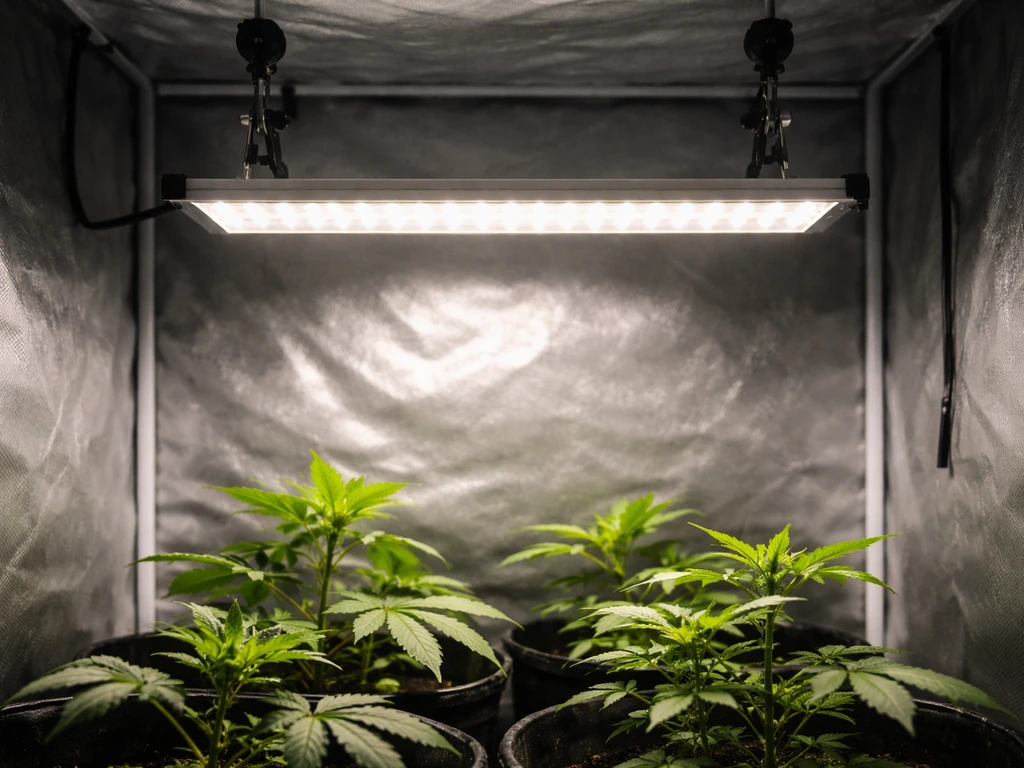
If you just pulled a Feit Electric grow light out of the box and the included instruction sheet feels thin, you are not alone. Feit makes dozens of different grow light models including clamp lamps, bar fixtures, bulbs, and panel-style lights, and the setup details genuinely differ between them. This guide walks you through the full process: identifying your exact model, mounting it correctly, dialing in your schedule, and fixing problems when plants are not responding the way you expected.
Feit Electric Grow Light Instructions: Setup, Placement, Troubleshooting

Marcus Tillman
5 Apr 2026
Find your Feit Electric model and get the right manual first
Before you do anything else, find your model number. Feit is very clear that manuals and specs are tied to the model number, not just the product name or description, so guessing from a generic guide can send you in the wrong direction. Look for a label or sticker directly on the fixture, the cord, or the base of the lamp. It will show a combination of letters and numbers like GLP24ADJS/32W/LED or a shorter numeric SKU.
Once you have that string, go to Feit's Download Center at feit.com and enter your item number or SKU into the search field. Feit's example entries in their help docs look like PAR38/RGBW/CA/AG or a number like 72120, so enter yours in the same format. The result will pull up the exact manual and spec sheet for your fixture. This is worth doing even if you think your model is straightforward, because coverage area, wattage, linking capability, and dimming behavior all vary. For instance, the 24-inch GLP24ADJS/32W/LED bar light can be daisy-chained with up to 5 fixtures, a detail you would never find on a generic guide.
If your fixture is a smart Wi-Fi enabled model, Feit handles that workflow separately through the Feit Electric Smart Wi-Fi app. Check your sticker for "Smart" or "Wi-Fi" in the model name, and if it appears, follow the app installation instructions rather than the manual dimmer or schedule controls described in this guide.
Unboxing, parts check, and safe electrical setup
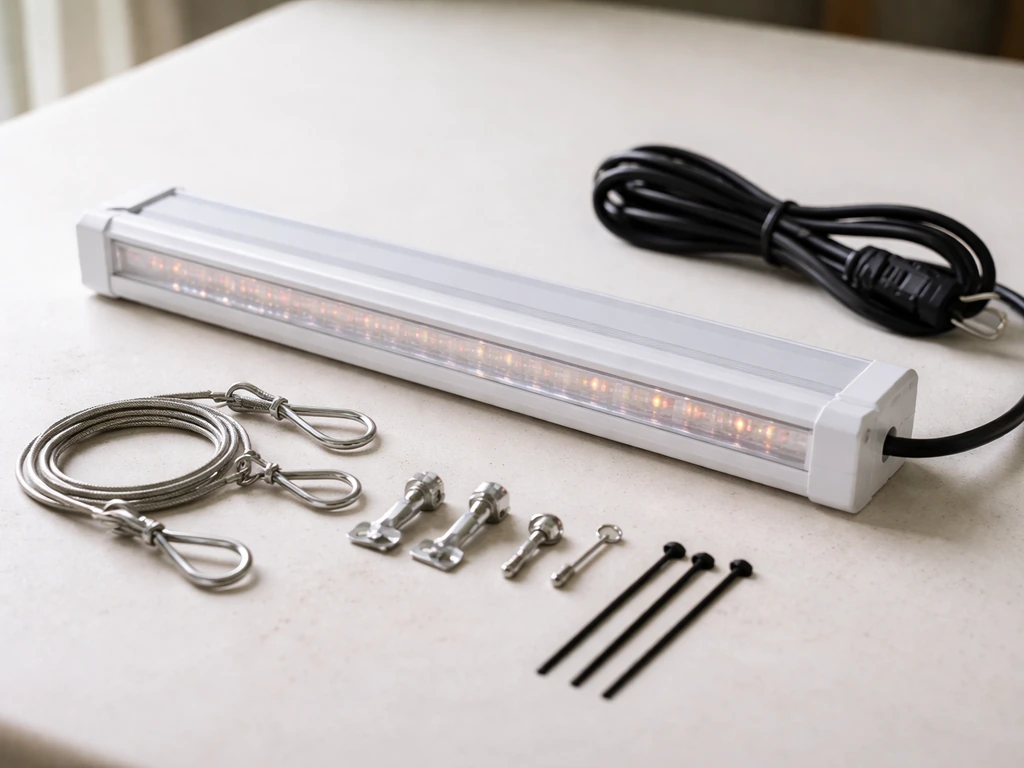
Lay everything out before you start hanging anything. Most Feit grow lights ship with the fixture, a power cord or plug, mounting hardware (hooks, zip ties, or a clamp), and a short instruction sheet. Some bar-style lights include daisy-chain cables for linking multiple units. Check the box contents against the parts list in your manual. If anything is missing, note the model number and contact Feit support before proceeding.
On the electrical side, Feit grow lights are designed for standard 120V household outlets in the US. Do not use extension cords rated below the fixture's wattage. If your fixture is 45W, for example, use a cord rated for at least 13 amps. Avoid daisy-chaining power strips or running grow lights on the same circuit as high-draw appliances like space heaters. Route cords so they are not pinched, buried under soil or water, or in contact with the plant canopy. Plug-in fixtures do not require grounding beyond what the standard 3-prong outlet provides. If your fixture is hardwired, hire a licensed electrician.
Keep the light away from water. Feit indoor grow lights are not rated for wet locations, so misting, overhead watering, or high-humidity greenhouse setups need careful cord routing to make sure no water contacts the fixture or plug.
Mounting, height, and spacing for your plants
Getting the height right matters more than most beginners expect. Too close and you burn or bleach leaves. Too far and plants stretch toward the light and grow weak, leggy stems. The right distance depends on your specific fixture's wattage and whether your plants are seedlings, in vegetative growth, or flowering.
| Growth Stage | Recommended Height Above Canopy | Notes |
|---|---|---|
| Seedlings / Germination | 24–36 inches | Light intensity is stressful for fragile seedlings; keep higher and observe daily |
| Vegetative / Leafy Growth | 12–24 inches | Adjust closer as plants establish; watch for leaf curl or bleaching |
| Flowering / Fruiting | 8–16 inches | Higher intensity needed; lower carefully over 1–2 weeks to avoid shock |
| Houseplants / Low-Light Species | 18–30 inches | These tolerate less; start high and only lower if growth is very slow |
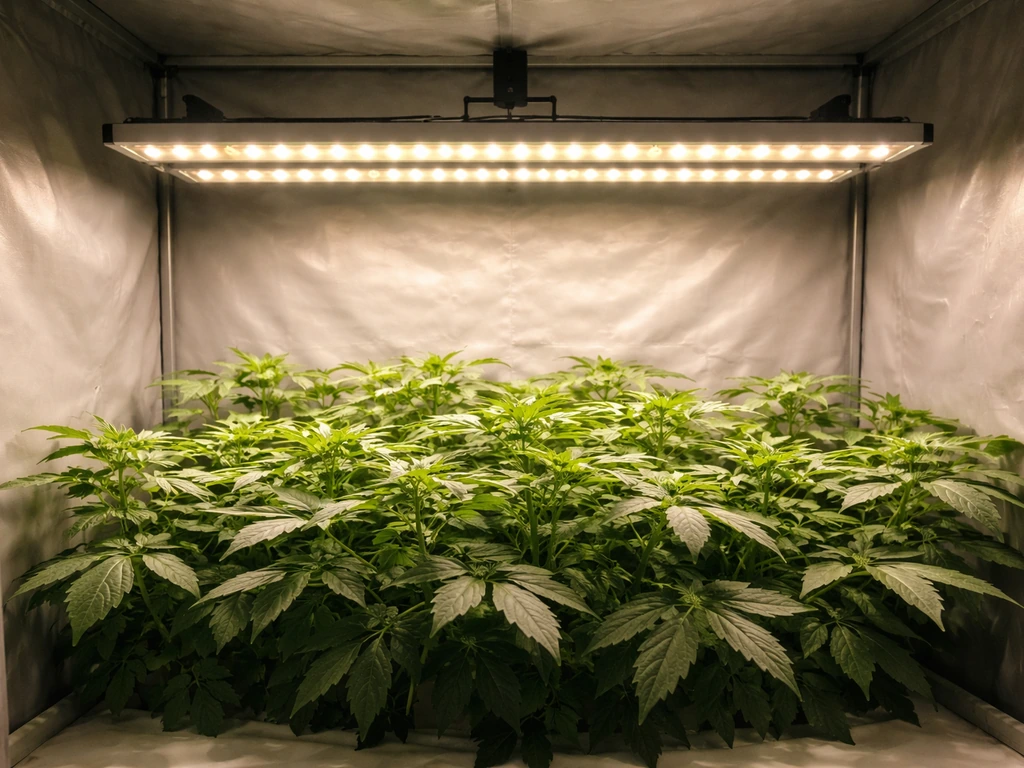
For bar-style fixtures like Feit's linked LED bars, center the light over the growing area and space multiple bars evenly so coverage overlaps slightly at the edges. A single 24-inch bar covers roughly a 2x2-foot footprint at 18 inches of height. If you are linking multiple fixtures, the combined coverage expands proportionally but edges will always be dimmer than the center, so rotate pots weekly for even growth.
Clamp-style Feit lights attach to a shelf edge or tent pole. Position the clamp so the light head is directly above the plant canopy, not angled sharply to one side. A 15 to 30 degree angle away from vertical is fine for reaching a wider spread, but avoid angles past 45 degrees because you lose too much intensity at the canopy level.
Bulb-style Feit grow lights in standard fixtures work best in reflector hoods or dome-shaped clamp lamps that direct light downward. In an open socket without a reflector, you lose a significant portion of the usable light to the sides and ceiling.
Setting a lighting schedule that actually works
The number of hours per day your grow light runs is one of the most important variables in the whole setup. Too few hours and plants starve for light. Too many and they cannot complete the dark-phase processes they need, which leads to stalled growth or, in flowering plants, disrupted blooming.
| Plant Type / Stage | Daily Light Hours | Daily Dark Hours |
|---|---|---|
| Seedlings | 14–16 hours | 8–10 hours |
| Vegetative herbs and greens | 14–16 hours | 8–10 hours |
| Fruiting vegetables (tomatoes, peppers) | 14–18 hours vegetative / 12 hours to trigger flowering | 6–12 hours depending on stage |
| Houseplants and tropical foliage | 10–14 hours | 10–14 hours |
| Succulents and cacti | 12–16 hours | 8–12 hours |
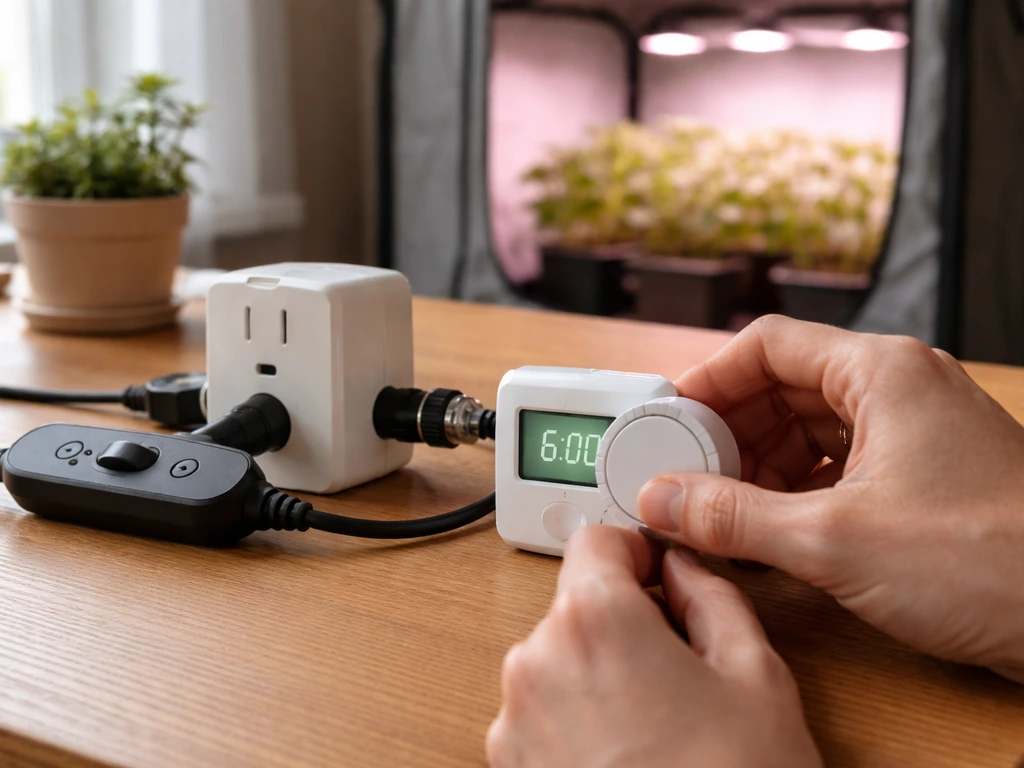
Use a mechanical outlet timer or a smart plug to automate the schedule. Set the on-time to coincide with daylight hours in your home if possible, because plants respond to light cues in relation to their internal clock. Running your light from 7 AM to 9 PM for a 14-hour cycle is more natural than running 10 PM to noon. Feit's smart Wi-Fi fixtures can be scheduled directly in the app, but for standard plug-in models a $10 mechanical timer does the job reliably.
If your Feit fixture has a dimmer, do not run it at 100% for seedlings. Start at 50 to 70% output and ramp up over two weeks as plants establish. Full intensity too early is a common cause of bleached or cupped leaves in young plants.
Setup verification checklist
Before you step back and let the light run for the first time, go through this list. Catching a mistake now saves a week of confused troubleshooting later.
- Model number confirmed and correct manual retrieved from Feit's Download Center
- All mounting hardware is secure and the fixture does not sway or tilt when the cord is handled
- Height above canopy measured with a tape measure (not estimated by eye)
- Power cord is not pinched, not near water, and not running on an overloaded circuit
- Timer is set and tested by hand: confirm light turns on and off at the correct times
- Dimmer (if present) is set to the appropriate percentage for current growth stage
- Coverage area matches your plant footprint (rotate or reposition pots if edges look underlit)
- Linked fixtures (if used) are properly connected with daisy-chain cables and total wattage is within outlet capacity
- Baseline photos taken of plants so you can compare growth over the first two weeks
Troubleshooting: won't turn on, flickering, overheating, and more
Light won't turn on
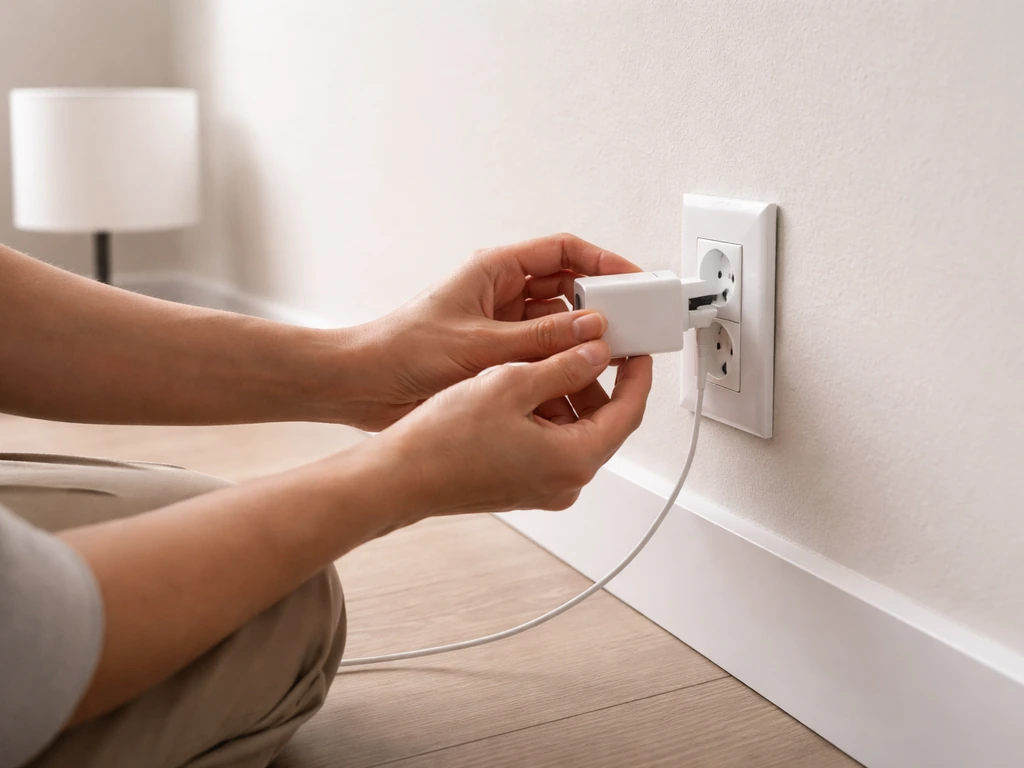
First check the obvious: is the outlet live? Plug a phone charger into the same outlet. If that works, check whether your timer is set correctly and that the timer's switch is in the "on" or "timer" position, not "off." If the outlet and timer are fine, inspect the daisy-chain connections on linked fixtures because a loose cable between units will prevent downstream lights from receiving power. Finally, check whether the fixture needs a short warm-up press on a power button rather than just receiving outlet power. Some Feit models have a physical on/off button that defaults to off even when plugged in.
Flickering or dimming unexpectedly
Flickering in LED grow lights is almost always a loose connection or a dimmer compatibility issue. If you are using a third-party dimmer switch or a dimmer-equipped smart plug that was not designed for LED loads, replace it with a passive timer instead. Also check that linked fixtures are connected firmly at every cable joint. A half-seated daisy-chain cable will cause the downstream fixture to flicker or pulse. If the flickering started after the light had been running for a while, check for heat buildup (see below).
Overheating fixture or warm plants
Feit LED grow lights run warm but should not be hot to the touch on the driver or housing after an hour of operation. If the fixture is genuinely hot, check that it is not enclosed in a space with no airflow. LED lights need ambient air circulation to shed heat. In a tent or cabinet, a small USB fan blowing air over the fixture can drop operating temperatures significantly. If the plant canopy itself feels warm when you hold your hand at leaf level, the fixture is too close regardless of what the default height chart says.
Poor plant response
If plants are not growing noticeably after two weeks, check light hours first, then height. Most underperformance comes from running too few hours or keeping the fixture too far away. Hold your hand palm-down at canopy height. If you can barely see a shadow, the light is too dim or too far. A clear, crisp shadow means the intensity is in the right range. This is a rough but surprisingly reliable field test. If you are following general grow light instructions and still seeing slow results, cross-check your specific Feit model's stated PPFD or lumen output in the manual to confirm the fixture is actually rated for your coverage area.
Fix stretching, yellowing, and slow growth fast
Plants are stretching toward the light
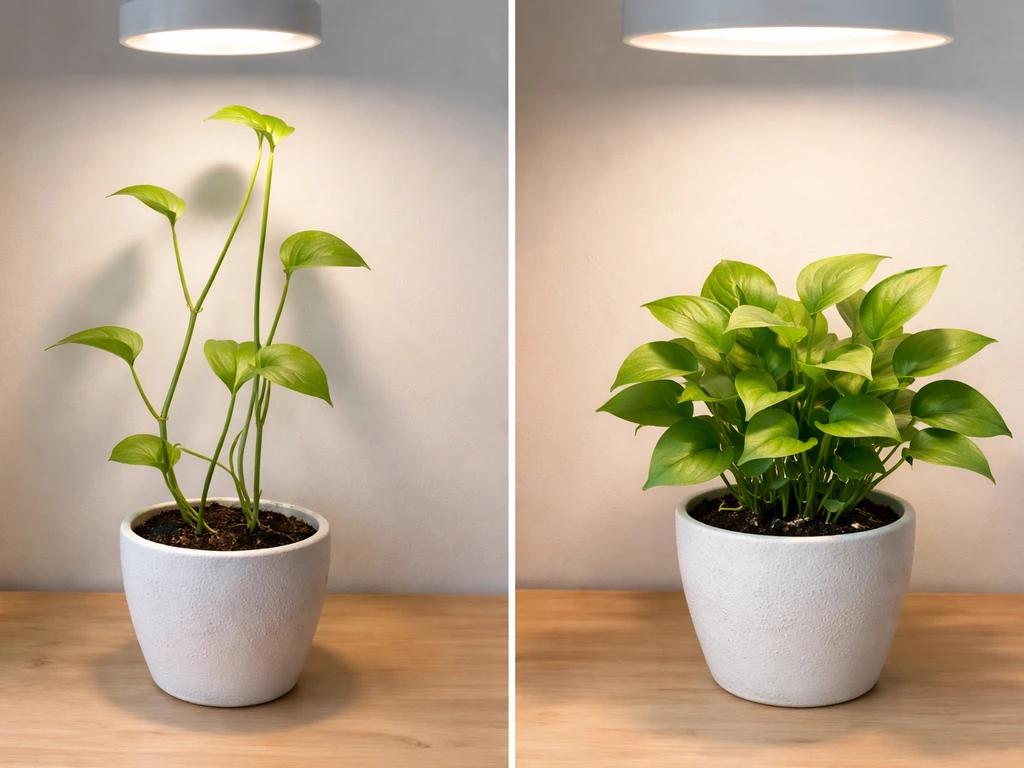
Stretching (etiolation) means the plant is not getting enough light intensity. Lower the fixture by 2 to 4 inches, wait five days, and observe whether new growth is more compact. If the fixture is already at the minimum safe height for your model, increase daily light hours by 1 to 2 hours before lowering further. If you are using a bulb-style Feit grow light without a reflector hood, adding a dome reflector can increase effective intensity at the canopy by 20 to 30% without changing height at all.
Leaves are yellowing
Yellowing has multiple causes, but if it appears across the whole canopy evenly it is often a light duration problem rather than a nutrient issue. Plants running under less than 10 hours of light per day start to show general chlorosis. Raise your daily hours to 14 and wait 10 days before concluding the cause is nutritional. If yellowing only appears on leaves closest to the light and the rest of the plant is fine, that is light bleaching from the fixture being too close. Raise the fixture by 4 to 6 inches.
Growth is slow across the board
Slow overall growth is usually a combination of insufficient intensity and insufficient duration. Run the intensity at 80 to 100% for established plants (not seedlings), confirm your schedule is delivering at least 14 hours for most edible plants, and check that the fixture's coverage area matches your actual growing footprint. If you have outgrown a single fixture, adding a second linked bar or a supplemental light is more effective than trying to stretch one underpowered unit over a larger area. Many growers who start with a single Feit bar eventually link two or three units as their setup scales.
How Feit compares to other brands at this price point
Feit Electric is a solid mid-range option for home growers. The fixtures are widely available at home improvement stores, parts and manuals are accessible through Feit's download center, and the smart-enabled models add scheduling flexibility that cheaper brands skip. The main limitation is that Feit's grow light lineup is oriented toward general-purpose and supplemental growing rather than high-intensity horticultural production, so if you are growing light-hungry crops like tomatoes or cannabis at scale, you will eventually hit the ceiling of what a single Feit fixture can deliver.
If you are comparing Feit against other popular brands, the setup process is broadly similar across plug-in LED bar and clamp fixtures. For example, Fecida grow light instructions follow a nearly identical height and scheduling framework, and Vogek grow light instructions also use the same timer-and-outlet approach. The main differences show up in spectrum tuning and maximum wattage, not in how you physically set them up.
If you are still deciding on a fixture or want to understand the broader setup principles before committing to a specific brand, reading through LED plant grow light instructions covering the general category is a good foundation. And if you have already been through the Feit setup and are helping a friend with a different brand, Lordem grow light instructions and Ferry-Morse grow light instructions cover two other commonly purchased lines with similar beginner-friendly setups.
A few things worth keeping in mind as you go
Grow lights reward patience and observation more than any other piece of equipment in an indoor setup. The most common mistake is adjusting too many variables at once: height, schedule, intensity, and watering all in the same week. Change one thing at a time and give it five to seven days to show results. Take photos on the same day each week under the same conditions so you can actually see whether growth is improving.
Keep your model number saved somewhere convenient, because Feit does update firmware and instructions for smart fixtures, and the download center is the fastest way to check if there is a revised spec sheet for your unit. Feit also maintains a Download Center where you can find manuals and spec sheets for Feit products by searching with the model or SKU. A sticky note on the inside of your grow tent or on the shelf next to the outlet takes about ten seconds and has saved me multiple trips back to the box hunting for a label.
Finally, if you bought a Feit fixture that covers a 2x2-foot area and you are trying to light a 3x3-foot shelf, no amount of height or schedule optimization will compensate for the coverage gap. Match the fixture to the footprint, or add a second light. That single adjustment fixes more "why aren't my plants growing" problems than anything else.
FAQ
How do I tell whether my Feit grow light is smart Wi-Fi or a standard plug-in model if the label is worn?
Check the fixture for any “Smart” or “Wi-Fi” wording, but also look at the controls. Smart Wi-Fi units typically mention app setup or Wi-Fi pairing on the label or have different control buttons than basic dimmer timers. If you cannot read the label, use the model number on the cord tag or base (even partially visible characters), then pull the exact manual from Feit’s Download Center to confirm the control method and scheduling options.
Can I use a standard outdoor extension cord with my Feit grow light to reach farther in my tent?
Avoid extension cords that do not meet the fixture’s current draw and amp rating, and do not assume “outdoor” means “safe for grow light power.” If the cord is undersized, you can get voltage drop, dim output, overheating, or intermittent operation. The safer move is to use a properly rated cord with appropriate amp rating for the wattage, keep connections elevated and dry, and prevent any strain on the plug at the tent entrance.
What’s the right way to position linked (daisy-chained) bar lights so the edges are not too dim?
Keep bars centered over the grow footprint and stagger placement so each plant receives more overlap from multiple bars rather than relying on a single bar’s edge. If plants are clustered in one corner, the far corner will often look worse even if the “coverage” chart seems adequate. Rotate or swap pot positions weekly and, if the canopy still looks dim at the perimeter, add a second bar rather than lowering the existing ones further.
My fixture turns on in the outlet but the light stays off. What should I check first?
First confirm the outlet is live with a known-working device, then verify any timer or smart plug is actually switching the power on to that outlet. After that, check whether your specific model has a physical power button that defaults to OFF when plugged in. If it still won’t start, inspect any daisy-chain connectors end-to-end for fully seated joints, since a loose upstream connection can block downstream lights even though the first unit powers.
Is it okay to run a Feit grow light on a dimmer, or can it cause flickering?
Many LED grow lights will flicker if paired with a dimmer that is not designed for LED loads, or if the dimmer’s minimum load requirement is not met. If you see flickering, remove the third-party dimmer and switch to a passive outlet timer for scheduling. If your setup needs intensity control, use the fixture’s built-in dimmer (if it has one) and confirm the dimming range is intended for seedlings versus mature plants.
How do I decide whether my plants need more light hours or the fixture needs to be lowered?
Start with the schedule, because insufficient daily duration shows up across the whole canopy. If the canopy is generally pale or slow with no strong leaf-edge symptoms, increase daily hours first (for many edible plants, moving toward 14 hours is a reasonable target). If you see symptoms localized near the top or closest leaves, that points more toward excessive distance or too much intensity at the canopy, then adjust height in small steps (2 to 4 inches) and wait several days before changing again.
Can I mist plants near the grow light or spray them while the fixture is running?
Do not mist or spray directly near the fixture or over the electrical connections, even if your plants tolerate it. Feit indoor grow lights are not intended for wet locations, so water that contacts the fixture or plug can create shock or failure risk. If you mist, turn the light off and keep water away from cords, the driver, and any hanging hardware, then let everything fully dry before switching back on.
What should I do if the fixture feels hot but not “too hot” to touch?
Warm-to-hot housing can be normal, but it should not be genuinely hot on the driver or housing after about an hour. If it runs hot, check airflow first. In a tent, add gentle ambient airflow (for example, a small fan aimed to move air across the fixture), avoid burying cords or driver area under dense plant material, and ensure the fixture is not enclosed in a sealed cabinet where heat cannot escape.
Do I need to worry about coverage matching, or will raising the light always fix it?
Raising helps reduce bleaching, but it will not compensate for an area mismatch. If your fixture is rated for a 2x2-foot footprint and you are trying to cover a 3x3-foot shelf, the outer zones will be underlit no matter how you adjust height or schedule. The practical fix is matching fixture footprint to your shelf size or adding another unit so the entire canopy receives adequate intensity.
Should I run full dimmer output for seedlings on day one?
Usually no. If your fixture includes dimming, start around 50 to 70% output for young plants, then ramp upward over roughly two weeks. Full intensity too early commonly leads to stress symptoms like cupping or bleaching on the newest growth. Keep changes incremental, since raising intensity and lowering the fixture at the same time can make it hard to identify the real cause.
Next Article
Innova Grow Light Instructions: Setup, Use, and Troubleshooting
Step-by-step Innova LED grow light instructions: setup, mounting, distance, schedules, intensity, and fast troubleshooti