Alocasia needs bright, indirect light for about 10 to 12 hours a day, hitting a PPFD of roughly 100 to 250 µmol·m⁻²·s⁻¹ at the leaf surface. That translates to around 8,000 to 20,000 lux if you're using a phone-based meter. Keep it in that range, use a full-spectrum LED in the 4,000 to 6,500K color temperature band, hang it 12 to 24 inches above the canopy, and you'll stop most of the leaf drop, browning, and stalled growth that's driving you here.
Alocasia Grow Light Requirements: Exact Setup for Healthy Growth
Marcus Tillman
19 May 2026
How much light Alocasia actually needs
Alocasia is a forest-floor plant. In its natural habitat it gets filtered light through a canopy, which means it's adapted to bright-but-not-blasting conditions. Indoors, that translates to a PPFD target of 100 to 250 µmol·m⁻²·s⁻¹ at the leaf level. If you're working in lux instead, aim for 10,000 to 20,000 lux as a comfortable range, with some varieties like Alocasia Polly and Amazonica sitting comfortably at the lower end (8,000 to 15,000 lux) and larger, more vigorous cultivars like Dragon Scale handling the higher end.
For photoperiod, 10 to 12 hours per day is your target. More than 14 hours starts to stress the plant because it disrupts the natural dark period it needs to rest. Less than 8 hours under low-intensity light will cause the slow, droopy decline a lot of growers mistake for a watering or humidity problem.
If you want to be precise, think in terms of DLI (Daily Light Integral), which is just the total dose of light your plant receives over the whole day. A PPFD of 150 µmol·m⁻²·s⁻¹ run for 12 hours gives you a DLI of about 6.5 mol·m⁻²·d⁻¹, which is a solid target for Alocasia. You can hit the same DLI by running a brighter light for fewer hours or a dimmer light for longer, which is useful if you're working around a timer schedule or a dimmer switch.
Best light spectrum and grow light types for Alocasia
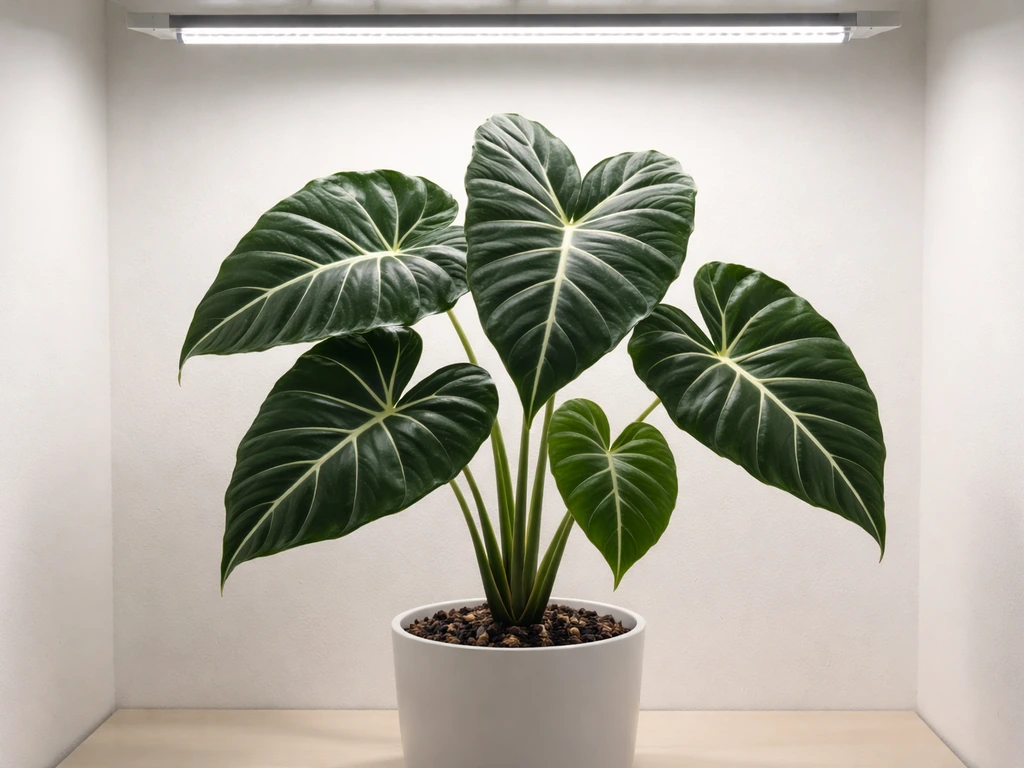
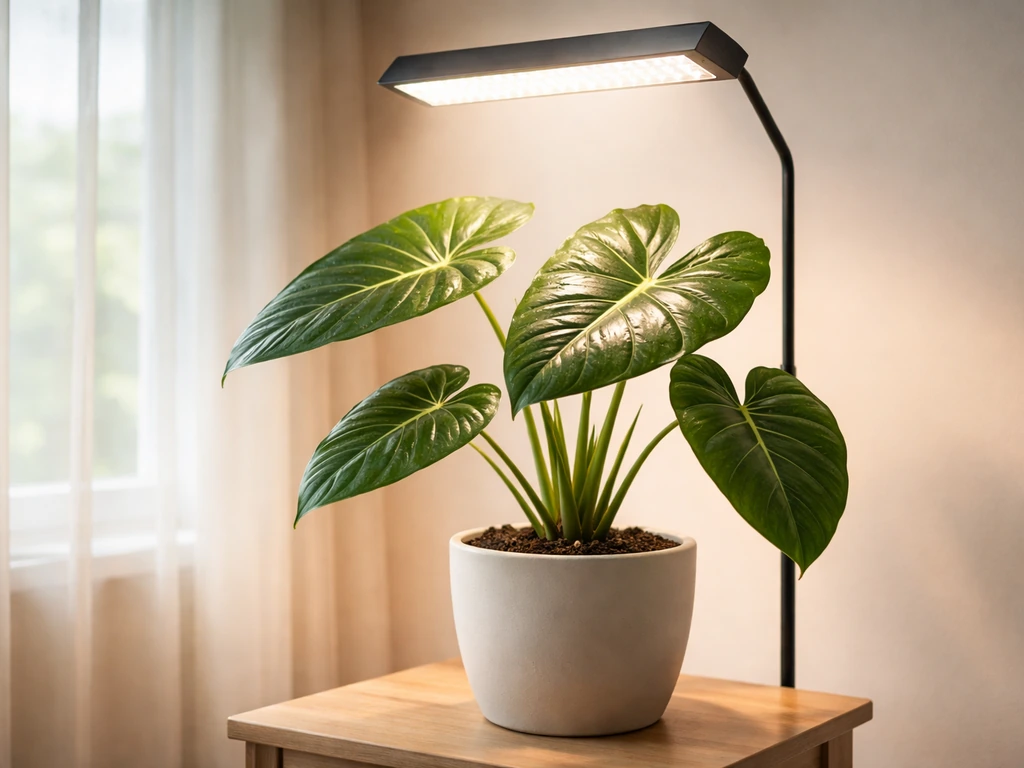
Full-spectrum white LEDs in the 4,000K to 6,500K range are the best practical choice for Alocasia. That cooler, slightly blue-white light supports vegetative growth, which is exactly what you want since you're growing for the leaves. A 5,000K or 6,500K quantum board or LED bar will cover the PAR spectrum cleanly, deliver even coverage, and run cool enough to sit reasonably close to the canopy without burning it.
Warmer LEDs in the 3,000K to 3,500K range are fine if that's what you have, but they're tuned more toward fruiting and flowering and will work harder to hit the vegetative sweet spot. If you're running a warmer panel, bump your hours slightly toward the 12-hour end to compensate.
Some higher-end LED setups include supplemental far-red (around 730 nm). Far-red can trigger elongation responses in plants, which sounds counterproductive for compact Alocasia foliage. If your light has a far-red channel, keep it minimal or off entirely for Alocasia. You want tight, upright leaf growth, not stretched internodes.
Avoid single-color red/blue 'blurple' lights. They technically deliver PAR photons, but the uneven spectrum tends to produce weird leaf coloration and growth patterns in Alocasia, and the light quality just doesn't match what this plant evolved under. For a straightforward LED setup aimed at general houseplant performance, the same principles that work well for a full LED grow setup apply here: choose a quality white-spectrum quantum board or bar-style fixture and you're 90% of the way there. If you want a simple led grow setup for reliable leaf growth, stick to a quality white-spectrum fixture and dial the height and intensity at canopy level.
| Light Type | Color Temp / Spectrum | Alocasia Suitability | Notes |
|---|---|---|---|
| Full-spectrum white LED (quantum board/bar) | 4,000K–6,500K | Excellent | Best all-around choice; even coverage, runs cool |
| Full-spectrum white LED (warm) | 3,000K–3,500K | Good | Works but leans flowering; extend hours slightly |
| Red/blue 'blurple' LED | 660 nm + 450 nm | Poor | Odd coloration, unbalanced spectrum for Alocasia |
| CFL / fluorescent (daylight) | 5,000K–6,500K | Decent | Works for small plants, lower intensity output |
| Incandescent / halogen | 2,700K–3,000K | Not recommended | Too much heat, poor spectrum, inefficient |
| HID (MH/HPS) | 4,200K (MH) / 2,100K (HPS) | Overkill for single plants | Intensity too high unless heavily dimmed or elevated far above canopy |
Placement: distance, height, and angle to avoid burn and etiolation
For most mid-range LED bars and quantum boards (in the 30 to 100W range), a starting height of 18 to 24 inches above the top of the leaves is a safe first position. That typically puts you in the 100 to 200 µmol·m⁻²·s⁻¹ range at canopy level, which is right where Alocasia wants to be. For lower-output fixtures like a single LED grow bulb, you may need to drop to 10 to 14 inches to hit sufficient intensity.
Light intensity drops fast with distance. Because of the inverse-square law, doubling the distance between your light and the plant doesn't halve the intensity, it cuts it to roughly a quarter. Moving your light from 12 inches to 24 inches above the canopy can drop PPFD from around 400 µmol·m⁻²·s⁻¹ down to 100 µmol·m⁻²·s⁻¹. That's why small height adjustments matter a lot, and why measuring at canopy level (not just picking a height that looks reasonable) is worth doing.
Angle matters less than you might think as long as the fixture is roughly centered above the plant. Alocasia leaves are naturally oriented to catch overhead dappled light, so top-down is the correct approach. If you're using a single light from one side, rotate the pot every week or so to avoid the plant leaning hard toward the light source, which stresses the petioles. Running lights from two sides isn't necessary for Alocasia and can sometimes overdose the center of the plant while the outer leaves stay underpowered.
Reflectors can help a lot in a smaller grow space. A simple white-painted wall, white foam board, or Mylar sheet positioned behind or to the side of the plant bounces light back onto lower leaves that would otherwise be in shadow. This is an easy, free improvement if you're working with a lower-power fixture.
How to set a light schedule for Alocasia
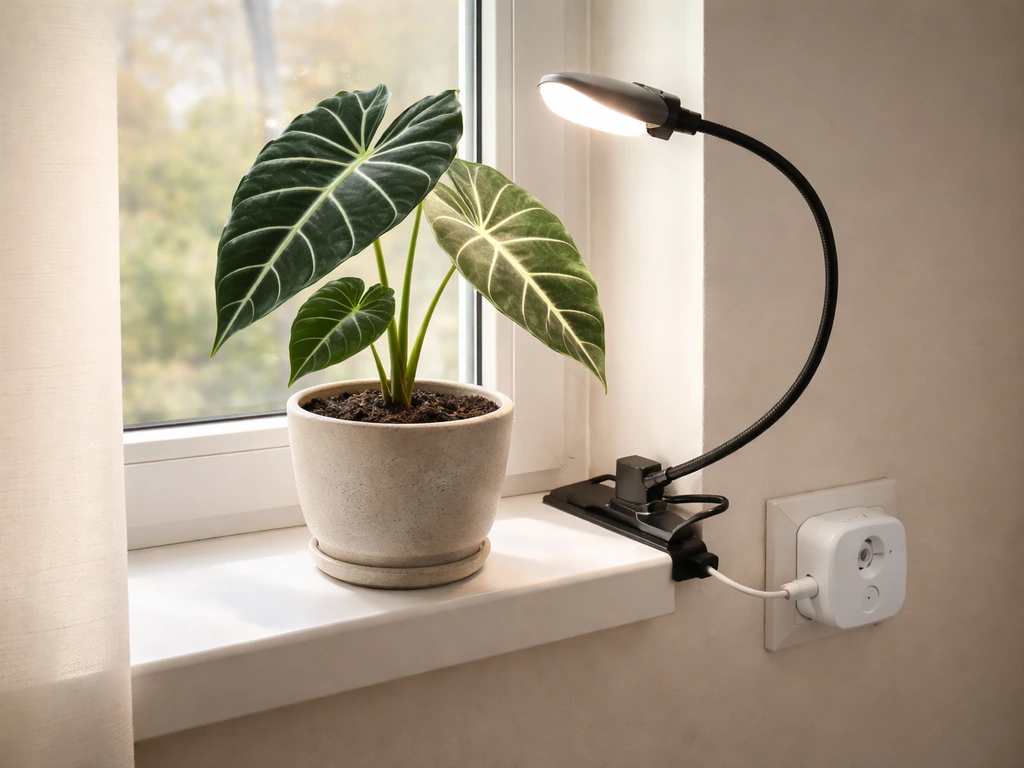
Start with 10 hours per day in winter and 12 hours per day in spring and summer. Alocasia is sensitive to sudden changes, so if your plant has been sitting in low light and you're introducing a grow light for the first time, don't just flip it on for 12 hours on day one. Acclimate it over two weeks by starting at 6 hours and adding an hour or two every few days. Jumping straight to full photoperiod on an unadapted plant can cause stress symptoms that look exactly like the problems you were trying to solve.
Use a simple plug-in timer or a smart plug. Set the light to run during the day hours your plant would naturally experience light (morning through evening), not overnight. Alocasia, like most plants, needs a consistent dark period, and running lights at night or randomly flipping them on and off confuses its internal rhythms. Consistency matters more than perfection.
Seasonally, mirror natural day length as a rough guide. In winter, 10 hours is appropriate. By late spring and summer, move to 12 to 13 hours. You don't need to adjust by the day, but a quarterly review of your timer settings is a good habit. If your Alocasia is also near a window, factor in the ambient daylight it's receiving, especially in summer when a bright window can contribute 2 to 4 hours of usable light before the grow light even turns on.
Measuring light at home: how to actually check what your plant is getting
The most accessible starting point is a phone app like Photone. Set it to PPFD mode if your light is a white LED (it works decently in this mode), hold the phone's front-facing camera at canopy level pointing up toward the light, and take the reading. It won't be lab-grade accurate, but it will tell you whether you're at 50, 150, or 400 µmol·m⁻²·s⁻¹, which is enough to make good decisions. GrowLED recommande également d’utiliser le mode PPFD avec une mesure au niveau du feuillage pour vérifier si l’Alocasia reçoit les valeurs recommandées PPFD mode. For lux, any dedicated light meter app or a cheap handheld lux meter will do the job.
If you're working in lux and want to estimate PPFD, use this rough conversion for white LEDs: PPFD ≈ lux ÷ 65. So 10,000 lux is roughly 150 µmol·m⁻²·s⁻¹, and 15,000 lux is roughly 230 µmol·m⁻²·s⁻¹. Another version of this rule puts the multiplier at 0.014 to 0.018 (so PPFD ≈ lux × 0.015). Both approaches give you the same result, just expressed differently. This is an approximation that varies with LED spectrum and room conditions, but it's accurate enough for practical adjustments.
For more accuracy, a dedicated quantum sensor like the Apogee MQ-500 measures PPFD directly in µmol·m⁻²·s⁻¹ by counting plant-relevant photons rather than weighting for human vision the way a lux meter does. Lux meters estimate light using human vision, so they can be misleading for indoor plant lighting compared with PPFD, which counts plant-relevant photons in the PAR range [lux meters weighting for human vision the way a lux meter does](https://yardandgarden. extension. iastate.
edu/how-to/growing-indoor-plants-under-supplemental-lights/important-considerations-providing-supplemental-light-indoor-plants). This is the right tool if you're dialing in multiple plants or want to verify fixture specs. It's also the only reliable way to calculate DLI, since you'd need to log PPFD readings across the full photoperiod and sum them. For most home growers, the phone app plus the lux-to-PPFD conversion is perfectly functional.
When you take readings, don't just measure one spot. Take readings at the center of the canopy and at the outer edges of the plant, then average them. Alocasia leaves are large and spread wide, so the outer leaves may be getting significantly less light than the center if your fixture is small. A 20 to 30% variation across the canopy is normal. More than that, and you should either move to a wider fixture, raise it slightly for more spread, or rotate the pot regularly.
Troubleshooting Alocasia under grow lights
Most grow light problems with Alocasia fall into a handful of patterns. Here's how to read what the plant is telling you and what to actually do about it.
Leaf tips and edges turning brown
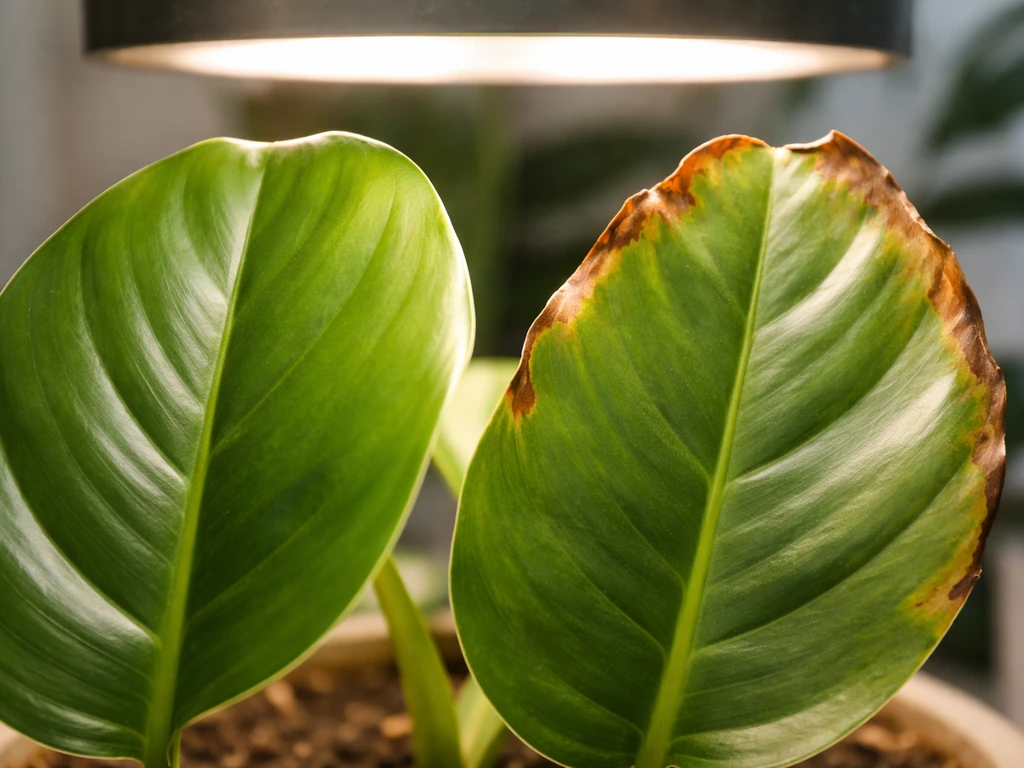
Brown tips and crispy edges are the most common sign that your grow light is too close or too intense. The tissue is getting dehydrated and the chlorophyll is breaking down from light overexposure. Check your PPFD or lux reading at canopy level. If you're above 300 µmol·m⁻²·s⁻¹ (roughly 20,000 lux), raise the light by 4 to 6 inches and re-measure. Also check whether the leaves are physically touching or very close to the fixture. Brown patches that appear only on the areas of the leaf nearest the light are almost always direct burn. Note that low humidity and underwatering cause similar browning, so rule those out too before blaming the light.
Yellowing leaves
Widespread yellowing, especially on older lower leaves, often points to too little light. The plant is pulling nutrients from old leaves to compensate. Check your reading: if you're below 80 µmol·m⁻²·s⁻¹ (under about 6,000 lux), lower the fixture or extend the photoperiod. But yellowing can also come from overwatering, which causes root issues that look just like light starvation. Check soil moisture before moving the light. If the soil has been consistently wet and the roots smell off, that's your real problem.
Leaf drop or leaves that never fully unfurl
Frequent leaf drop with new leaves that emerge slowly or stay curled is a classic low-light response, but it can also be triggered by sudden environmental changes. If you just moved the plant or introduced the grow light recently, give it two to three weeks before diagnosing. If the drop continues after that and your readings are below 100 µmol·m⁻²·s⁻¹, move the light closer or add more hours. If light levels look fine, check temperature and drafts near the fixture. Grow lights can create warm updrafts that pull moisture away from leaves faster than the roots can supply it.
Long, thin petioles and small leaves (etiolation)
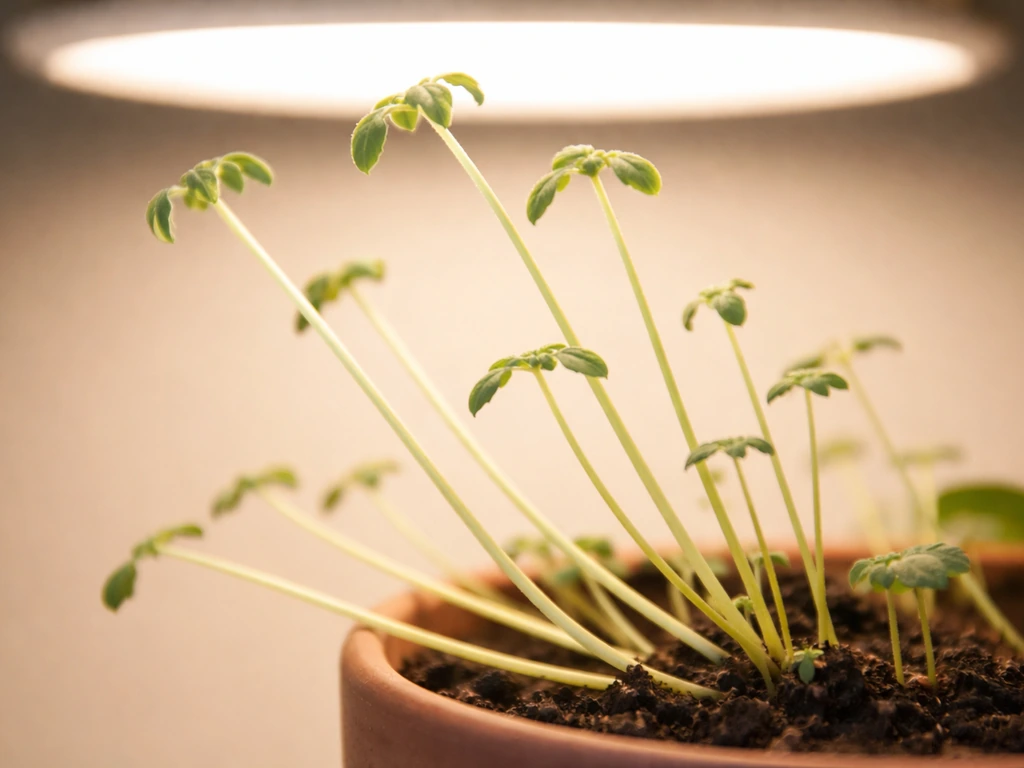
If new leaves are coming in smaller than usual and the stems are unusually long and floppy, the plant is stretching toward more light. This means it's not getting enough intensity, even if it looks bright to you. Your eyes are a terrible light meter. Measure the PPFD. If you're below 100 µmol·m⁻²·s⁻¹, lower the fixture, switch to a higher-output bulb, or add more hours. Etiolated growth won't reverse on existing leaves, but fixing the light will stop new growth from doing the same thing.
Symptom quick-reference
| Symptom | Likely Light Cause | Quick Fix |
|---|---|---|
| Brown leaf tips and edges | Too intense or too close | Raise fixture 4–6 inches; check PPFD, target under 250 µmol·m⁻²·s⁻¹ |
| Brown patches on leaf face | Direct burn from fixture proximity | Raise fixture immediately; ensure no leaves are within 10 inches |
| Widespread yellowing | Too little light (below 80 µmol·m⁻²·s⁻¹) | Lower fixture or extend photoperiod; rule out overwatering first |
| Frequent leaf drop | Low light or sudden change | Increase intensity gradually; check for drafts from fixture heat |
| Long petioles, small new leaves | Etiolation from insufficient intensity | Lower fixture; target 100–200 µmol·m⁻²·s⁻¹ at canopy |
| Leaves lean hard to one side | Uneven light distribution | Rotate pot weekly; center fixture above plant |
Quick setup checklist and recommended starting configurations
If you're starting fresh or resetting a setup that isn't working, here's a configuration that works for most Alocasia varieties (Polly, Amazonica, Dragon Scale) grown under a mid-range LED bar or quantum board.
- Choose a full-spectrum white LED fixture in the 4,000K to 6,500K range. A 30 to 60W quantum board or quality LED bar works well for one to three plants.
- Mount it 18 to 24 inches above the top of the tallest leaf. This is your starting point, not your final position.
- Turn it on and measure PPFD or lux at canopy level using a phone app or handheld meter. Target 100 to 200 µmol·m⁻²·s⁻¹ (roughly 8,000 to 15,000 lux).
- Adjust height up or down in 2-inch increments until you hit that target range. Re-measure after each move.
- Set a timer for 10 hours per day if it's fall or winter, or 12 hours if it's spring or summer. Run the light during daytime hours.
- If the plant hasn't been under a grow light before, start at 6 hours and increase by 1 to 2 hours every 3 to 4 days until you reach your target photoperiod.
- Take readings at the center and edges of the canopy. If the edges read less than 60% of the center value, either raise the fixture slightly to spread coverage or rotate the pot every 5 to 7 days.
- Check the plant after 2 to 3 weeks. New growth coming in normal-sized and upright means the setup is working. Adjust only if you're seeing symptoms.
One thing worth noting: if you're also setting up lights for other plant types nearby, Alocasia's moderate light needs (100 to 250 µmol·m⁻²·s⁻¹) sit between the lower end suited for low-light aroids and the higher end used for seedling setups or high-light plants. If you're running a shared fixture for a mixed shelf, position your Alocasia toward the edges of the light footprint where intensity naturally drops off, and reserve the high-intensity center for plants that can handle more.
Dimmer-equipped fixtures are genuinely useful here. If your panel has a dimmer, dial it to around 50 to 70% output at 18 inches and measure. If you're dialing in a succulent grow light setup, use the same workflow: choose the right spectrum, set a safe distance, then measure PPFD at canopy level and adjust gradually. This gives you room to turn it up as the plant adjusts or as you move to a larger, more light-hungry cultivar. Running a high-output fixture at full power from close range is the fastest way to trigger burn, and it's completely avoidable.
Finally, don't overthink the perfect setup before you start. Pick a fixture, set it to a reasonable height, measure what you're actually delivering, and adjust. If you’re also considering a cannabis grow light setup, use the same approach of measuring PPFD at canopy level and dialing intensity to match the plant’s needs. The measurement step is the one most people skip, and it's the reason so many Alocasia setups keep producing the same problems. Ten minutes with a phone meter on day one will tell you more than any chart or rule of thumb.
FAQ
Can I run my alocasia grow light for more than 12 hours to compensate for weaker intensity?
Yes, but only if you keep the delivered intensity consistent. Use a timer to give the same total DLI, for example by running fewer hours at higher PPFD or more hours at lower PPFD. If you extend past about 14 hours, expect stress even if the plant looks bright during the day.
How accurate are phone apps for alocasia grow light requirements (lux or PPFD modes)?
It can help, but it is not a substitute for measuring at canopy level. White LEDs can be close to the stated lux-to-PPFD conversion, yet different fixtures and beam angles shift readings. If your phone app or lux meter shows you are within the target lux range, still verify by taking multiple readings across the canopy.
What’s the fastest way to know if my alocasia grow light is too intense?
Avoid relying on “leaf feels warm” as a safety check. Instead, watch for the pattern that matches light burn, brown tips that start on the parts closest to the fixture, then back the light off by 4 to 6 inches. If you have a dimmer, adjust in smaller steps and re-measure after a day.
Why do I get inconsistent results when I only measure PPFD at one spot?
Covering the whole plant matters more than chasing a single number. Take readings at the center and multiple outer leaf locations, then average them. If the outer edges are more than about 30% lower than the center, expect slower growth on outer leaves and rotate the pot or widen/adjust the fixture.
Should I adjust photoperiod or intensity first when my alocasia is struggling?
Use DLI targets as your guide, not only PPFD. If your plant has been in low light, reduce the PPFD first or increase photoperiod gradually, then keep the total daily dose in the same ballpark. Sudden jumps in dose can cause leaf drop that looks like watering issues.
Is supplemental far-red worth using with alocasia grow light requirements?
Far-red is usually unnecessary for alocasia, especially in a home setup aimed at compact leaf growth. If your fixture has a far-red channel, keep it off or minimal, because adding it often promotes stretching and softer, less upright growth.
How should I use a dimmer, and is it better than moving the light up or down?
On most setups, dimming is safer than changing distance alone. Start at a moderate output (about half to two-thirds if your fixture allows), measure PPFD at canopy level, then fine-tune. Changing distance can swing intensity quickly, so you may overshoot without realizing it.
My alocasia leaf burn is only on certain leaves. What could cause that besides too much light?
Treat it as a calibration and coverage problem. If you see brown tips only near the center or only on one side, rotate the pot more consistently and check whether the fixture is centered and wide enough. Also confirm that leaves are not directly contacting the fixture or a hot surface.
Can temperature or airflow near the grow light mimic low or high light problems on alocasia?
Yes, but only when temperature and humidity are stable. A cool LED and a consistent dark period usually make it easier for the plant to recover, whereas strong heat, drafts, or dry air near the canopy can mimic light problems. Check soil moisture and airflow before raising or lowering intensity.
What’s the best “first setting” approach for alocasia grow light requirements when I’m starting from scratch?
If you want a simple starting point, position the light so your canopy measurements land near the middle of the target band (roughly 120 to 200 µmol·m⁻²·s⁻¹). Then adjust within that band based on symptoms, and keep the photoperiod consistent while you make changes one at a time.
Next Article
Cool Tube Grow Light Setup Guide: Build, Mount, and Tune
Step-by-step cool tube grow light setup: choose parts, mount safely, tune airflow and intensity, troubleshoot overheatin