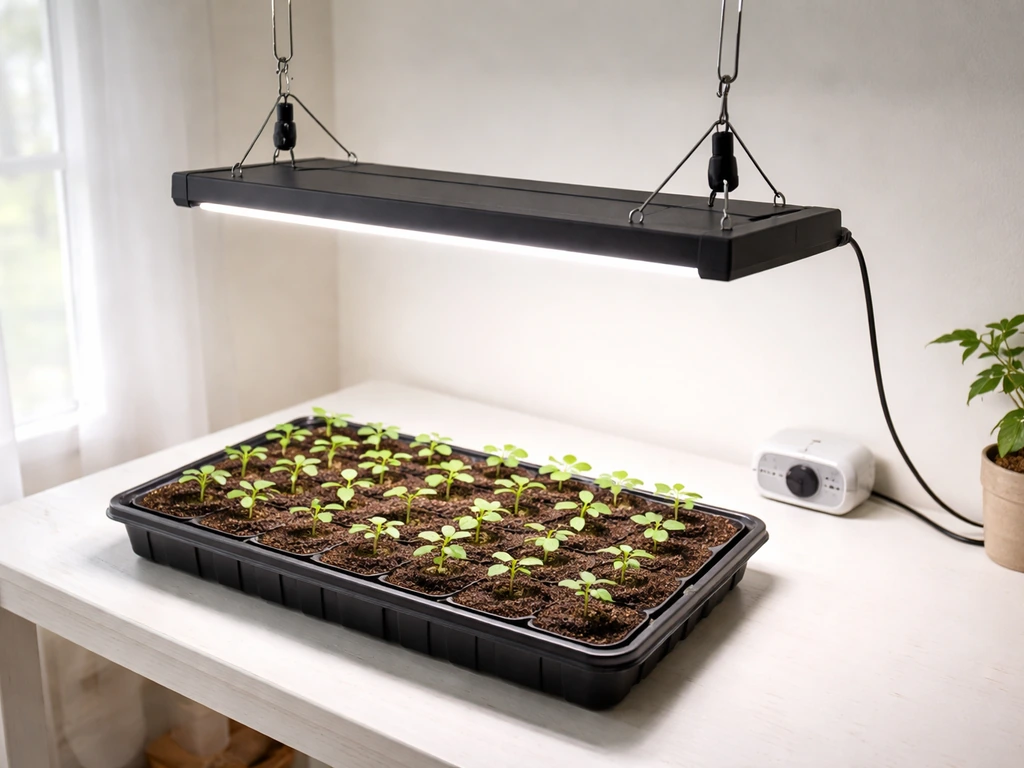
The short answer: a full-spectrum LED positioned 18–24 inches above your succulents, running 12–14 hours a day, hitting 200–400 µmol/m²/s PPFD at the canopy. That setup covers most indoor succulents in most situations. Everything below is the detail you need to make it work for your specific space, plants, and budget.
Succulent Grow Light Setup: Step by Step Placement and Schedule
Marcus Tillman
10 Apr 2026
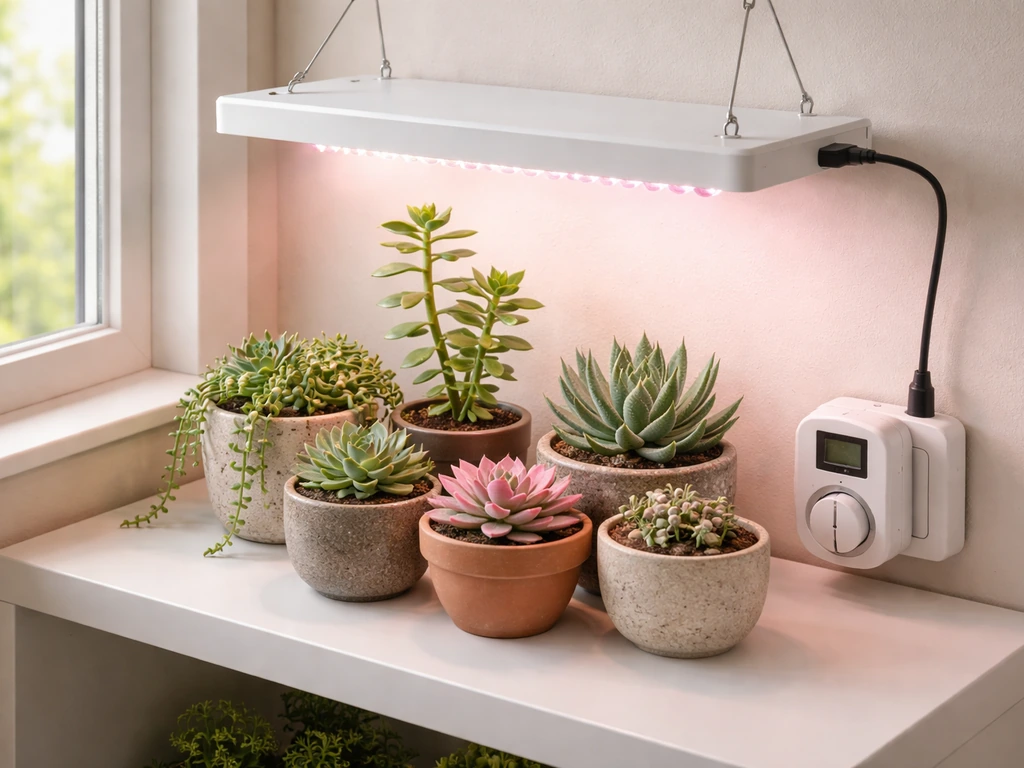
Why succulents need grow lights indoors (and how to tell your setup is off)
Succulents are desert plants. Outside, they can receive 10,000+ µmol/m²/s of PPFD on a bright day. Even a south-facing windowsill delivers a fraction of that once you factor in glass, seasons, and cloud cover. Most windowsill situations just aren't enough to keep succulents compact and colorful year-round, especially in winter or in apartments with limited sun exposure.
Insufficient light causes etiolation, which is the plant stretching toward the nearest light source with elongated, widely-spaced leaves. You'll also see pale or faded coloration, since the rich reds, purples, and oranges many succulents show are stress responses triggered by high light. A plant that was vivid purple or coral-tipped in summer will turn flat green under low indoor light. Other warning signs include leaning, soft or mushy new growth at the center (often combined with overwatering in low-light conditions), and leaves that feel thinner or more papery than usual.
On the flip side, too much light or light placed too close produces bleaching, white or tan patches, and crispy leaf tips. These are heat-stress and photoinhibition symptoms. If you see either extreme, your setup needs adjustment before you lose the plant.
Choosing the right grow light for succulents
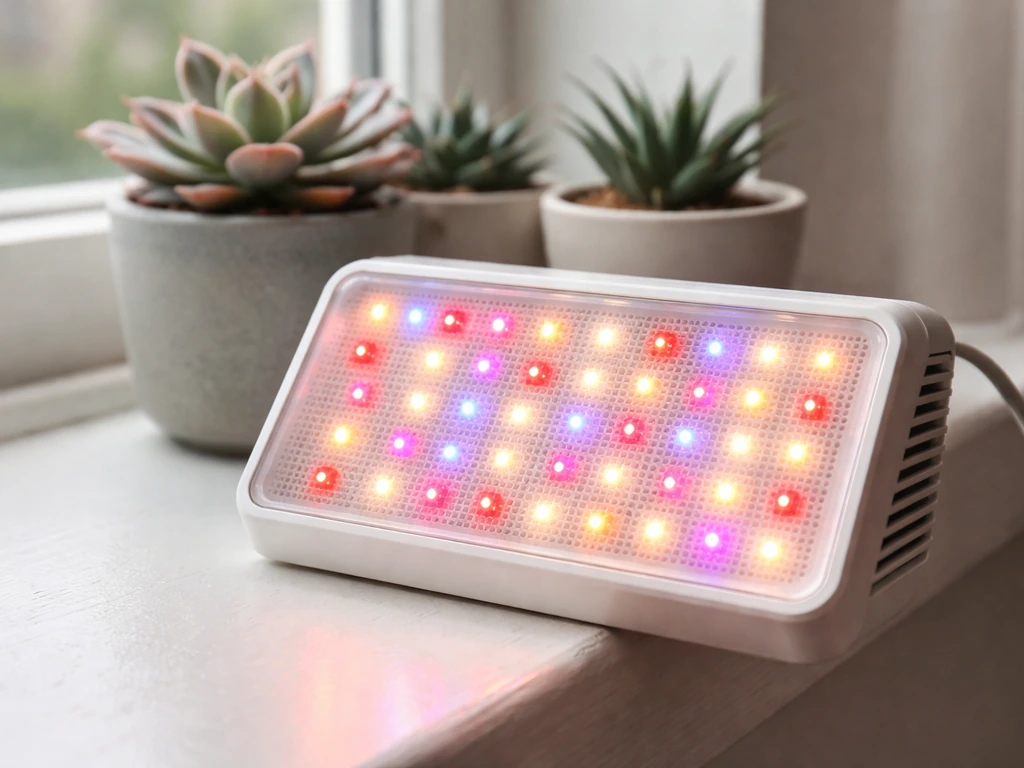
LED is the right choice here
For succulents specifically, LED wins on almost every axis: low heat output, low operating cost, long lifespan, and available in the right spectrum. Fluorescent T5s can work for small shallow setups, and HID/HPS lights are overkill (plus they generate heat that succulents don't need in a home setting). If you want to dig deeper into the general case for LEDs, a good led grow setup covers the broader comparison. For succulents, though, just go LED and move on.
Spectrum: what to look for on the label
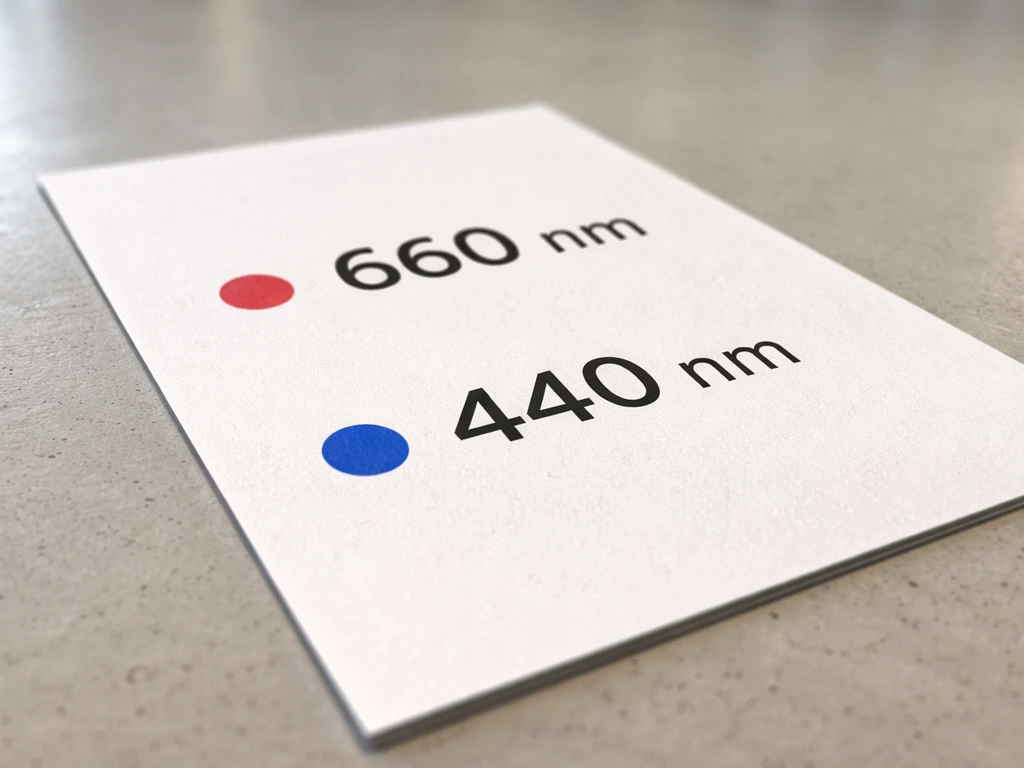
Succulents respond best to full-spectrum LEDs that emphasize red (around 660 nm) and blue (around 440 nm) wavelengths. Some horticulture LEDs also include far-red (730 nm), which can influence growth habit and flowering timing. You don't need to engineer the perfect spectrum from scratch. Just look for lights labeled 'full spectrum' or 'sunlight spectrum' with a color temperature between 3000K and 6500K. Blue-heavy (cool white, 5000–6500K) light keeps growth compact and encourages stress coloration. Warmer spectra (3000K) are fine too and tend to look better in a living room setting.
Key specs to match to your space
The metric that actually matters for plant growth is PPFD (photosynthetically active radiation in µmol/m²/s), not watts or lumens. Succulents are high-light plants. You're targeting 200–400 µmol/m²/s at the canopy surface. A small panel like the Spider Farmer SF300 is a solid reference point for a single shelf or compact setup, covering roughly a 1.5 ft x 1.5 ft area at 18 inches. Larger shelves need more coverage or multiple fixtures. Always check the manufacturer's PPFD map, not just the wattage, because two lights with identical wattage can deliver very different actual photon output.
| Light Type | Heat Output | PPFD Efficiency | Best For | Typical Cost |
|---|---|---|---|---|
| Full-spectrum LED panel | Low | High | Shelves, tents, single plants | $20–$150+ |
| LED PAR38 spotlight | Low–Medium | High (focused beam) | Single pots, accent lighting | $15–$60 |
| T5 fluorescent | Medium | Moderate | Low-budget shallow setups | $30–$80 |
| HID / HPS | High | High (but overkill) | Not recommended for home use | $100–$300+ |
For most indoor succulent setups, a small LED panel or a PAR38 LED spotlight is the practical choice. PAR38 spots work especially well for single pots or small clusters, and some are designed with PPFD maps specifically for sun-loving plants including succulents. Spotlights also look clean in a living room compared to a blurple panel hanging over your windowsill.
Placement and mounting height
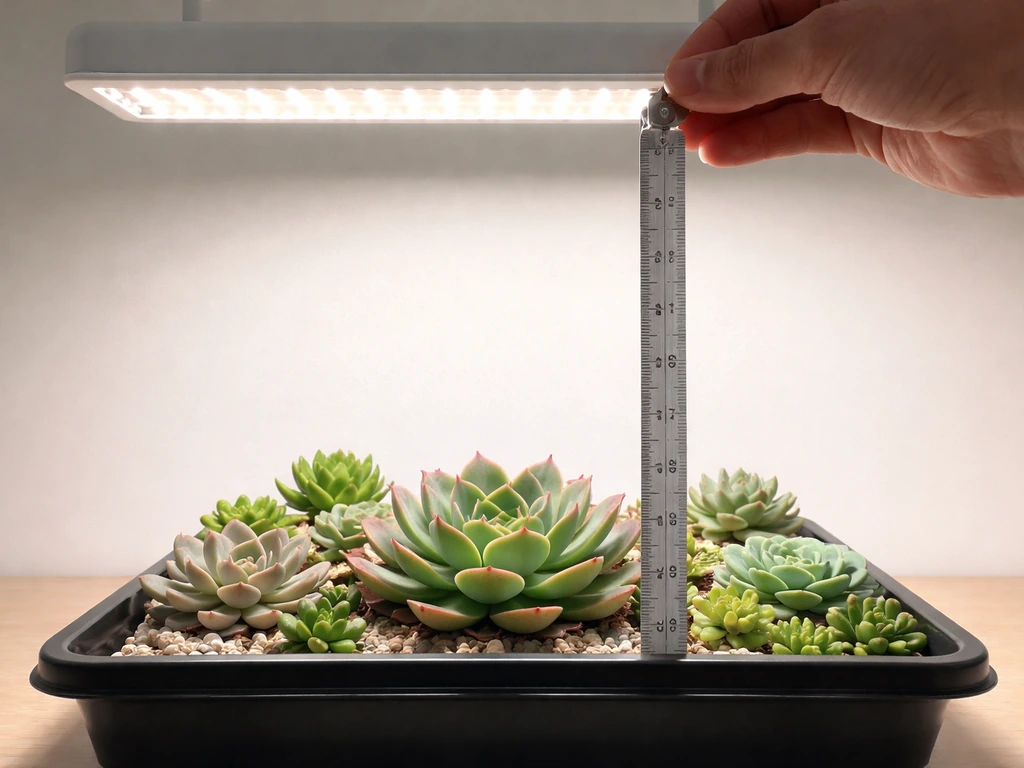
A general rule of thumb for LED grow lights over succulents is 18–24 inches from the top of the plant canopy. At 18 inches, a quality LED panel or PAR38 will typically land in that 200–400 µmol/m²/s sweet spot. Closer than 12 inches and you risk bleaching or heat stress even with cool-running LEDs. Beyond 30 inches and you start losing intensity quickly (light follows the inverse square law, so doubling the distance roughly quarters the intensity).
The most reliable way to set height isn't guessing, it's checking the manufacturer's PPFD map for your specific fixture. These maps show the light intensity at different heights and distances from center. If your light doesn't come with one, use an app-based PAR meter (they're not perfectly accurate but useful for relative comparisons) or invest in an actual PPFD meter if you're running a serious collection. Always start at the higher end of the range (24 inches) and move the light down incrementally over a week or two, watching for stress signs.
For mounting, adjustable hanging ratchet straps are standard. They let you raise the fixture as you add taller plants or lower it when plants are small. If you're placing a light on a shelf above a tray of succulents, measure the actual gap between the light and the tallest plant in the arrangement, not the shelf itself.
Setting the right schedule and duration
Succulents are not photoperiod-sensitive in the same way flowering crops are, but light duration still matters for total daily light dose, which is measured as DLI (daily light integral). DLI is the total number of photons your plants receive over a full day. The formula connecting DLI, PPFD, and hours is straightforward: DLI = PPFD × hours × 0.0036. So at 250 µmol/m²/s, running your light for 12 hours delivers a DLI of about 10.8 mol/m²/day, which is solidly in the healthy range for most succulents.
For most indoor succulent setups, 12–14 hours per day is the practical target. This aligns with general guidance for foliage and semi-succulent indoor plants. Never run lights 24 hours a day. Plants need a dark period to complete metabolic processes, and succulents in particular use a photosynthesis pathway (CAM) that actually requires the night cycle to function properly.
[CAM](https://pmc. ncbi. nlm. nih.
gov/articles/PMC5462028/) plants use a temporally separated stomatal pattern, keeping stomata closed during the day and opening them at night to take in CO₂. CAM plants open stomata at night and take up CO2 at night, with decarboxylation and re-fixation occurring during the day [CAM plants require the night cycle to function properly](https://www. mpgcamb. com/wp-content/uploads/2024/12/PlantPhysiologyTaiz2002.
pdf). Use a simple plug-in timer. Set it once and forget it.
If your plants also get some natural window light, factor that in. You don't need the grow light running all day if they get 3–4 hours of direct sun from a window. In that case, supplement with 8–10 hours of grow light (ideally during the natural light period or extending it in the morning and evening) to hit your DLI target without overexposing the plants.
Coverage and arrangement
Single plant or small cluster
For one to three small succulents in individual pots, a single PAR38 LED spotlight or a compact panel like the SF300 is more than enough. Position it directly above the group. Rotate pots 90 degrees every week or so if you notice any leaning toward the light source.
Shelf setup
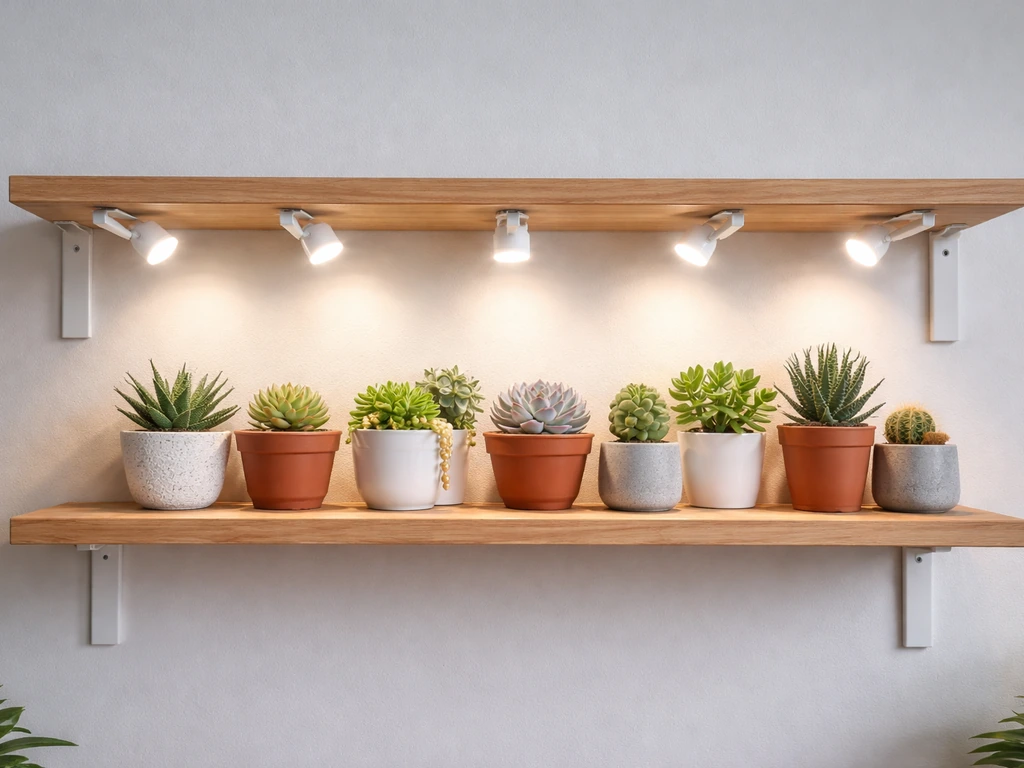
Shelves are the most common indoor succulent setup and also the trickiest to light evenly. The biggest mistake is using a single fixture centered on the shelf and expecting even coverage to the edges. Light intensity drops off fast at the edges, especially on shelves wider than 18 inches. Use either a bar-style LED strip that spans the full shelf width, or two smaller fixtures on a 24-inch or wider shelf.
Keep the light as close to the top of the canopy as the tallest plant allows, and check corner pots regularly for signs of etiolation. Seedling grow light setup principles apply here too, since seedlings and succulents share the same need for even, consistent light distribution across a tray.
Grow tent setup
A grow tent lets you maximize light efficiency through reflective interior walls and gives you full control over the environment. For a small 2x2 or 2x4 tent dedicated to succulents, one 100–200W LED panel is usually sufficient. Keep in mind that succulents in a tent still need airflow, both to manage temperature and to mimic the light breeze that helps strengthen stems. Most people underestimate how quickly a tent heats up under lighting, so a small fan is non-negotiable. If you're using a tent and want to understand ventilation options in more detail, the air cooled grow light setup guide explains how to integrate cooling into your light system without losing efficiency.
For planning coverage across any space, tools like a PPFD/DLI calculator let you estimate how many fixtures you need to hit your target intensity across a given canopy area. This removes a lot of the guesswork, especially when you're setting up more than one shelf or a full room.
Trailing succulents vs compact rosettes
Compact rosette types (Echeveria, Haworthia, most Sedum) stay low and are easy to light from above. Trailing types like String of Pearls or Donkey's Tail grow outward and downward, so a top-down light will leave the lower strands in shadow. For trailing succulents, consider a side-mounted light or a combination of top and side lighting to keep the full plant healthy.
Troubleshooting common problems
Leggy or stretching growth (etiolation)
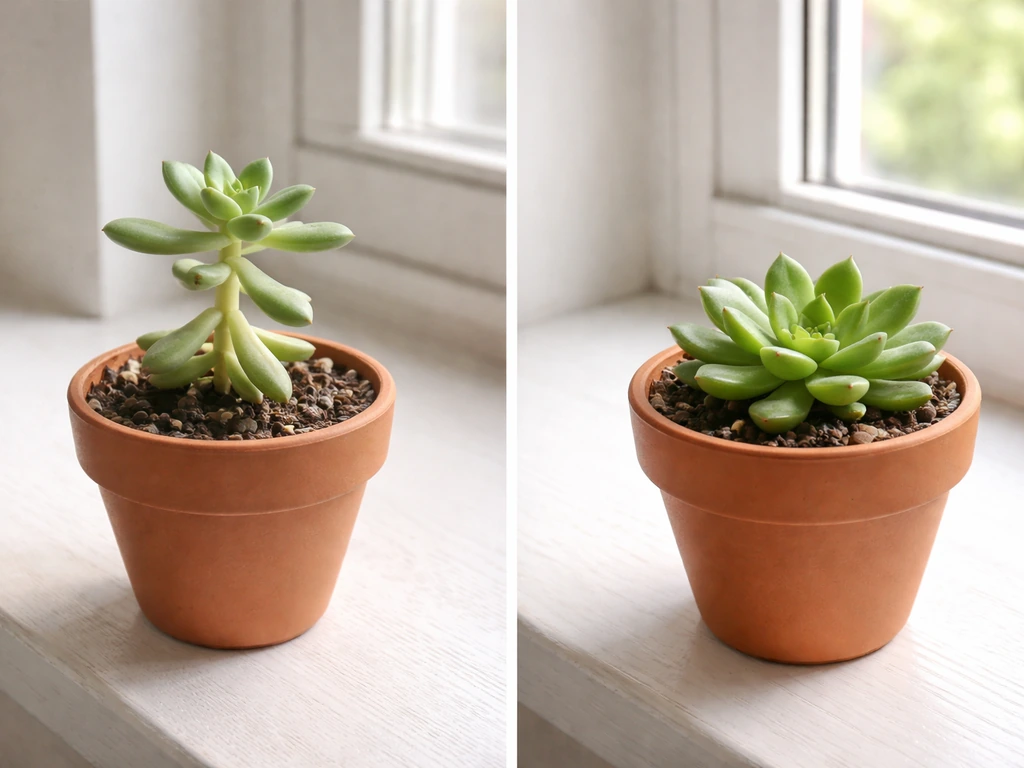
This is the most common symptom of insufficient light. The plant is literally reaching for more photons. The fix is to increase intensity (lower the light or add a fixture) and make sure the schedule is hitting 12+ hours. Don't try to reverse etiolation by suddenly blasting the plant with intense light. Increase intensity gradually over 1–2 weeks to avoid shock. Note that etiolation can't be reversed in the existing stretched stem, but new growth will come in compact once light is corrected.
Fading or washed-out color
Succulents produce their vivid colors partly in response to high light intensity and mild stress. If your plants are turning green and losing their color, they likely need more light. Bump up the schedule to 14 hours, or lower the fixture by a couple of inches and monitor over two weeks. Colorful varieties like Echeveria 'Perle von Nurnberg' or Sedum rubrotinctum need 300–400 µmol/m²/s to show their best color.
Bleaching, white patches, or crispy tips
These are heat stress or light overexposure symptoms. LED heat stress is commonly caused by the fixture being too close or by inadequate airflow around the canopy. First, raise the fixture by 4–6 inches and add a small fan if you don't already have one. If the bleaching is only on one side of the plant, rotate the pot. Also check that the light isn't running more than 14–15 hours, since continuous high-intensity exposure without adequate dark period recovery can compound the problem.
Leaning toward or away from the light
Leaning toward the light means the plant still isn't getting enough intensity directly above it. Lower the fixture. Leaning away or curling leaves away from the light means it's too intense or too hot. Raise the fixture and add airflow. Rotate pots weekly regardless, since even a well-placed light has a hot spot at center and drops off toward the edges.
Leaf drop or soft new growth
This is often a combined light-and-watering issue. Low light slows the plant's metabolism, so any water it receives takes much longer to dry out, making it easy to accidentally overwater. If you've corrected the light setup, also adjust your watering schedule. Succulents under grow lights still follow the 'water deeply, then let it fully dry out' rule, but the drying cycle will be faster than a plant sitting in a dim corner.
Dialing it in over time
Getting a succulent grow light setup right isn't a one-time task. Plants grow, seasons change, and you'll add or move pots. The good news is that a simple periodic check takes five minutes and catches problems early. Here's the checklist and setup recipe to run when you first install your light and revisit every 4–6 weeks:
- Measure or estimate PPFD at the canopy level using a PPFD meter or app. Target 200–400 µmol/m²/s for most succulents.
- Confirm your fixture height is 18–24 inches above the tallest plant in the arrangement.
- Check that your timer is set for 12–14 hours per day and that the dark period is uninterrupted.
- Calculate your DLI: PPFD × hours × 0.0036. Aim for 10–15 mol/m²/day for most indoor succulents.
- Inspect every plant in the arrangement, not just the center ones. Check edge pots for etiolation and center pots for bleaching.
- Rotate pots 90 degrees if any are showing directional lean.
- Check fixture temperature and airflow. The area around the light should not feel hot to the touch after 30 minutes of operation.
- Verify all electrical connections are secure and no cords are pinched or near water.
If you're supplementing natural window light rather than replacing it entirely, use the DLI math to calculate how many additional hours of grow light you need. Estimate how much DLI the window is already providing, then subtract from your target to find the gap. Convert that gap to hours using: hours = (additional DLI needed) ÷ (PPFD × 0.0036). This is the same approach used in greenhouse supplemental lighting calculations and it works just as well for a home shelf setup.
Safety tips
- Never run electrical fixtures near water or open drainage trays without drip protection.
- Use a surge protector or smart power strip for your timer and light, especially in humid plant rooms.
- Check hanging hardware every 4–6 weeks. Ratchet straps can loosen over time if the cord gets bumped.
- Don't stack multiple extension cords to reach an outlet. Run a proper extension rated for the load.
- If you're running lights in a tent, never leave a sealed tent unventilated while lights are on.
One last note: the setup principles here for succulents are more demanding than most foliage houseplants when it comes to light intensity, but more forgiving than crops like cannabis or fruiting plants. If you've been reading around and stumbled into guides for cannabis grow light setup or found yourself comparing specs for specialized configurations like a cool tube grow light setup, dial those recommendations back significantly for succulents. The intensity targets are lower, the heat management needs are lower, and the photoperiod is more forgiving. Keep it simple, measure your PPFD, and use a timer.
For context on how different plants compare: alocasia grow light requirements are a useful contrast, since alocasias are low-to-medium light plants that need the opposite approach from succulents. Knowing both ends of the spectrum helps you understand where succulents sit and why getting the intensity right matters so much for them specifically.
Your starting setup recipe
If you want a single recipe to follow today: hang a full-spectrum LED panel or PAR38 spotlight 20 inches above your succulents, set a timer for 13 hours on and 11 hours off, and check the plants every week for the first month. Lower the light by 2 inches if you see stretching. Raise it by 2 inches if you see bleaching or heat stress. Add a small fan if the light makes the air feel warm around the plants.
Most setups stabilize within 3–4 weeks of small adjustments, and once you've found the sweet spot for your specific light in your specific space, your succulents will reward you with tight rosettes and vivid color that makes the whole setup worth it.
FAQ
Can I just use a dimmer or lower the wattage to hit the right light level?
If you have a dimmable LED, use it to fine-tune intensity, not to compensate for bad placement. Keep distance in the 18–24 inch range first, then adjust output in small steps and re-check appearance over 1 to 2 weeks. Sudden large dimming changes can look like etiolation or bleaching for different parts of the plant.
Why can’t I rely on watts or lumens for a succulent grow light setup?
No. PPFD can vary widely because different fixtures have different optics and beam spreads. Two lights with similar watts may deliver very different canopy PPFD, especially with spots versus panels. Use the manufacturer PPFD map for the exact model and distance, or measure with a PAR meter app only for relative comparison.
How do I prevent uneven lighting on a shelf when using one light?
Yes, especially for small plants clustered together. Since the bright zone is usually centered, rotate the pots 90 degrees weekly, and keep corner plants under frequent inspection. If multiple pots keep leaning toward the same spot, add a second fixture or switch to a bar style that spans the full shelf width.
What’s different about lighting for trailing succulents like String of Pearls?
For trailing succulents, top-only lighting often leaves lower strands in shadow, which can cause sparse growth and weak coloration. Use side mounting aimed across the plant, or combine a top light with a lower side light to bring light to the underside and trailing tips.
Do succulents need a strict on/off schedule, or can I change hours day to day?
Aim for a consistent dark period, not just “some hours off.” Even though succulents are CAM plants, they still need uninterrupted night-time recovery. If you want a flexible schedule, keep the same total daily hours and avoid turning the light on and off multiple times during the night.
How should I adjust the setup if I see both stretching and bleaching at the same time?
Start with a safe range, then treat any stress signs as a direction for adjustment rather than a guess. If plants stretch and look pale, lower intensity is likely the issue (raise the light or increase output depending on distance you already set). If you see bleaching or crispy tips, raise the fixture 4–6 inches and improve airflow before trying longer daily exposure.
What’s the best way to run the grow light schedule safely with a timer or smart plug?
Use a timer rated for the power draw of your fixture, and verify it works reliably during a power blink. If you use smart plugs, choose ones that do not introduce frequent reconnect delays, and avoid cycling the power manually. The goal is consistent photoperiod, not occasional resets.
How often should I re-check height, PPFD, and DLI after my plants start growing?
Check the canopy at the same height after you repot or when plants grow, because PPFD drops quickly with distance. Re-measure or visually re-evaluate every 4 to 6 weeks, and after any major layout change. Even small height differences across a crowded shelf can cause one row to underperform.
If I add a second light, should I also lower the light duration?
Usually yes. If your setup is already hitting the 200–400 µmol/m²/s target and you add more fixture wattage, you risk localized bleaching and higher heat around the canopy. Instead, increase coverage first (reduce dark corners), then adjust distance/output to keep average PPFD near target.
Is a PAR38 spotlight actually better than an LED panel for a small succulent grow light setup?
For single small plants, PAR38 can be excellent because it concentrates photons and often looks cleaner in a room. The tradeoff is narrow coverage, so it can produce hotspots. Keep PAR38 centered, watch the sides of the pot, and consider a panel or two spots if you want uniform color across multiple plants.
How should I change watering after I install or adjust grow lights for succulents?
Often, yes. Insufficient light and slow drying can make overwatering more likely, but you may not notice it until leaves feel soft or centers rot. After you change the light schedule or height, wait a few days longer before watering, and confirm dryness at the soil level rather than by surface appearance.
Do full-spectrum lights with far-red affect succulent flowering or growth form?
Yes, if you’re using far-red LEDs or fixtures labeled full spectrum, flowering timing can shift slightly, but succulents often prioritize light intensity over exact photoperiod. If your goal is more compact rosettes and color rather than blooms, focus on PPFD targets and keep the 12–14 hour schedule steady.
Next Article
Seedling Grow Light Setup: Step-by-Step Guide for Beginners
Step-by-step seedling grow light setup: pick the right light, place and adjust height, set timing, avoid leggy heat stre