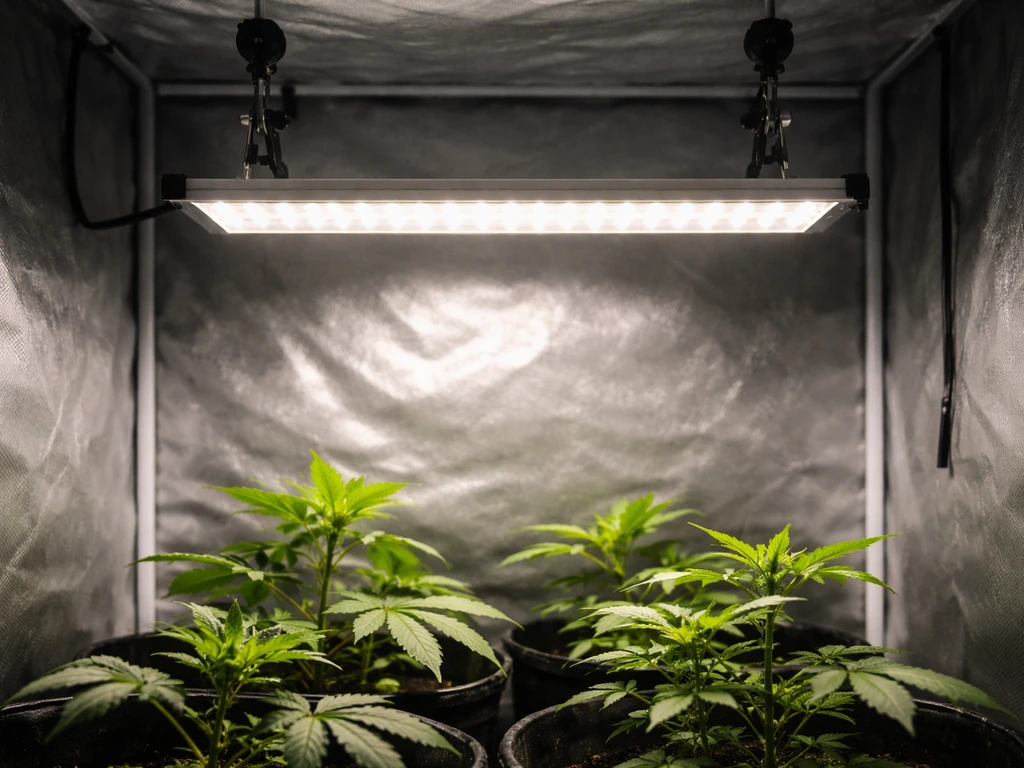
You can absolutely create bright indirect light with a grow light, and it comes down to three things: keeping the light at the right height, dialing in the right intensity, and spreading that light so it reaches your plants evenly without blasting them from point-blank range. The goal is to land somewhere between 2,000 and 5,000 lux (or roughly 400 to 600 µmol·m⁻²·s⁻¹ in PPFD terms) at the leaf surface. That range gives you the "bright but not scorching" effect that most tropical houseplants, pothos, monsteras, and ferns crave.
How to Create Bright Indirect Light With Grow Lights
Marcus Tillman
4 Apr 2026
What bright indirect light actually means for your plants
When a plant tag says "bright indirect light," it means the plant wants high-ish intensity without the harsh, uninterrupted beam of direct sun. Direct outdoor sunlight can hit around 100,000 lux. Bright indirect sits far below that, usually in the 2,000 to 5,000 lux range, which is why a north-facing window or a spot set back from a south-facing window qualifies. The light is still strong enough to drive real photosynthesis, but it's been softened by distance, diffusion, or angle.
For grow light users, the cleanest way to think about this is in PPFD (photosynthetic photon flux density, measured in µmol·m⁻²·s⁻¹). It's the plant-relevant metric that tells you how many light photons are actually hitting the leaf surface per second. A good bright indirect target for most foliage houseplants is 400 to 600 µmol·m⁻²·s⁻¹. Seedlings want less (often under 100), and succulents in bright indirect can push to 100 to 200, while actively growing foliage plants sit comfortably in that 400 to 600 zone. Knowing these numbers means you're not guessing. If you want a deeper explanation of the underlying science, how grow lights work is a good starting point before diving into setup.
How to mimic bright indirect sunlight with a grow light
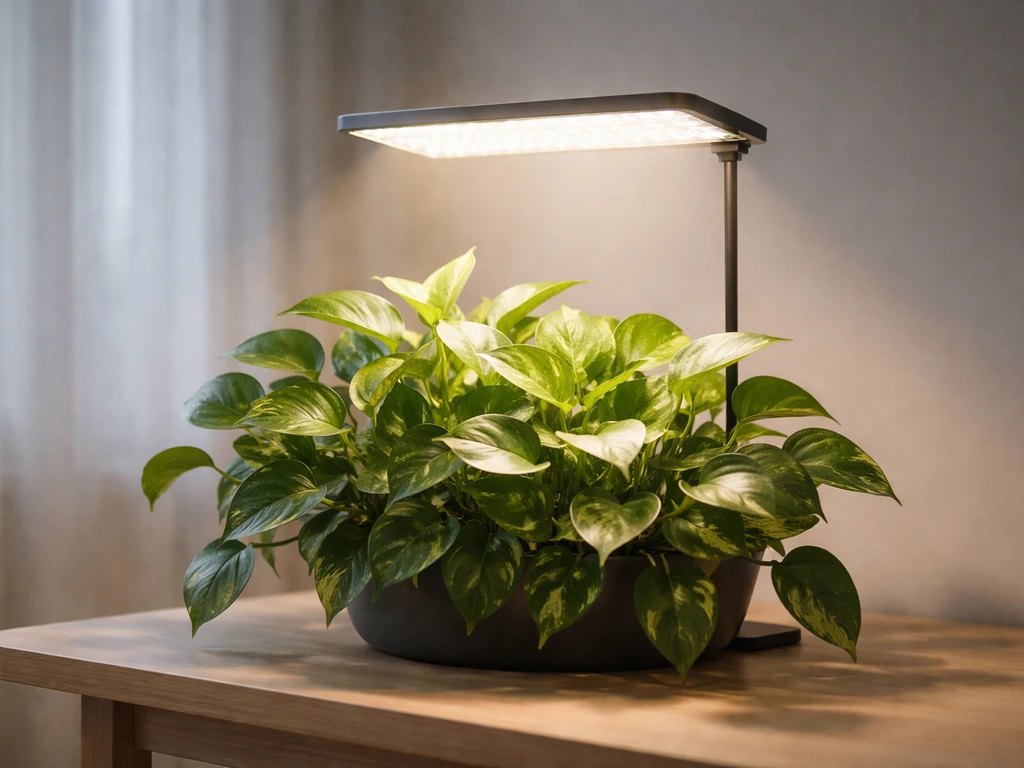
The core concept here is simple: instead of shining a grow light directly down onto a plant from close range, you want to position it so the light spreads across a wider area, arrives at a gentler angle, or passes through something that softens it. Think of how a sheer curtain takes the edge off afternoon sun. You're recreating that effect artificially.
There are three reliable methods to get there. First, raise the fixture higher so the beam has more distance to spread before it hits the canopy. Second, aim for lights with a wider beam angle (120 degrees or more) rather than focused directional fixtures. Third, use diffusion or reflection to scatter the light rather than letting it hit leaves as a concentrated beam. Most real-world setups combine at least two of these. If you're just getting started, how to set up grow lights walks through the hardware basics before you start tweaking placement.
Choosing the right fixture for an indirect effect
Panel-style LED grow lights with wide beam angles work best for bright indirect setups because they distribute photons across a large footprint rather than concentrating them at the center. Dimmable fixtures give you a huge advantage: you can bring a light down to 50 to 70 percent power and dial in your target PPFD without constantly physically adjusting the hanging height. Spider Farmer's SE and G series are good examples of dimmable panels that let you manage intensity through both height and the dimmer knob together.
Placement and distance rules to avoid direct beam light
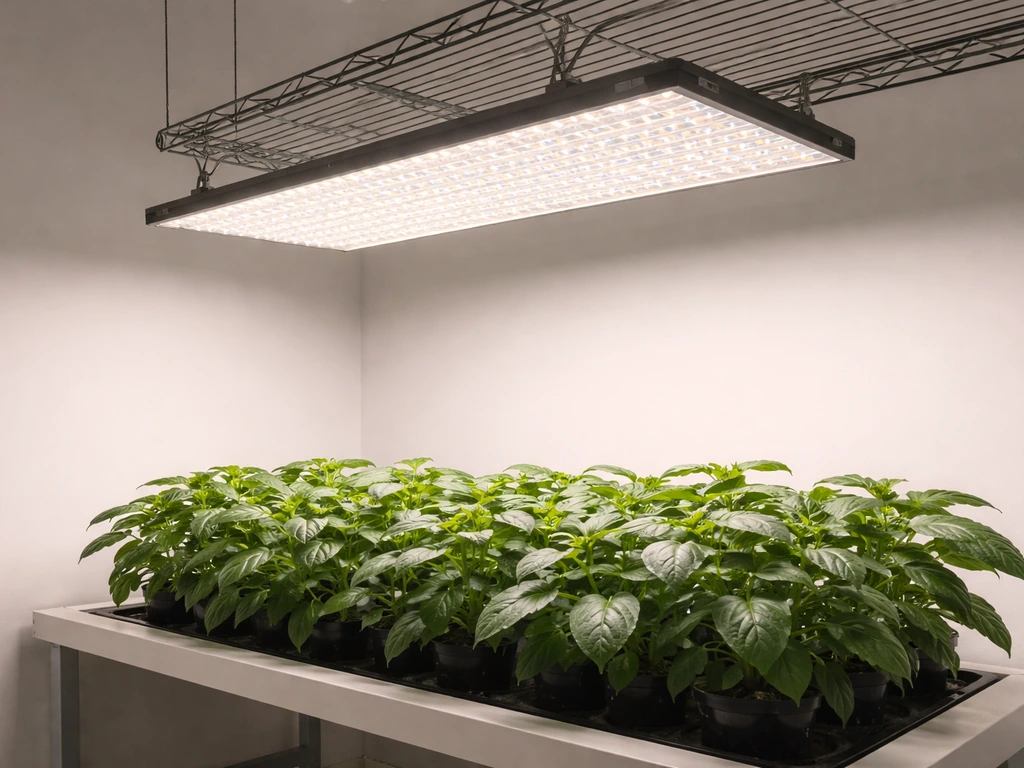
Distance is your most powerful tool. As a general starting rule, hang a full-spectrum LED panel 18 to 30 inches above the canopy when targeting a bright indirect effect for foliage plants. At 18 inches you'll be on the higher end of intensity, and at 30 inches you've spread the light out considerably and reduced intensity at the leaf. The exact number depends on your fixture's output and the target PPFD, which is why measuring matters (more on that in a minute).
Different growth stages call for different distances. Manufacturer distance charts, like those published for Spider Farmer's SE series, show stage-based hanging heights because a seedling flat needs a much gentler light level than a mature monstera in active growth. As a rule, start at the far end of the recommended range (30 inches) and move the fixture closer by a few inches every few days while checking for stress signs. Never drop below 12 inches for foliage houseplants on full power.
One quick sanity check: hold your hand at the canopy level for 30 seconds. If it feels uncomfortably warm, the light is too close. Move it up. This isn't a substitute for measuring PPFD, but it's a fast first filter that catches obvious mistakes. For a full breakdown of placement logic by plant type and fixture, how to position grow lights covers the geometry in detail.
Using diffusion, reflection, and beam spread to soften light
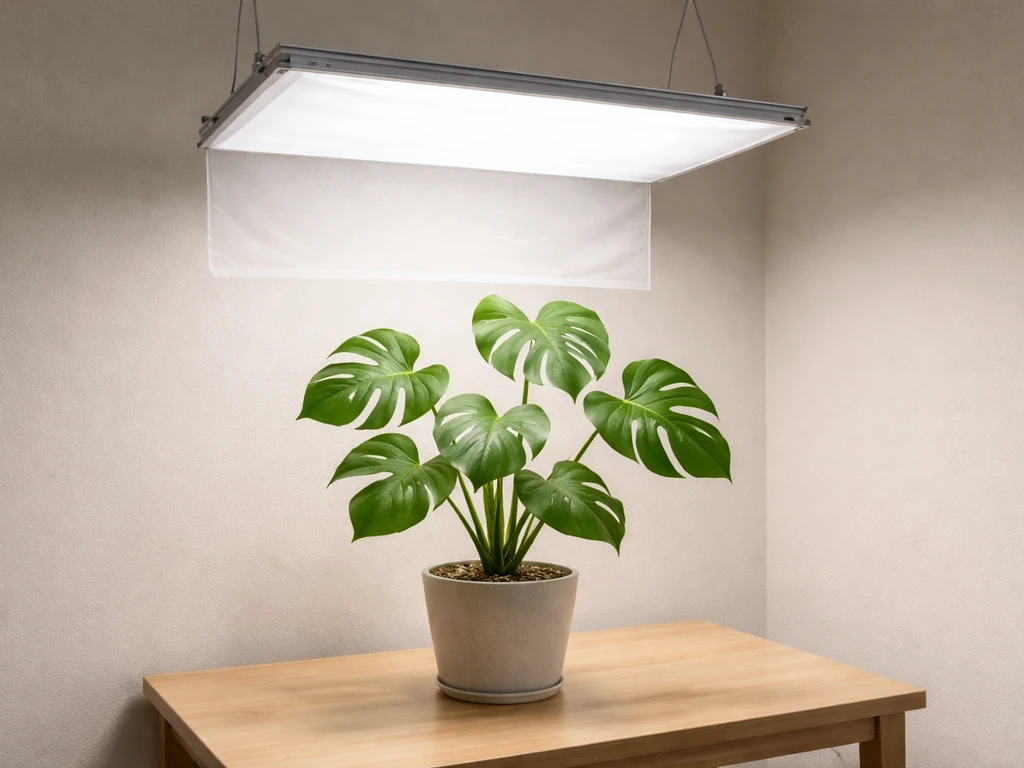
Raising the fixture is the most common approach, but you can also physically soften the light before it reaches the plant. A sheet of white ripstop nylon or a simple frosted acrylic panel hung below the fixture acts like that sheer curtain, scattering the photons so no single point on the leaf gets hammered. You'll lose some intensity through diffusion (roughly 10 to 25 percent depending on the material), so account for that when planning your height.
White walls and white reflective surfaces nearby help too, but in a different way. Rather than softening the direct beam, they bounce ambient fill light back toward the plant from the sides and below, which fills in shadows and creates a more even, wrapping light quality. This is exactly how bright indirect light behaves near a window: the main light source is indirect, but reflected light bounces off walls and ceiling from multiple directions. Painting your grow space white or using mylar sheets on walls amplifies this effect significantly.
Using multiple lower-intensity fixtures spread across a space is another underrated strategy. Instead of one powerful light running at full blast from directly above, two or three smaller LED panels at wider spacing create overlapping light fields that feel much more "indirect" to the plants underneath. This is worth considering if you're growing a shelf full of mixed plants. How to daisy chain grow lights explains how to connect multiple fixtures efficiently so you're not dealing with a tangle of outlets and cords.
How to measure and confirm you're actually in the bright indirect range
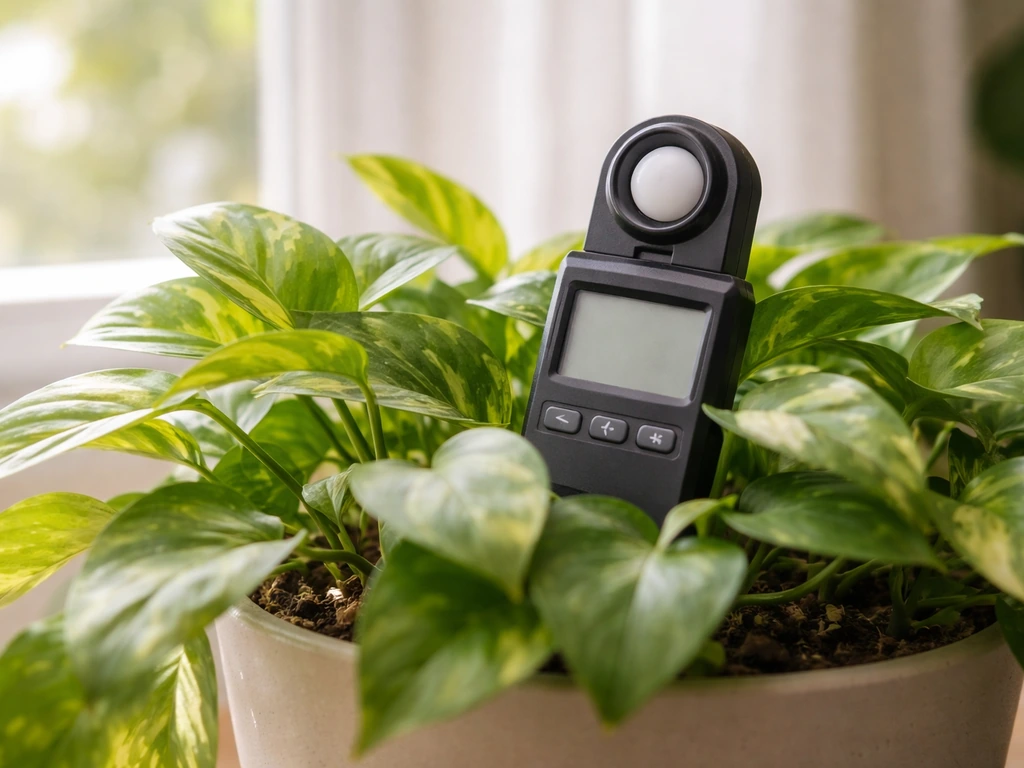
Guessing doesn't work well here. The good news is that measuring your light level is much easier and cheaper than it used to be. A lux meter (basic ones run $15 to $30 on Amazon) will get you a usable reading. Point it at the light source from leaf level, and aim for a reading between 2,000 and 5,000 lux for a bright indirect effect. Below 1,000 lux and you're in low-light territory. Above 6,000 lux and most shade-tolerant houseplants will start showing stress.
For more accuracy, PPFD is the right metric. The Photone app on a smartphone gives you a PPFD reading using the phone's light sensor, and it supports different light source types including specific LED categories. Just note that lux-to-PPFD conversions aren't universal: the relationship shifts depending on your light's spectrum, so validating with a direct PPFD reading rather than converting from lux is worth it when precision matters. The University of Illinois Extension notes that light intensity for houseplants is commonly measured in foot-candles (defined as light produced by one candle at one foot) foot-candles (light intensity). The Photone app also has a calibration feature that lets you align it to a reference meter for improved accuracy if you want to get serious about it.
You can also connect PPFD to your daily light schedule using the DLI (daily light integral) formula: DLI = 0.0036 × PPFD × hours of light per day. For example, if you're running 500 µmol·m⁻²·s⁻¹ for 12 hours, your DLI is about 21.6 mol·m⁻²·day⁻¹. Most foliage houseplants are happy in the 10 to 20 DLI range, so this formula helps you balance intensity against schedule length and avoid overdoing it.
| Light Category | Lux Range | PPFD Range | Typical Plants |
|---|---|---|---|
| Low light | 200–1,000 lux | 20–100 µmol·m⁻²·s⁻¹ | ZZ plant, cast iron plant, low-light ferns |
| Bright indirect | 2,000–5,000 lux | 400–600 µmol·m⁻²·s⁻¹ | Pothos, monstera, peace lily, philodendron |
| Bright direct (outdoor equiv.) | 10,000–100,000 lux | 800–2,000+ µmol·m⁻²·s⁻¹ | Succulents, herbs, fruiting plants |
Troubleshooting: too bright, too dim, or uneven coverage
When your light is too intense or too direct
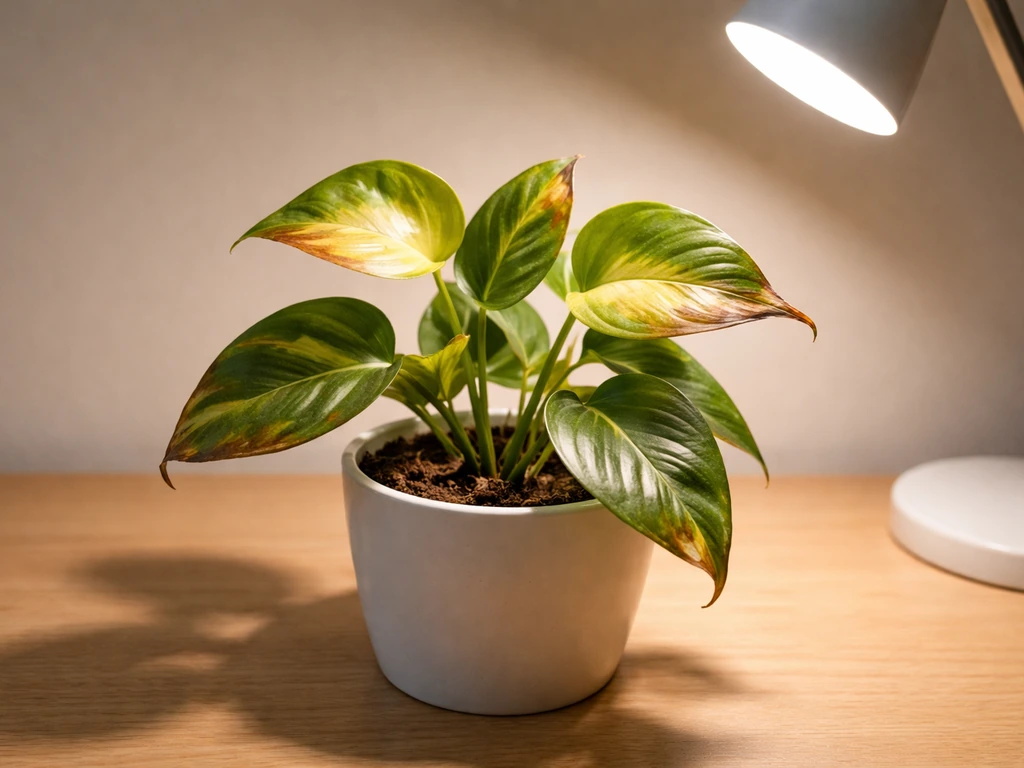
Signs of too much direct intensity include bleached or yellowing leaf centers, crispy edges, or leaves curling away from the light source. If you see these, your first move is to raise the fixture by 4 to 6 inches and recheck your lux or PPFD reading. If your fixture is dimmable, drop it to 60 to 70 percent power rather than constantly repositioning. If you're still too hot at the canopy after raising and dimming, add a diffuser panel below the light.
When your light is too weak
Leggy growth, pale new leaves, and stems reaching toward the light are all signs the plant isn't getting enough intensity. A common mistake is hanging the fixture too high in the hope of getting a gentle, indirect feel, then ending up with insufficient PPFD at the leaf. Drop the fixture by 4 to 6 inches, increase dimmer output, or add a second light source. If you're running a very small or budget fixture, it may simply not have enough output to deliver bright indirect levels across a large area. Check the manufacturer's coverage footprint spec before assuming placement is the problem.
When coverage is uneven
Uneven coverage shows up as plants on the edges of a shelf doing worse than those directly under the center of the fixture. This happens because most LED panels have a hotspot at the center and drop off toward the edges. Solutions include raising the fixture higher (which widens and evens out the footprint), using multiple overlapping fixtures, or rotating plants regularly so each one spends time under the center. White walls nearby help fill in edge coverage with bounced light. For a broader look at how to grow with grow lights effectively across different plant types, it's worth reviewing spacing strategies by plant category.
When your setup seems right but plants still struggle
Sometimes the light is fine but something in the control system drifts over time. Dimmer drivers can degrade, timers can lose their schedule after a power outage, and some fixtures experience output changes as LEDs age. If your plants were doing well and suddenly aren't, and nothing obvious changed, check that your timer is still running the correct schedule and use your lux meter or Photone app to confirm the output hasn't dropped. It's a quick check that catches a surprising number of "mystery" plant problems.
Scheduling and plant-specific adjustments for consistent results
Getting the intensity right is only half the equation. Duration matters just as much. For most bright indirect foliage plants, 12 to 14 hours of light per day is the standard starting point. Running a 500 µmol·m⁻²·s⁻¹ setup for 12 hours gets you a DLI of about 21.6, which sits in the sweet spot for tropical foliage plants. Running that same setup for 16 hours pushes DLI to 28.8, which is more than most foliage plants need and can cause stress or throw off flowering cycles in short-day species.
Photoperiod is worth paying attention to if you're growing any flowering plants alongside your foliage collection. Some short-day plants, like poinsettias and certain orchids, will refuse to flower if they're getting 14-plus hours of artificial light. Keep flowering plants on a 10 to 12 hour schedule and use a physical barrier or separate timer if they're sharing a space with foliage plants on a longer schedule.
Plant-specific intensity adjustments are also worth making rather than running everything at the same level. A pothos sitting right next to a fiddle leaf fig doesn't need the same PPFD, and a single dimmable fixture doesn't let you customize per-plant. The practical solution here is physical: move lower-demand plants slightly to the edges of the light footprint where intensity is naturally lower, and keep higher-demand plants under the center of the fixture. Growing plants with a grow light has more specific guidance on matching light levels to common houseplant varieties if you want a plant-by-plant breakdown.
Your next steps to nail the bright indirect setup
Start by measuring what you have right now with a lux meter or the Photone app. Compare that to the 2,000 to 5,000 lux (400 to 600 µmol·m⁻²·s⁻¹ PPFD) target. If you're over, raise the fixture or dim it. If you're under, lower it or increase power. Add a diffuser if you want a softer quality of light without sacrificing too much intensity. Set your timer for 12 to 14 hours and use the DLI formula to make sure you're in a reasonable daily range. Then check your plants after two weeks. New growth that's compact, healthy, and a good green color means you've nailed it. Leggy, pale, or scorched growth means you adjust one variable and check again. It's a short feedback loop, and once you've dialed it in, it stays consistent.
If you want to go further with your overall setup, whether you're expanding to more plants, adding fixtures, or refining your scheduling approach, understanding how grow lights work at a deeper level will give you the foundation to make smarter decisions about every variable. The more you measure and observe, the less trial-and-error the whole process becomes.
FAQ
Do I measure lux at the plant top, or do I need to measure at the leaf surface only?
Measure at canopy or leaf height, but specifically aim the sensor where the plant’s active leaves sit. If your leaves vary in height (tiered shelves), take multiple readings (top, middle, bottom) because one measurement can miss a “hot spot” or a dim edge.
What if my plants are different heights on the same shelf, can bright indirect still work?
Yes, but you’ll need zoning. Either raise the fixture and rely on a wider footprint, or use multiple fixtures per level. If you keep one height and one dimmer setting, taller plants will likely receive more intensity than the shorter ones.
How do I choose between targeting lux versus targeting PPFD for bright indirect light?
Lux is fine for a reliable starting setup because it’s quick and widely available. Choose PPFD (or validate lux-to-PPFD with a direct PPFD reading) when you’re using a specialized spectrum, a very dimmed fixture, or you’re trying to hit a narrow target like 400 to 600 µmol·m⁻²·s⁻¹.
Will a diffuser always help with brightness without hurting plant growth?
Not always. Diffusers reduce intensity (you may lose roughly 10 to 25 percent), so you often must compensate by lowering the fixture slightly or increasing power to keep PPFD in range. Diffusion can also improve “quality” for leaves by reducing hotspotting, but it cannot fix an underpowered light.
Is it better to use one stronger grow light higher up, or multiple dimmer lights?
Multiple fixtures are often more controllable for even coverage. Spreading two or three lower-intensity sources reduces center hotspots and makes it easier to tune different spots on a shelf. One strong light can work, but it’s more likely to create uneven PPFD across the footprint.
If I see leaf curling or bleaching, should I always raise the light?
Raise first if you’re getting heat stress or obvious over-intensity, then recheck lux or PPFD. If the plant is pale but not scorched, the issue might also be spectrum mismatch or inconsistent photoperiod, so confirm both intensity and schedule before changing too many variables at once.
My lux meter readings don’t match what the Photone app shows, is one wrong?
They can both be “right” but measuring different things. Lux depends on how the meter weights wavelengths, while PPFD depends on photon output. Use the same tool consistently for tuning, and when precision matters, calibrate your approach by taking at least one PPFD reference reading.
How close is too close for bright indirect with LED panels?
A practical safety limit is to avoid going below about 12 inches for foliage houseplants on full power. If you need closer spacing to meet PPFD, use dimming and measure at leaf height so you don’t accidentally shift from bright indirect into direct-like intensity.
Can I use a grow light on a timer for bright indirect, and what duration is safest?
Yes, but start at a conservative photoperiod (around 12 to 14 hours) and adjust using DLI. If you’re unsure, shorten first, then increase slowly. Longer runtimes raise DLI quickly, which can cause stress even if brightness looks “fine.”
How do I know my DLI is too high or too low for my specific plants?
For many foliage houseplants, staying roughly in the 10 to 20 mol·m⁻²·day⁻¹ range is a good general target. If you see pale new growth or stretched stems, increase PPFD or duration. If you see bleaching, crispy edges, or stubborn stress despite “green color,” reduce either intensity (PPFD) or hours.
What happens if I rotate plants under the same light, does it affect bright indirect performance?
Yes, rotation helps correct uneven footprints caused by LED hotspots. Rotating weekly gives each plant time in the higher-intensity center and the dimmer edges, which reduces long-term “edge plants” problems on shelves.
Should I ever run bright indirect light with seedlings or succulents together?
Usually avoid it on the same setting. Seedlings often need far lower PPFD, and succulents can tolerate more than typical foliage but still vary by species. The simple fix is physical spacing (edges for lower-demand plants) or separate timers/fixtures.
My timer loses power after outages, how can I prevent unintended light schedules?
Use a timer with memory backup or a surge-protected outlet, and verify the schedule after any outage. After disturbances, recheck with your lux meter or Photone app for output consistency, since some fixtures also drift over time.
Next Article
Innova Grow Light Instructions: Setup, Use, and Troubleshooting
Step-by-step Innova LED grow light instructions: setup, mounting, distance, schedules, intensity, and fast troubleshooti