The safest and most effective DIY tabletop grow light setup for small plants and seedlings uses LED strips or a compact COB/quantum board panel wired to a properly rated constant-current driver, mounted 4–12 inches above the canopy depending on plant type, and run on a timer for 14–16 hours a day. That combination gives you controllable intensity, manageable heat, and a photoperiod you can actually dial in without guessing. Everything below walks you through how to pick parts, put it together safely, place it correctly, and fix it when something goes wrong. If you want a deeper DIY walkthrough beyond choosing parts, you can use this same approach for how to make a grow light for plants, especially when thinking through placement and troubleshooting grow light placement. Once you have the basics down, you can apply the same placement and wiring principles to build a light trap for a grow box and keep the lighting focused where plants need it light trap for grow box.
DIY Table Top Grow Light: Build, Mount, and Tune It Safely
Choosing the right setup for your goals and plant types
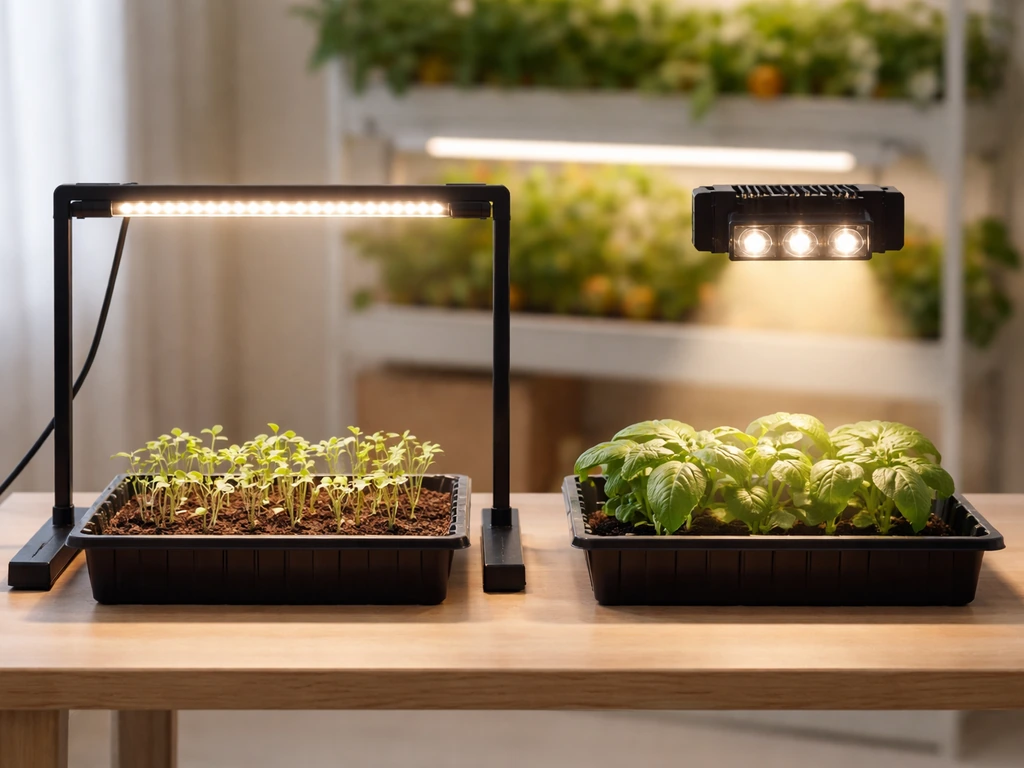
Before you buy a single part, get clear on what you're growing. Seedlings, herbs, and leafy greens have very different light needs than fruiting plants like tomatoes or peppers. Seedlings and clones sit at the low end of the intensity scale, needing roughly under 100 µmol·m⁻²·s⁻¹ PPFD (that's the standard measure of usable light hitting your plants per second). Herbs and leafy greens like basil, lettuce, or spinach do well between 100 and 300 µmol·m⁻²·s⁻¹. Fruiting or flowering plants push into the 400–1,200 range. For a small tabletop setup, herbs, seedlings, and compact houseplants are where DIY LED rigs shine, and that keeps your power requirements modest, usually under 30–40 watts total.
For the light source itself, you have three practical choices at the tabletop scale: LED strip lights, small COB (chip-on-board) modules, and compact quantum board panels. LED strips are the easiest entry point since they're flexible, cheap, and easy to mount in custom shapes. COB modules deliver more concentrated light and are great if you want a single-point source over one or two plants. Quantum board panels are the most efficient and give the most even spread, but they cost more and may be overkill for a single shelf. For most people starting out, a set of full-spectrum LED strips (look for ones with a color temperature of 3500K–5000K and a mix of warm and cool white diodes covering the 400–700 nm PAR band) or a small 20–40W quantum board is the sweet spot.
Spectrum matters more than most people think. Blue-heavy light (roughly 400–500 nm) keeps seedlings and leafy plants compact and discourages leggy, stretched growth. Red-dominant spectrums push flowering and fruiting. For a general-purpose tabletop setup covering herbs, seedlings, and houseplants, a full-spectrum white LED with a decent blue component does the job well without needing to get fancy. If you want to go deeper on building a COB-specific rig or a T5-style frame, those are separate build paths worth looking into on their own.
Parts and equipment checklist
Here's what you actually need to build a functional, safe tabletop grow light. Don't skip the driver or the timer; those two items make the difference between a rig that works reliably and one that burns out your LEDs or fries your plants.
- LED light source: Full-spectrum LED strip (look for 5630 or similar high-output chips, 12V or 24V rated) OR a small quantum board/COB module in the 20–40W range
- Constant-current (CC) LED driver: Match the driver's output current to your LED's rated current and sum the forward voltages if wiring multiple LEDs in series. Mean Well is a reliable, widely available brand. For dimming capability, choose a driver with 0–10V dimming input.
- Dimmer (optional but recommended): A 0–10V analog dimmer like the SR-2015 lets you adjust intensity without changing height. This is the cleanest way to tune PPFD at a fixed mounting distance.
- Timer: A simple mechanical outlet timer works fine. Digital timers give you more precision. This is non-negotiable for proper photoperiod control.
- Mounting hardware: Adjustable hanging rope clips, small pipe clamps, or a simple shelf bracket system. You need to be able to change height easily as plants grow.
- Reflector or reflective material: Even a piece of mylar or white foam board behind and around your strips noticeably improves light distribution and reduces wasted output. You can also build a dedicated reflector hood.
- Heat sink: Required for COB modules and high-power LEDs. Aluminum extrusion heat sinks are cheap and effective. For strip lights under 20W total, passive cooling is usually fine.
- Wiring supplies: UL-listed wire connectors sized for your gauge, 18–20 AWG stranded copper wire for low-current LED connections, and strain relief fittings where wires enter enclosures or exit the driver.
- Thermal fuse or switch (recommended): A thermal cutoff rated just above your expected operating temperature (commonly 70–85°C range) adds a fail-safe if your heat sink gets overloaded.
- Light meter (strongly recommended): A cheap quantum PAR meter or even a smartphone-based lux meter lets you verify you're actually hitting your PPFD targets instead of guessing.
Step-by-step build and safe installation
Step 1: Plan your layout before cutting anything
Measure your grow area first. A typical tabletop setup covers a footprint of 1–2 square feet. Sketch out where your LED strips or panel will go, where the driver will mount (outside the grow area if possible, since drivers generate heat), and how wires will route. If you're using multiple LED strips, plan your series wiring now. With a constant-current driver, LEDs must be wired in series, not in parallel. Parallel wiring with a CC driver causes uneven current distribution and can damage your LEDs or driver.
Step 2: Mount the heat sink and LEDs
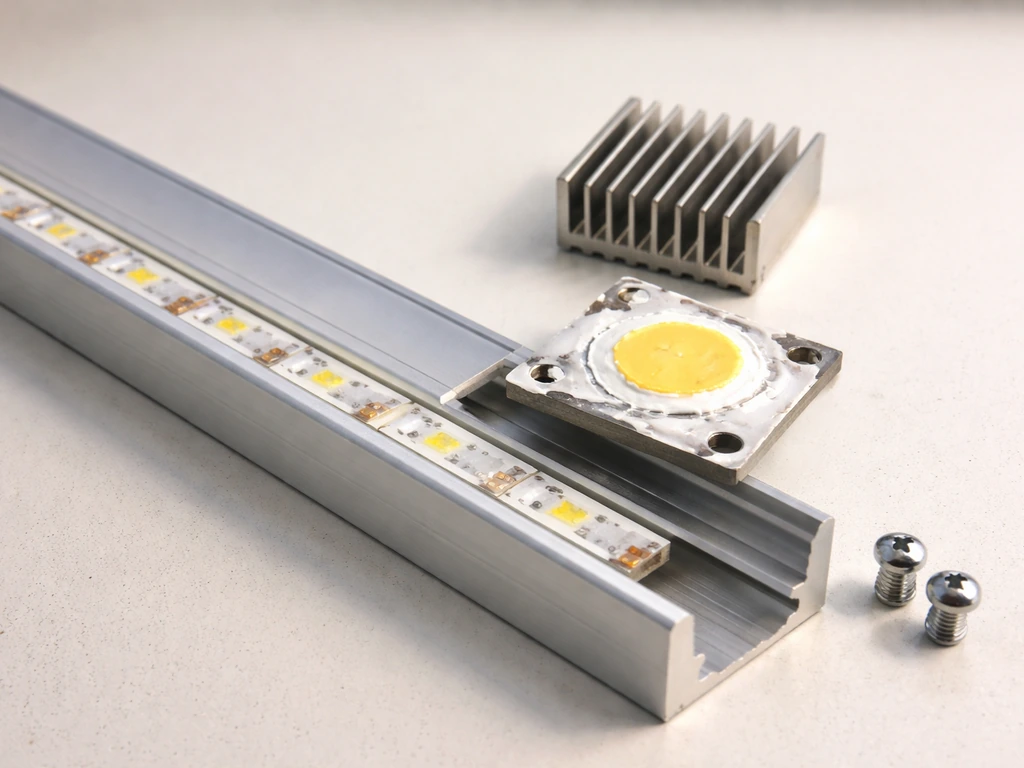
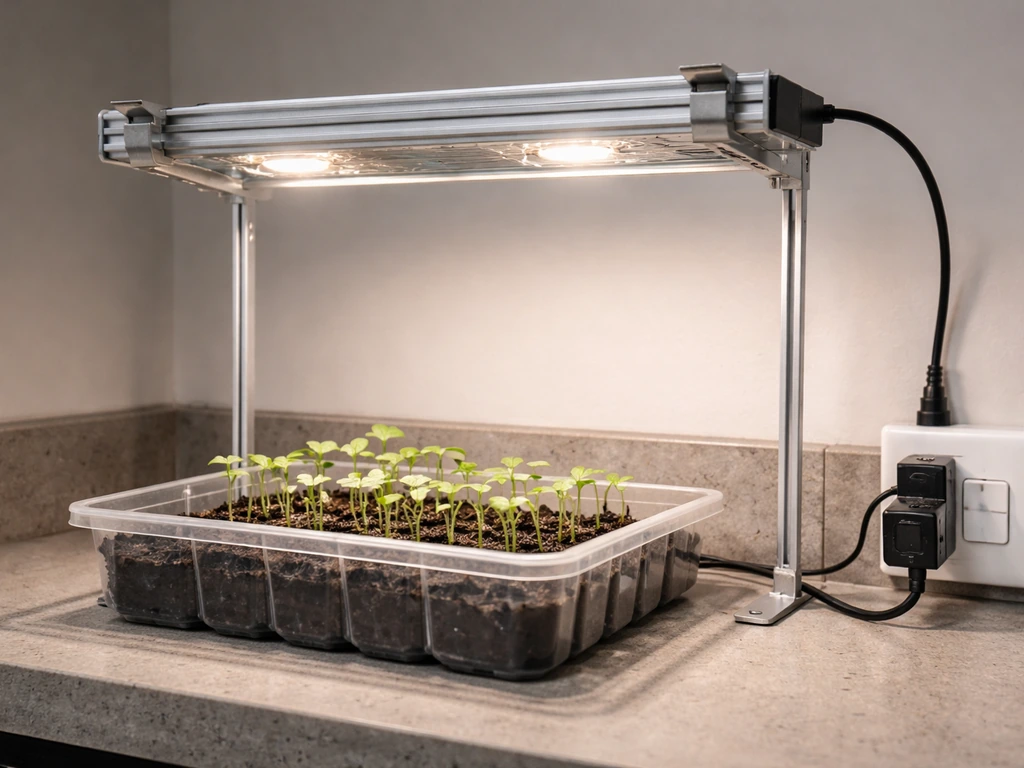
For COB modules, apply thermal paste to the back of the COB and press it firmly onto the heat sink before securing with screws. For LED strips, stick them onto an aluminum channel or extrusion using the adhesive backing, then press the channel firmly to whatever surface you're mounting it to. Aluminum channels act as passive heat sinks for strips and make them look clean. Leave at least 1–2 inches of airflow clearance around heat sinks and the driver casing. Enclosed, poorly ventilated setups are the number one cause of premature driver failure and LED degradation.
Step 3: Wire your LEDs to the driver
Connect your LED series string to the driver's DC output terminals. Use 18–20 AWG stranded wire for low-current LED circuits. Match driver output current to LED rated current, and confirm the driver's output voltage range covers the total forward voltage of your series string (add up each LED's Vf). Tighten terminal screws firmly and add strain relief where wires exit the driver enclosure. Use UL-listed wire connectors sized for your wire gauge at any splices. Do not use twist-and-tape connections inside a DIY grow light rig.
Step 4: Connect AC power and add a timer
The driver's AC input side connects to your wall outlet, ideally through a grounded power strip with surge protection. Plug your power strip into a mechanical or digital timer set to your desired photoperiod. Keep 0–10V dimmer wiring (those two low-voltage DC control wires) completely separate from AC power wiring to avoid interference and safety issues. If your driver has a 0–10V dimming port, wire your dimmer to those terminals now, following the dimmer's wiring diagram exactly. ERP Power's ESP series driver information notes multiple Tri-Mode Dimming options, including 0, 10V dimming for adjusting light output intensity For a driver with a 0–10V dimming port, wire your dimmer to those terminals now.
Step 5: Set mounting height and do a test run
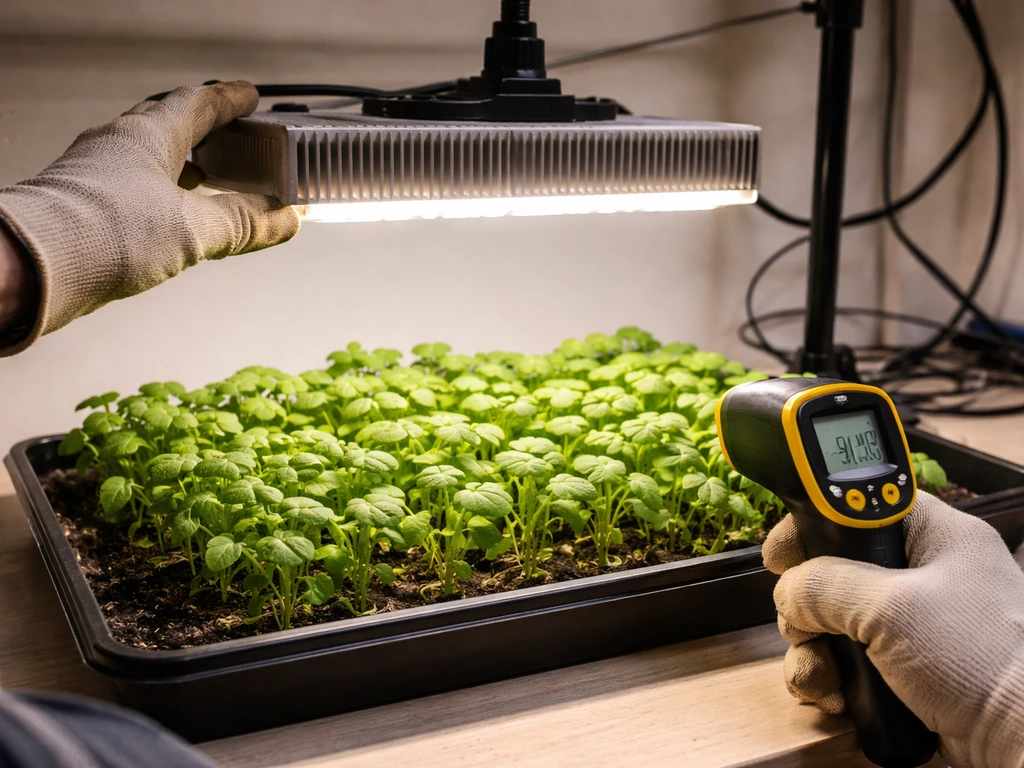
Before plants go under the light, run it for 30–60 minutes and check the heat sink temperature by touch (warm is fine, too hot to hold means inadequate cooling). Verify the driver case stays well below 90°C, which is the maximum safe case temperature for most UL and IEC-rated drivers. If you have a light meter, measure PPFD at your intended canopy height and adjust from there. If the setup runs cool and the light output looks even, you're ready to add plants.
Placement and distance for best results
Getting the height right is probably the single thing most DIY growers get wrong first. Too far away and you get leggy, stretched plants as they reach for light. Too close and leaves bleach, curl, or show stress from heat and photon overload. PPFD drops as you move the light further away, so every inch of distance you add is intensity you're giving up.
| Plant Type | Target PPFD (µmol·m⁻²·s⁻¹) | Recommended Starting Distance | Notes |
|---|---|---|---|
| Seedlings / clones | Under 100 | 10–12 inches | Increase distance if tips look bleached |
| Herbs (basil, mint, parsley) | 100–300 | 6–10 inches | Compact growth; watch for drying out |
| Leafy greens (lettuce, spinach) | 150–300 | 6–10 inches | Tolerant; lower end of PPFD is fine |
| Compact houseplants | 100–250 | 8–12 inches | Most prefer indirect intensity |
| Fruiting/flowering plants | 400–1,200 | 4–8 inches (high-power LEDs) | DIY tabletop setups often underpowered for this |
Start at the upper end of the distance range and work your way down over a few days, watching for plant response. Healthy plants under correct intensity show compact internodal spacing (short gaps between leaf sets on the stem) and deep green color. Leggy plants with long gaps between leaves need more light, either move the light closer or increase intensity via the dimmer. Bleached or curling leaves mean too much light or heat, so raise the light or dial down intensity first before assuming there's a bigger problem.
As seedlings grow taller, raise your light to maintain a consistent distance to the canopy. A lot of DIY setups use adjustable rope clips or a simple hook-and-chain system precisely for this reason. If you can't raise the light, dimming the driver achieves a similar result. The goal is to keep PPFD at the canopy consistent as the plant grows toward the source.
Lighting schedules and intensity tuning
The amount of useful light a plant gets in a day is captured in a number called DLI, or Daily Light Integral, measured in mol·m⁻²·day⁻¹. The formula is simple: DLI = 0.0036 × PPFD × hours of light per day. So if you're running 200 µmol·m⁻²·s⁻¹ PPFD for 16 hours, your DLI is 0.0036 × 200 × 16 = 11.5 mol·m⁻²·day⁻¹. That's a reasonable target for herbs and leafy greens. Seedlings of sun-loving crops often want closer to 12–16 mol·m⁻²·day⁻¹ to develop properly.
For most tabletop setups, 14–16 hours on and 8–10 hours off is a reliable starting photoperiod. This mimics a long summer day and works well for non-photoperiod-sensitive plants like herbs, lettuce, and seedlings. Set your timer the moment you set up the rig and don't change it randomly. Inconsistent photoperiods stress plants more than a slightly wrong schedule that stays consistent.
To tune intensity without moving the light, use your driver's dimming feature. Start at full output, measure PPFD at the canopy with your light meter, and compare to the targets in the table above. If you're over your target range, dial back the dimmer rather than raising the fixture. This keeps the light spread even while reducing intensity. If you don't have a light meter yet, use the plant's physical response as feedback: compact, dark green growth means intensity is good; stretched and pale means increase light; bleached tips or curled leaves mean reduce it.
Troubleshooting common DIY grow light problems
Leggy, stretched plants
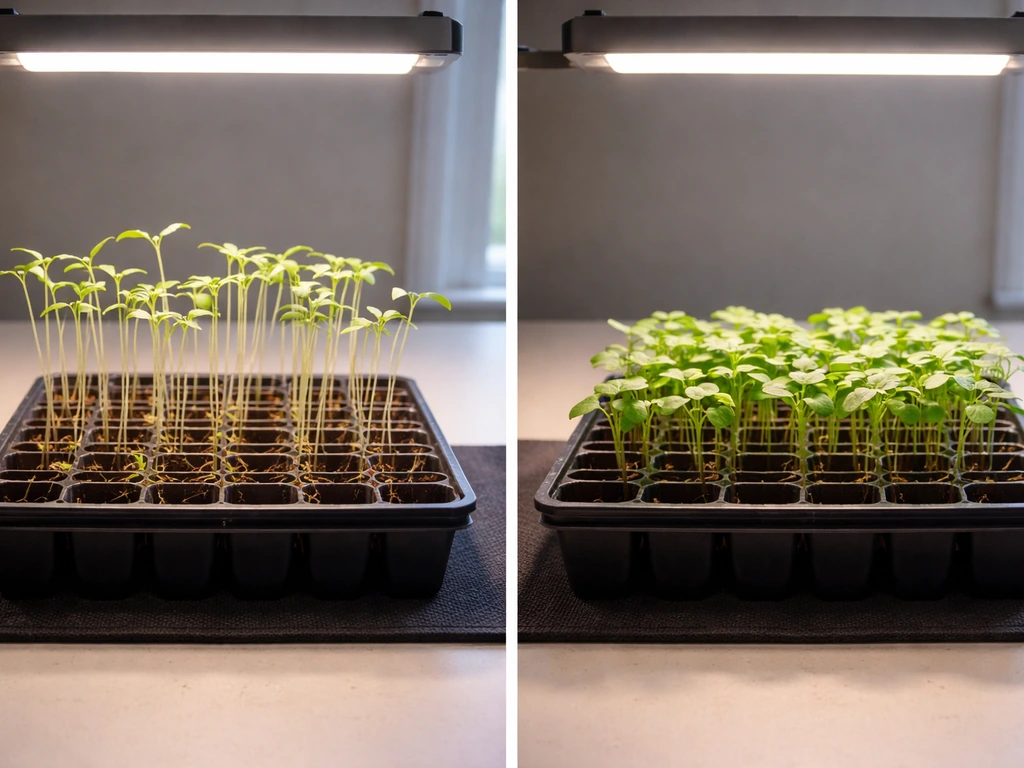
Long internodal spacing almost always means insufficient PPFD at the canopy. Check your distance first: if you're more than 10–12 inches away from seedlings with a modest-output strip setup, that's your problem. Lower the light or increase driver output. Also confirm your photoperiod is actually running at 14–16 hours; a misconfigured timer is a surprisingly common culprit.
Bleached leaves or leaf curl
Bleaching (white or yellow patches on the tops of leaves closest to the light) or downward leaf curl means too much light intensity or heat at the canopy. Raise the light 2–3 inches at a time and wait 48 hours to see if the plant recovers. If you have a dimmer, back it off 20–30%. Also check whether heat from the fixture itself is contributing: hold your hand at canopy height for 30 seconds. If it's uncomfortably warm, your heat management is the real issue.
Overheating driver or heat sink
If the driver case feels very hot or shuts off intermittently, check that it has at least 1–2 inches of clearance on all sides and isn't enclosed in a box without ventilation. Driver case temperature should stay below 90°C. A small 5V USB fan aimed at the driver can make a big difference in a compact setup. If a COB module's heat sink is getting too hot to touch after 30 minutes of operation, your heat sink is undersized for your LED's wattage or isn't making good thermal contact. Re-check your thermal paste application and consider a larger heatsink.
LED flicker or inconsistent output
Flicker usually points to a loose connection, a failing driver, or an incompatible dimmer. Check all terminal connections and tighten any loose screws first. If you added a 0–10V dimmer, confirm it's wired only to the dimming control terminals, not accidentally tied into the AC or DC power circuit. PWM-based dimmers can cause visible flicker at low dimming levels with some drivers; if that's the case, set a minimum dim level of 20–30% or switch to a driver with native 0–10V analog dimming support.
Weak or uneven growth across the tray
Plants at the edges of the light footprint receiving noticeably less light than those in the center is a very common issue with single-point COB setups and short strip runs. Adding a reflector behind and to the sides of your light redirects otherwise wasted output back toward the edges of the canopy. Even white foam board or mylar taped to the back wall of a shelf helps significantly. If the coverage issue is severe, consider spreading multiple shorter LED strip segments across the width of the tray rather than a single center strip.
Timer or scheduling mistakes
Double-check that your timer is set to the correct AM/PM cycle and that it's actually switching on and off at the right times. Mechanical timers can slip over time; check them weekly. If your light is running 24 hours a day because the timer failed or was set wrong, most plants will actually do worse because they need a dark period for proper metabolic function. Reset to 16 hours on, 8 hours off as a safe default if you're unsure what your plants need.
Maintenance and how to improve your setup over time
LED strips and boards lose output gradually over time, typically showing meaningful degradation after 30,000–50,000 hours of operation. For a tabletop setup running 16 hours a day, that's years of useful life. What kills DIY LEDs faster than age is heat. Keep your heat sinks clean (dust them monthly), make sure airflow isn't blocked, and your LEDs will last as long as rated. Wipe LED diffusers or lenses clean every few weeks too; dust accumulation visibly reduces output.
Once your basic setup is running well, the most useful upgrade you can make is adding a cheap quantum PAR meter to your toolkit. Even a budget model gives you real PPFD readings so you can verify you're hitting your targets instead of estimating. From there, you can use the DLI formula to confirm your plants are actually getting the daily photon dose they need, and make small adjustments to photoperiod or intensity rather than guessing. This is how a DIY setup goes from approximate to genuinely dialed in.
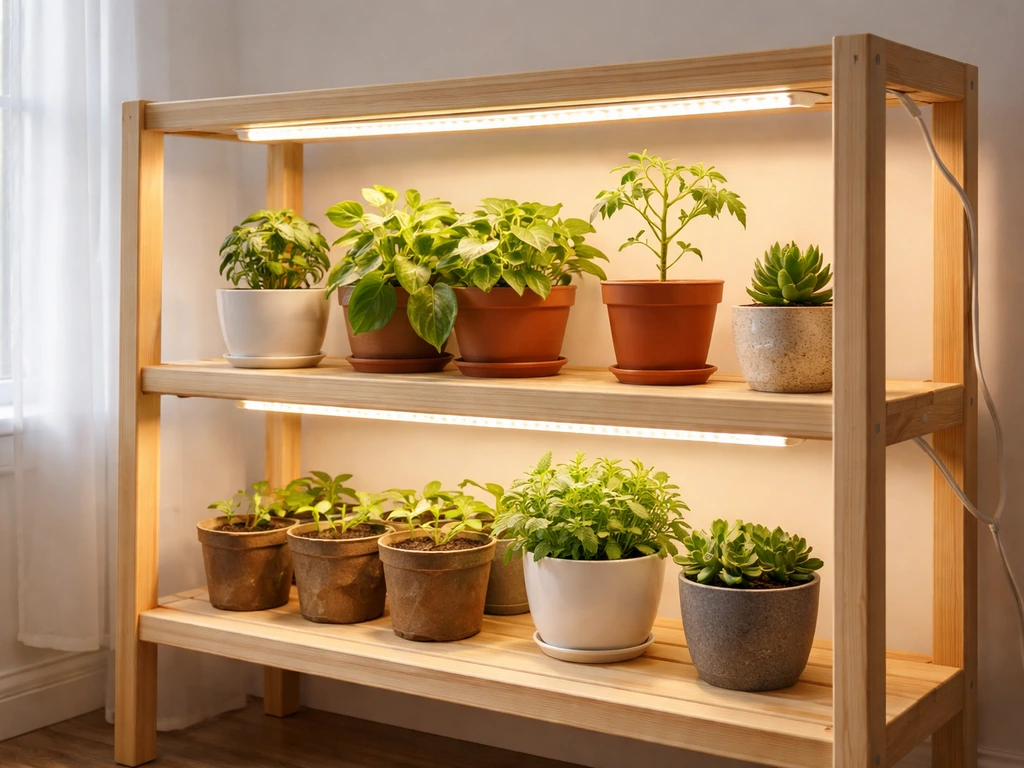
If you find your setup underperforms for the plant types you're growing, the most common upgrade path is increasing wattage (add a second strip run or swap to a larger quantum board), improving your reflector situation, or switching to a driver with better dimming control. If you want to expand beyond a single shelf, building a dedicated plant stand with integrated grow lights is a natural next step that keeps everything organized and lets you scale up without creating a wiring mess. A dedicated plant stand also makes it easier to maintain consistent light height as plants grow, which is key for stable PPFD building a plant stand with integrated grow lights. Improving your reflector design is also worth exploring as a standalone project once you understand how much output you're currently losing to scatter.
Start simple, measure early, and adjust based on what your plants actually show you. FYTECH Systems also provides indicative PPFD targets by crop type, including example ranges for seedlings around ~100, 200 µmol·m²·s and leafy greens around the mid-200s to mid-300s, which you can use when setting your grow-light distance and intensity Start simple, measure early, and adjust based on what your plants actually show you.. A basic LED strip setup on a 16-hour timer at 6–10 inches will outperform expensive setups that are poorly positioned or run on a random schedule. Get the fundamentals right first, then optimize.
FAQ
Can I power my DIY table top grow light directly from a bench power supply or USB instead of a constant-current driver?
For bare LED strips, COBs, or quantum board modules, avoid voltage-only power unless the manufacturer explicitly specifies constant-voltage operation for that exact board. Most DIY grow LEDs are meant for constant-current drivers, using the driver’s rated output current and voltage range to prevent overheating and uneven brightness.
What should I do if my constant-current driver output voltage doesn’t match my LED string when I test it?
Re-check your series wiring and the total forward voltage by summing each LED’s Vf for the LEDs in your string at the intended current. If the driver cannot provide enough headroom within its voltage range, the circuit may not light consistently or may stress components, so you may need fewer LEDs in series or a driver with the correct output voltage window.
How do I safely mount a diy table top grow light on a shelf or inside a small enclosure?
Prioritize ventilation. Leave clearance around the driver and any aluminum heat sink, and avoid trapping heat in a box or under foam that blocks airflow. If you need an enclosure for looks, use it like a reflector with open sides, not a sealed compartment, and consider a small fan aimed at the driver area.
Is a timer enough to protect my plants, or do I need a dimmer plus a timer?
A timer controls photoperiod, but it does not prevent intensity from being too high at canopy height. Many growers get better results by using the timer for on and off, then using the dimmer to tune PPFD to target values. If you have no light meter, use plant response to set intensity and keep the photoperiod fixed.
Why do seedlings get leggy even when the light seems bright?
Most often the light is too far from the canopy or the photoperiod is unintentionally shorter due to a misconfigured timer. If distance and timer are correct, check for hotspotting and uneven coverage, especially with a single center strip or single-point COB setup that leaves corners underlit.
What’s the difference between “full spectrum” and “grow light spectrum” for a tabletop build?
For most tabletop rigs, the key is not a marketing label, it is that your LEDs include enough blue to discourage stretching and enough overall output to reach your PPFD target. You can use a reasonable white LED mix, but confirm it produces usable blue content and that the driver can deliver steady current across the intended wattage.
How can I reduce flicker in my diy table top grow light at low dim levels?
First verify wiring and tighten all terminal connections. If you’re using a dimmer that relies on PWM, some driver-dimmer combinations flicker noticeably. A practical fix is raising the minimum dim setting to 20 to 30 percent, or switching to a driver that supports native analog 0 to 10 V dimming that matches your dimmer type.
Is it safe to use adhesive backing on LED strips directly on plastic or wood?
Yes in some cases, but only if heat can dissipate. Many strip adhesives are not a substitute for thermal design. For better reliability, mount strips onto an aluminum channel (or another heat sink surface), keep airflow around it, and avoid enclosing the strip where heat builds up behind the board or channel.
How often should I clean my diy table top grow light, and does dust really matter?
Dust on LEDs, lenses, and diffusers can meaningfully reduce output. A practical routine is to dust heat sinks monthly, and wipe or clean optical covers every few weeks, especially in dusty rooms, so your PPFD does not slowly drift below target.
Can I run my tabletop grow light 24 hours a day to speed growth?
Not usually. Even if the plants appear to be growing, lack of a dark period can disrupt normal metabolism and increase stress. If you suspect a timer failure, immediately reset to a reasonable default like 16 hours on and 8 hours off, then fine-tune from plant response.
What edge cases should I watch for if my driver trips or shuts off intermittently?
Intermittent shutoffs often point to overheat, insufficient clearance, or a loose connection causing a momentary fault. Confirm the driver case stays well below 90 C, ensure it is not enclosed without airflow, and check terminals and strain relief where wires exit the enclosure.
How do I handle color mismatch, where one side of the canopy looks dimmer or different?
Color and brightness differences can come from uneven coverage and reflector losses. With a COB or a short strip run, add a reflector behind and to the sides to redirect output toward edges, or split into multiple shorter segments spread across the tray width for more uniform coverage.
What’s the fastest way to diagnose “too much light” versus “too much heat”?
Use canopy-height touch testing and a step change. If the canopy feels uncomfortably warm after about 30 seconds, heat likely contributes. For intensity, raise the fixture or reduce dimming, then wait roughly 48 hours to see recovery before changing multiple variables at once.
How to Build a Plant Stand With Grow Lights
Step-by-step DIY plant stand with grow lights: size, spacing, wiring safety, ventilation, setup, schedules, and troubles