To measure grow light intensity accurately, you need to know what you're actually measuring (PPFD, not lux or watts), hold a sensor at canopy level, take readings across a grid of points, and average them. That's the short version. The longer version involves picking the right tool, avoiding a handful of common mistakes that throw off your numbers, and then actually doing something useful with the results, like adjusting height, dimming level, or daily run time. This guide walks through all of it, step by step.
How to Measure Grow Light Intensity: PPFD and Lux Guide
Marcus Tillman
9 Apr 2026
Why intensity measurement matters for indoor plants
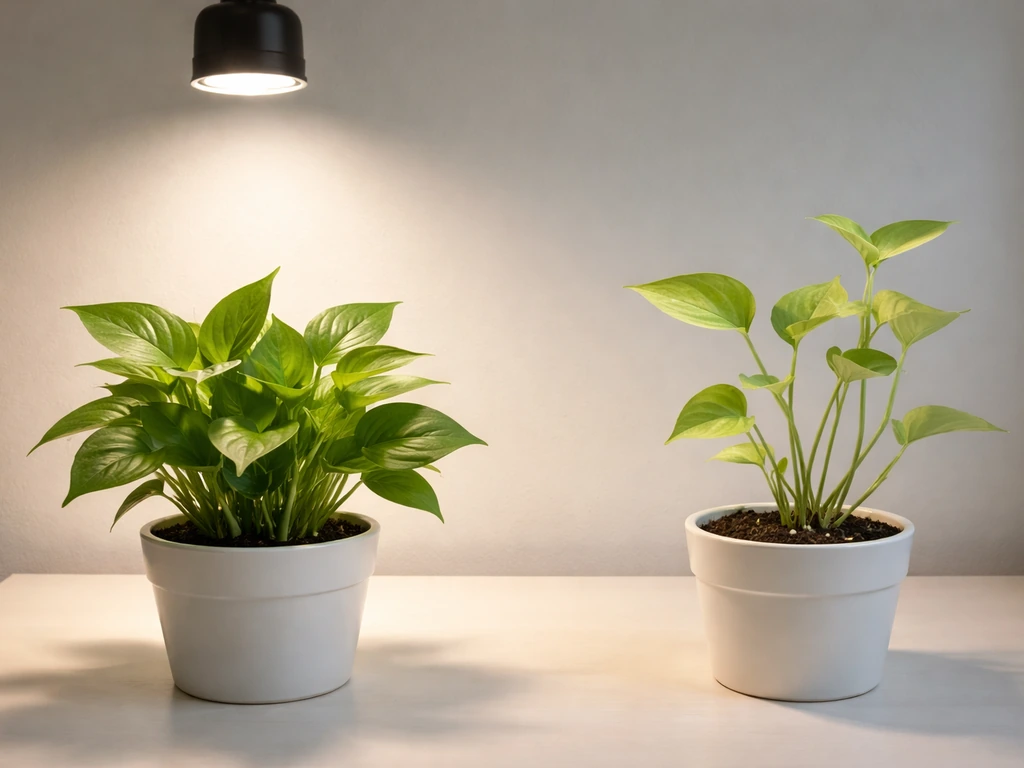
When you grow plants indoors, you're substituting your LED fixture for the sun. The sun delivers a relatively predictable amount of light energy, but your grow light? That depends on the fixture model, its height above the canopy, whether it's dimmed, and how far toward the edges of the coverage area you're looking. Two plants sitting under the same light can be receiving dramatically different amounts of usable photons depending on where exactly they sit. Without measuring, you're flying blind.
Intensity that's too low means slow, stretched, pale growth. Intensity that's too high causes bleaching, tip burn, or heat stress, especially in seedlings. Getting this dialed in isn't just for perfectionists. It's the difference between plants that thrive and plants that limp along. And since LED grow lights vary wildly in output even between models from the same brand, the only way to actually know what your plants are receiving is to measure it.
There's another practical reason to measure: troubleshooting. If your plants aren't responding the way they should despite running the light on schedule, a quick intensity check tells you immediately whether the problem is light-related. If you've ever had a situation where your grow light not working correctly wasn't obvious from just looking at it, you'll know that what seems like normal output can sometimes be far below spec.
What to measure: PPFD vs lux vs watts (and which to use)
This is where most beginners get confused, so let's clear it up fast. There are three numbers you'll encounter when researching grow light intensity: watts, lux, and PPFD. They measure very different things, and only one of them tells you what your plant actually receives.
Watts: how much electricity the light pulls, not how much plants get
Wattage describes electrical power consumption, not photon delivery. A 300W LED and a 300W incandescent bulb consume the same electricity but deliver wildly different amounts of plant-usable light. LED grow lights convert electrical input into photons with varying efficiency depending on the driver, the diodes, the optics, and even the temperature of the room. Watts tell you your electricity bill. They don't tell you what's hitting your canopy.
Lux: how bright it looks to human eyes, not to plants
Lux is a photometric unit calibrated to human vision, specifically the photopic response curve which peaks around 555 nm (green-yellow). Plants photosynthesize across the 400–700 nm band (photosynthetically active radiation, or PAR), and they use red and blue wavelengths heavily, which the human eye is relatively insensitive to. So a blueish LED that plants love can look dimmer to your lux meter than a warm-white LED, even if it's delivering more usable photons. You can't reliably convert a lux reading to a PPFD number without making strong assumptions about the specific light spectrum, which vary fixture to fixture.
PPFD: the number that actually matters
PPFD stands for Photosynthetic Photon Flux Density, measured in micromoles of photons per square meter per second (µmol/m²/s). It measures the photon flux density in the 400–700 nm PAR band striking a surface, which is directly what drives photosynthesis. This is the number you want. Seedlings typically thrive around 200–400 µmol/m²/s, vegetative growth from 400–600, and flowering plants from 600–900+. PPFD is also the basis for calculating DLI (daily light integral), which is a more complete picture of total photon dose per day.
| Unit | What it measures | Plant relevance | Recommendation |
|---|---|---|---|
| PPFD (µmol/m²/s) | Photon flux density in 400–700 nm at a surface | Directly measures what plants use for photosynthesis | Use this — it's the standard |
| Lux (lx) | Light intensity weighted by human vision (~555 nm peak) | Indirect at best; spectrum-dependent conversion | Use only if PPFD meter isn't available |
| Watts (W) | Electrical power consumed by the fixture | No direct relationship to canopy photon delivery | Ignore for intensity decisions |
Tools you can use to measure LED grow light intensity
You have a few options here depending on budget and how precise you need to be. Here's an honest breakdown:
Quantum (PAR) meters: the right tool for the job
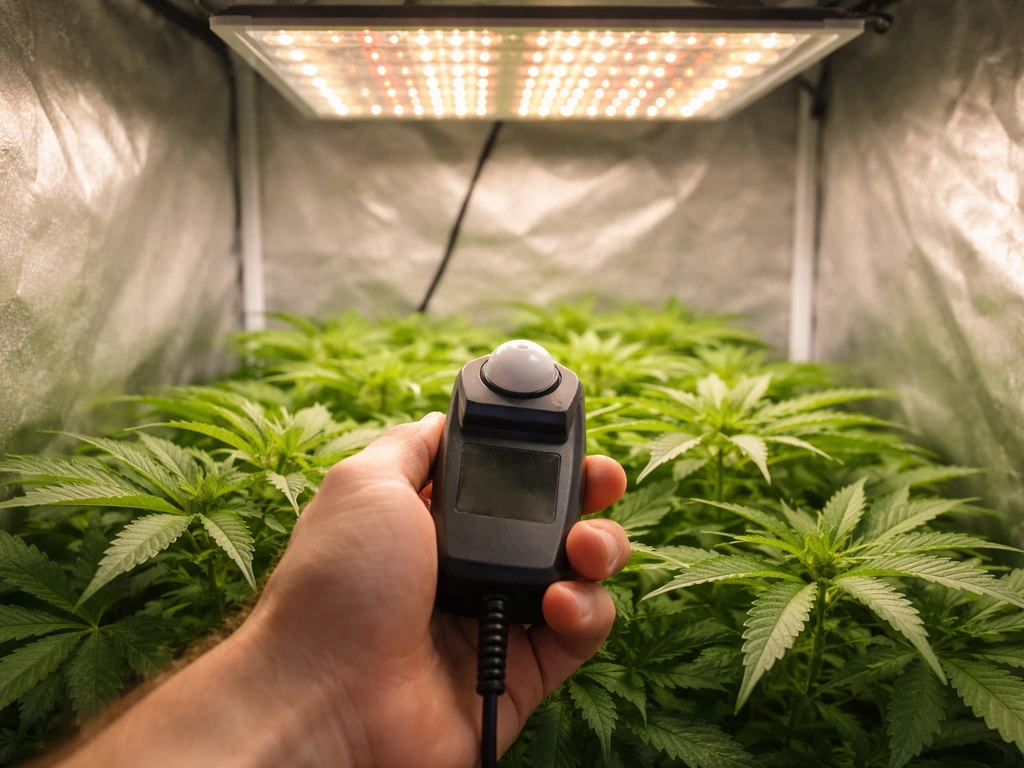
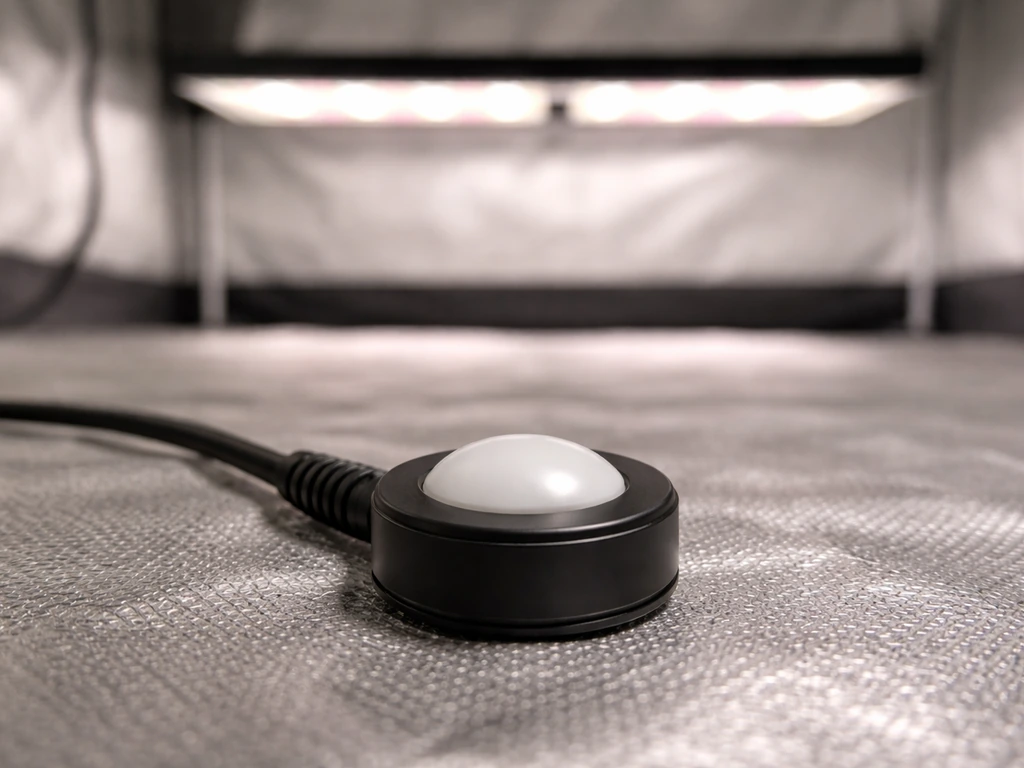
A quantum meter (also called a PAR meter) reads PPFD directly. The sensor is calibrated across the 400–700 nm range with equal weighting for all wavelengths, which is exactly what you need for plant measurements. Apogee and LI-COR make research-grade models that run several hundred to a few thousand dollars. For home growers, the Apogee MQ-500 (around $350–$400) is a popular mid-range choice that works well with LED spectra. If budget is tight, the Photone app (with a full-spectrum diffuser) is a smartphone-based option that many growers use successfully with LEDs, though it's less accurate than a dedicated meter, especially under narrow-spectrum or purple LEDs.
Lux meters: workable with caveats
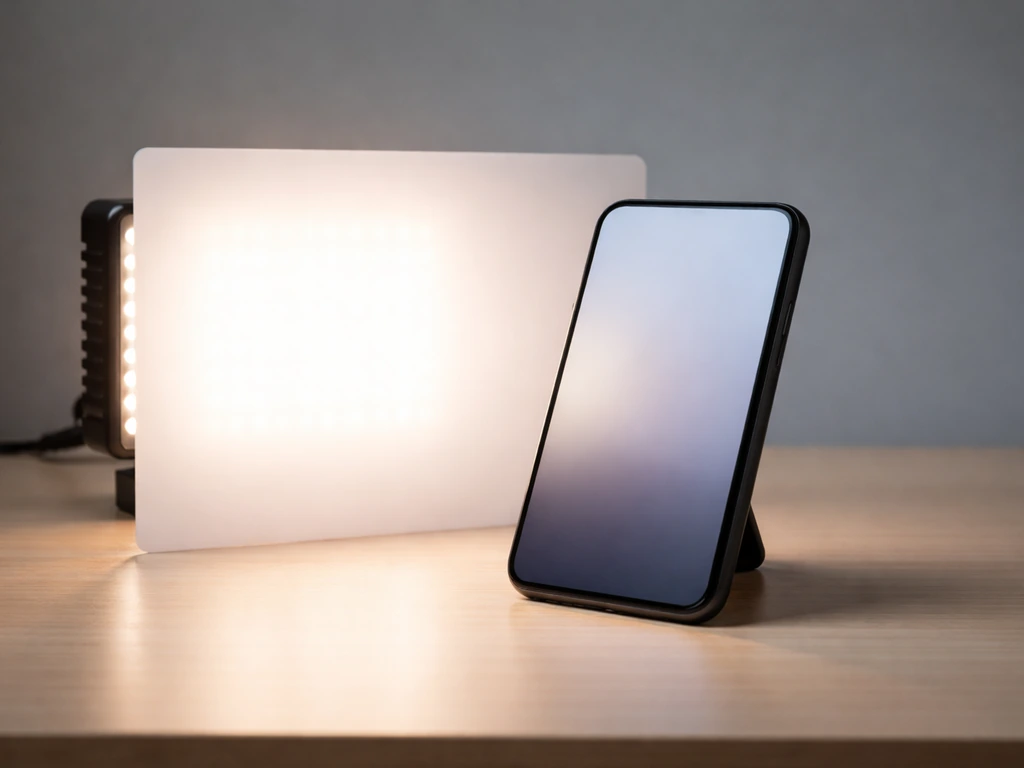
A basic lux meter is inexpensive (under $30 for decent ones) and widely available. The limitation is the conversion to PPFD. For broad-spectrum white LEDs, a rough conversion factor of around 0.013–0.020 µmol/m²/s per lux is sometimes used, but this varies by spectrum. For blurple (red/blue) LEDs, the conversion is completely unreliable because the lux meter barely sees those wavelengths. If you're only working with full-spectrum white LED bars, lux can give you a ballpark. Just don't rely on it for precision targeting.
Smartphone apps
The Photone app uses your phone's ambient light sensor and, with the right diffuser card, provides PPFD estimates that are surprisingly useful for dialing in approximate intensity on white LEDs. It's free to use at a basic level with an upgrade for advanced features. Accuracy varies by phone model and how well you use the diffuser, so treat it as a directional tool rather than a calibrated measurement. It's genuinely useful for comparing relative intensity at different heights or positions under the same fixture.
Manufacturer data and charts
Many reputable LED grow light brands publish PPFD maps for their fixtures at specific hanging heights. If your light came with these charts (or they're available on the manufacturer's website), they're a good starting reference, but they're measured in ideal lab conditions, often without reflective walls. Your actual grow space will differ. Use manufacturer charts as a starting point, then verify with a meter.
Step-by-step: how to measure grow light intensity
Here's the actual process. Follow this and you'll get reliable, repeatable numbers you can act on.
Step 1: Set up your light at the target height
Hang your light at the height you're currently using or planning to test. Keep the dimmer at a fixed setting (100% is easiest to start). If you have a fan or oscillating airflow, turn it off temporarily so nothing moves your sensor. Make sure the light has been running for at least 5–10 minutes first, because LEDs shift slightly as they warm up.
Step 2: Position the sensor at canopy level
Hold or mount your sensor face-up, pointing directly at the light source, at the height of your plant canopy (not at the light itself). If you have plants in the space, measure at the top of the foliage. The sensor must be flat and level, not tilted. Even a 10–15 degree tilt introduces meaningful error because PPFD is measured on a horizontal plane.
Step 3: Map the coverage area with a grid
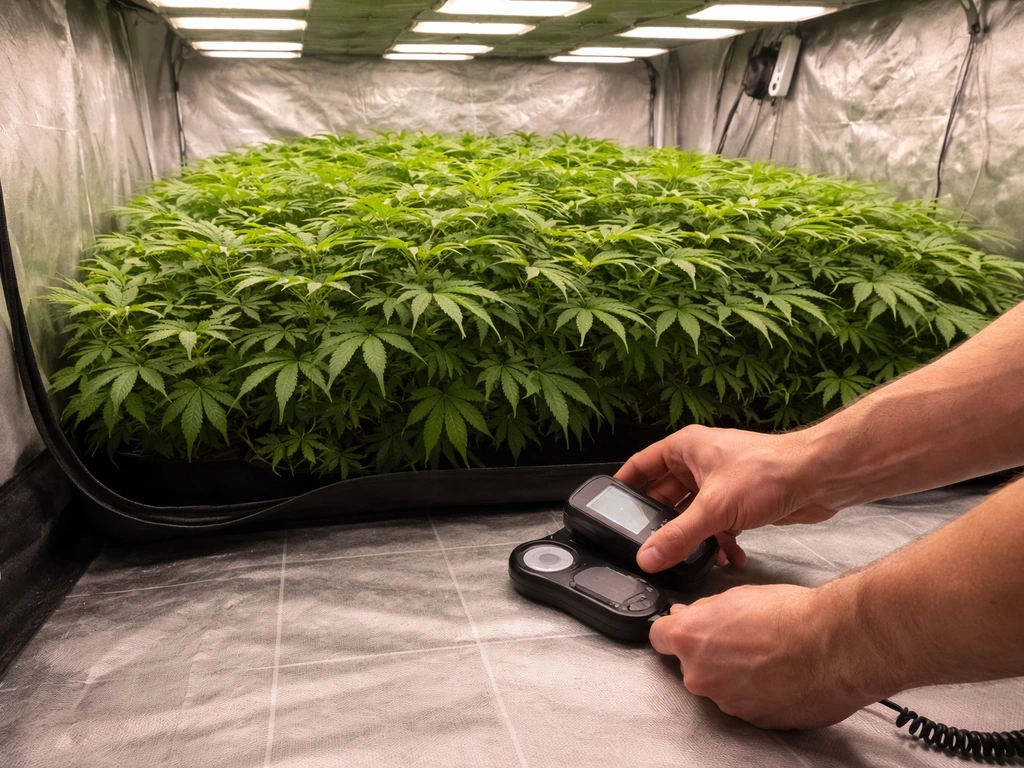
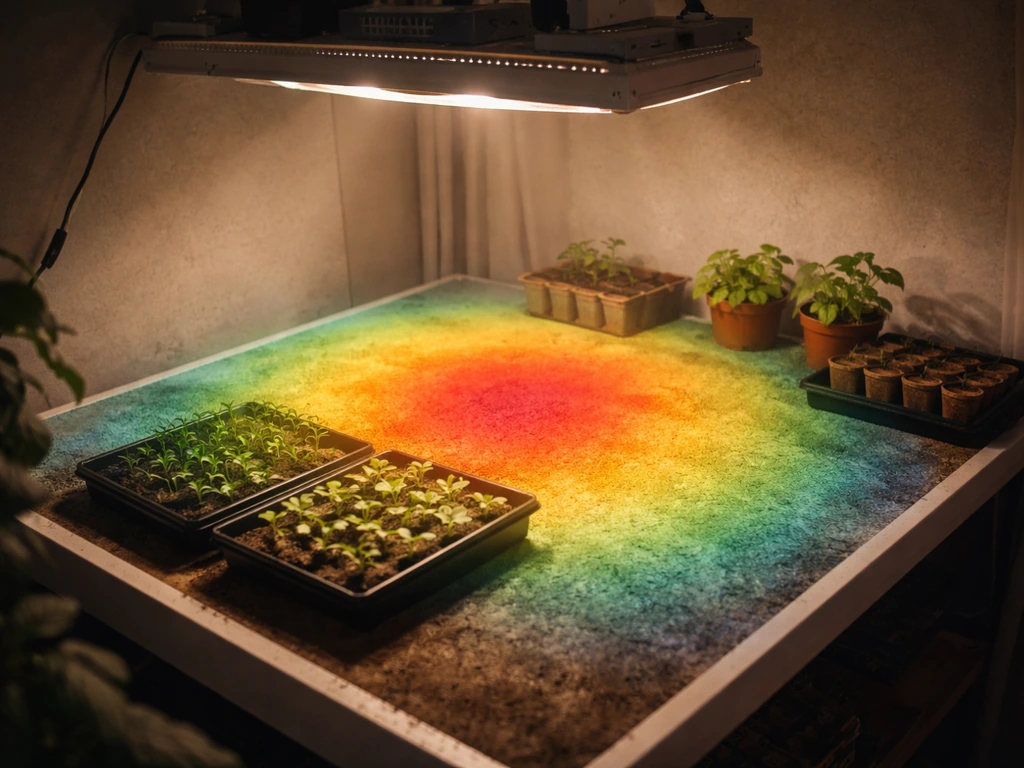
Single-point readings are almost always misleading. Grow lights are brightest directly below the center and fall off significantly toward the edges. To get a real picture, divide your grow area into a grid. For a 2x4 ft space, a 3x5 grid (15 points) works well. For a 4x4, use a 5x5 grid (25 points). Mark the grid on the floor or tent edge with tape, then take a reading at each point, writing down or recording each value. This takes about 10–15 minutes and gives you data you can actually use.
Step 4: Average your readings
Add up all your readings and divide by the number of points. That's your average canopy PPFD. Also note the minimum and maximum readings. A big spread (say, 200 µmol/m²/s in the center and 60 at the corners) tells you the light isn't covering the area evenly, which is useful to know when placing plants or deciding whether you need a second fixture or a wider spread.
Step 5: Log your results
Write down the fixture model, height, dimmer setting, average PPFD, min/max readings, and the date. This log is valuable when you adjust the light and want to compare. It also helps you track output over time, since LED output gradually decreases with age.
Converting and interpreting your readings
Once you have a PPFD number, here's how to put it in context. The table below shows general target ranges for common growth stages. These aren't rigid rules, but they're solid starting points for most leafy greens, herbs, vegetables, and flowering plants.
| Growth Stage | Target PPFD (µmol/m²/s) | Target DLI (mol/m²/day) | Notes |
|---|---|---|---|
| Seedlings / clones | 100–300 | 5–12 | Start low; seedlings are sensitive to high intensity |
| Vegetative growth | 400–600 | 15–25 | Ramp up gradually as plants mature |
| Flowering / fruiting | 600–900 | 25–35 | Higher DLI supports bud and fruit development |
| High-light crops (tomatoes, cannabis) | 800–1200+ | 30–50+ | Requires CO2 supplementation at very high levels |
DLI (Daily Light Integral) gives you the total photon dose per day and is calculated from PPFD using the formula: DLI = 0. 0036 × PPFD × light hours per day. NDSU lighting webinar slides also express the daily light integral relationship as DLI = PPFD × hours × 0. 0036, describing DLI in mol/m²/day derived from PPFD and photoperiod [DLI = 0.
0036 × PPFD × light hours per day](https://www. ndsu. edu/agriculture/sites/default/files/2025-03/Lighting. sixslide.
pdf). So if you're running a light delivering 400 µmol/m²/s for 16 hours, your DLI is 0. 0036 × 400 × 16 = 23 mol/m²/day, which puts you solidly in the vegetative range. This formula lets you trade off intensity and duration: a lower-intensity light can hit the same DLI if it runs longer, within reason.
If you only have a lux reading and need a rough PPFD estimate for full-spectrum white LEDs, divide your lux value by approximately 60–70 to get a ballpark µmol/m²/s figure. For example, 30,000 lux divided by 65 gives roughly 460 µmol/m²/s. This is an approximation, not a precise conversion, and it doesn't work for non-white spectra.
Common mistakes, weird readings, and brand considerations
Even with the right tool, it's easy to get numbers that don't make sense. Here are the most common reasons readings go wrong and how to fix them.
- Tilting the sensor: Even a slight angle causes the sensor to read less than the actual horizontal PPFD. Always keep it perfectly flat and facing the light source.
- Measuring too close to reflective walls: White or Mylar tent walls bounce light back onto the sensor and inflate your readings. Measure in the actual plant zone, not near the edges of a highly reflective tent.
- Not letting the light warm up: Taking readings immediately after turning on the light can give slightly lower values. Wait 5–10 minutes for stable output.
- Using the wrong unit on your meter: Some lux meters have multiple modes. Make sure you're reading lux, not foot-candles (1 foot-candle = 10.76 lux). Easy mistake, very common.
- Measuring at the wrong distance: Light follows the inverse square law, so intensity drops off sharply with distance. A 2-inch measurement error at close range (say, 6 inches from the light) creates a big difference. Always measure at the actual canopy height.
- Assuming manufacturer specs match your setup: PPFD maps from manufacturers are usually measured in open air without reflective walls, with a brand-new fixture. Your actual readings may be higher (reflective tent) or lower (aging LEDs, driver heat throttling).
- Ignoring hot spots: A high center reading doesn't mean your whole canopy is fine. A single-point reading at center can be 3–5x the reading at the corner of a 4x4 tent under a single bar light.
Troubleshooting weird or inconsistent readings
If your readings seem way off from what the manufacturer claims, check the light itself before assuming your meter is wrong. Flickering, partial output, or dimming can all appear as low PPFD readings. Knowing how to know if grow light is working at full capacity is actually a useful diagnostic step before trusting your intensity measurements, because a partially failed fixture will give you valid readings of invalid output.
If you're working with a specific brand and suspect a hardware issue, model-specific quirks matter. For example, if you have a Bell and Howell unit and readings seem low or erratic, the Bell and Howell grow light instructions include dimming and power cycling procedures that can reset output to factory levels and are worth reviewing before concluding your light is underperforming. Similarly, if the fixture shows other signs of malfunction like no output or partial illumination, a dedicated Bell Howell grow light not working troubleshooting guide can help you rule out hardware issues before chalking it up to bad intensity readings.
Using your measurements to set placement, height, and schedule
This is where measurements translate into actual decisions. Once you know your average PPFD at a given height, you can adjust the fixture height to hit your target range. Because light intensity follows the inverse square law, halving the distance roughly quadruples intensity, and doubling the distance drops it to about a quarter. In practice, moving from 24 inches to 18 inches above canopy might increase PPFD by 50–70% depending on the optics of your fixture.
Start with the manufacturer's recommended height, measure, and compare to your target range. If you're running seedlings and measuring 600 µmol/m²/s, raise the light or reduce the dimmer. If you're in veg and measuring 200 µmol/m²/s, lower the light or increase the dimmer level. Adjust in small increments, 2–4 inches at a time, and remeasure.
For coverage area decisions, your grid map is invaluable. If the corners of your 4x4 tent are receiving less than 200 µmol/m²/s while the center is at 800+, you have a coverage problem. Options include raising the light slightly to spread the beam more evenly (at the cost of center intensity), adding a second fixture, or simply keeping your most light-hungry plants at center and shade-tolerant ones toward the edges.
For schedule adjustments, use the DLI formula. If you're targeting 20 mol/m²/day for veg and your PPFD averages 500 µmol/m²/s, you need: 20 ÷ (0.0036 × 500) = 11.1 hours per day. That's a concrete schedule number you can set on your timer. If you raise the light and PPFD drops to 350, recalculate: 20 ÷ (0.0036 × 350) = 15.9 hours. This approach lets you compensate for equipment limitations through run time rather than proximity, which is especially useful for fixtures without dimmers.
If you hit a situation where even at maximum safe proximity your PPFD is too low for flowering plants, that's a signal your fixture may be underpowered for your grow area, not just a placement issue. In that case, refer to your setup guide or a broader troubleshooting resource covering why a grow light not working at expected output might indicate an aging fixture, driver degradation, or simply a light that was never rated for that grow area, even when it appeared to be functioning.
Once you've established your baseline measurements, log them and repeat every 4–6 weeks. LED output decreases over thousands of hours of use, slowly enough that you won't notice by eye but measurably enough to affect plant performance over a full grow season. Regular logging lets you catch gradual output decline early and adjust height or schedule accordingly before it affects your plants.
FAQ
Where exactly should I place the sensor when I’m measuring grow light intensity, on the light or at the plants?
Measure PPFD at the exact height you care about, meaning the top of the canopy (or the potting mix for seedlings if you track from there). If you measure at the light instead of the canopy, you will overestimate delivered intensity and likely dial your fixture too high.
Is one PPFD measurement enough, or do I really need a grid?
Yes. A single reading under the center is easy to misread. If you can, take a grid and calculate average, min, and max, then adjust the light using the average for plant health and min for coverage (corners).
How long should the light warm up, and can temperature or airflow affect my grow light intensity measurements?
Before you take readings, let the fixture stabilize for 5 to 10 minutes and avoid changing dimmer or spectrum settings during the measurement session. Also keep the room conditions consistent (no moving curtains, fans, or reflective objects you can bump), since you can alter readings by changing what the sensor “sees.”
Can I just use lux instead of PPFD to measure grow light intensity?
If your goal is PPFD, you need a PPFD-capable sensor (quantum meter/PAR meter) or an app calibrated with a diffuser for your specific LED type. Lux meters only approximate PPFD for broad white LEDs, and they can be wildly wrong for blurple or narrow-spectrum fixtures.
If I only have a lux reading, what conversion should I use, and how accurate is it?
A common method is to divide lux by about 60 to 70 to estimate PPFD, but treat that as a rough guess only for full-spectrum white LEDs. For dimmable fixtures, take lux at the same dimmer setting you will use long term, because the conversion can drift with spectral changes at different power levels.
My sensor is slightly tilted, will that ruin my PPFD numbers?
Use horizontal orientation. If your sensor is tilted even slightly, PPFD can shift because the measurement assumes a flat surface catching photons. Mount it so the face is parallel to the floor, and double-check with a small level.
What should I do if the center PPFD looks right but the corners are much lower?
It can. If your fixture has hotspots, the center may look acceptable while the edges are too low. For placement decisions, use min readings (or your lowest grid points) to choose whether to add a second fixture, raise/lower the light, or rearrange plant positions.
My PPFD readings are much lower than the manufacturer claims, how do I tell if it’s the light or my meter?
LED output can drop with age, but “low” readings can also come from incorrect dimmer settings, a power supply issue, a partial failure, or the fixture not running at full output. If the measured PPFD does not match spec or fluctuates, troubleshoot output first before concluding your sensor is wrong.
How often should I re-measure, and how can I make my results comparable month to month?
Yes, repeatability depends on consistent setup. Measure at the same canopy height, same fixture height, same dimmer %, and similar grid spacing every time, then log average and min. That makes it much easier to tell whether the change is due to plant growth or real light output decline.
What does it mean if I’m still too low even at my closest safe light height?
If your measured PPFD is too low at maximum reasonable proximity for seedlings or flowering, you may be underpowered for your grow area or you need additional fixtures or better optics. Keep your adjustments within safety limits for heat and fixture design, and use the grid map to decide whether adding coverage is better than raising center intensity.
How do I correctly use my PPFD measurements to calculate DLI?
When calculating DLI from PPFD, confirm you are using the same PPFD average you measured (often grid average) and the same daily light hours you plan to run. If you change intensity and keep the same schedule, DLI changes immediately, so recalculate instead of assuming it stays constant.
Should I set my timer based on PPFD or based on a growth-stage schedule?
For schedule planning, target DLI first, then solve for run time using your measured average PPFD. This avoids guessing based on wattage, and it also accounts for your real distance, dimmer setting, and room setup rather than label specs.
Do I need to measure PPFD at multiple dimmer settings?
Yes, especially for dimmable fixtures. If you have a dimmer, measure at the dimmer levels you actually plan to use, then log those PPFD results. Many people measure at 100% once and later assume lower dim settings scale proportionally, which is not always true.
Next Article
Bell and Howell Grow Light Instructions Setup and Use
Bell and Howell grow light setup and use: placement, distance, intensity, schedule, pros/cons, maintenance, troubleshoot