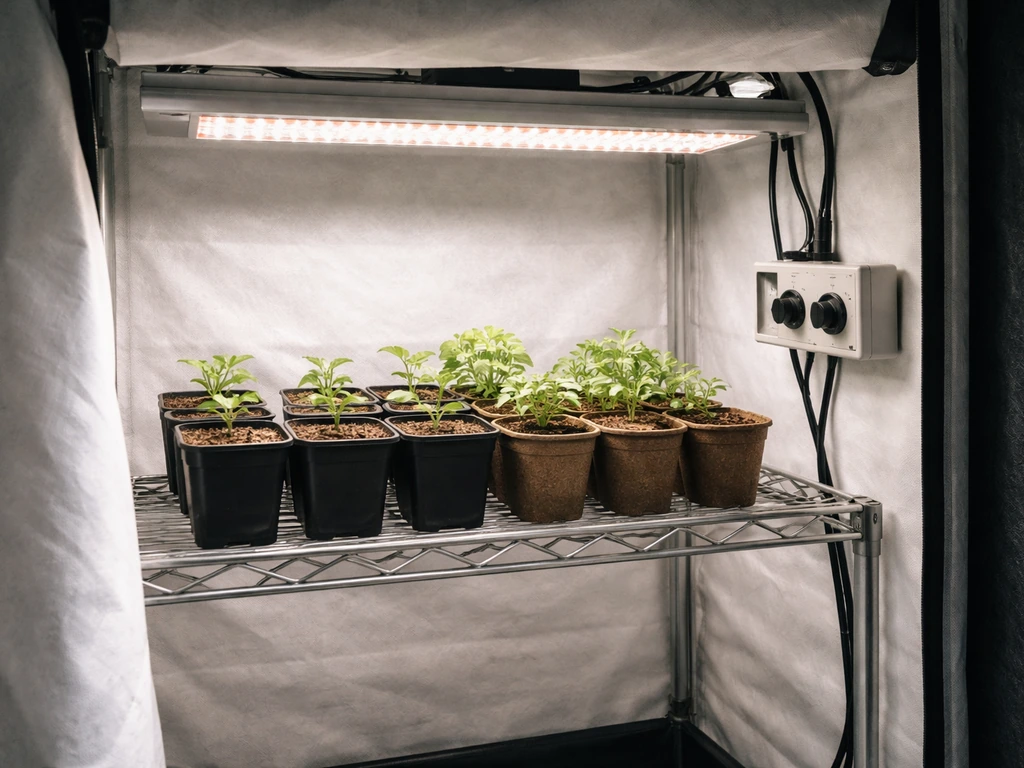
A grow light is an electric light source designed specifically to support or replace natural sunlight for plants growing indoors. That sounds simple, but the key word is "designed", a grow light is not just any bright bulb. It emits light in the wavelengths plants actually use for photosynthesis and development, primarily in the 400–700 nm range known as PAR (Photosynthetically Active Radiation). A regular incandescent or household LED might look bright to your eyes, but it is often optimized for human vision, not plant biology. Grow lights are built around what plants need, which is a very different target.
Grow Light Explained: Definition, Types, and Setup
Marcus Tillman
9 Apr 2026
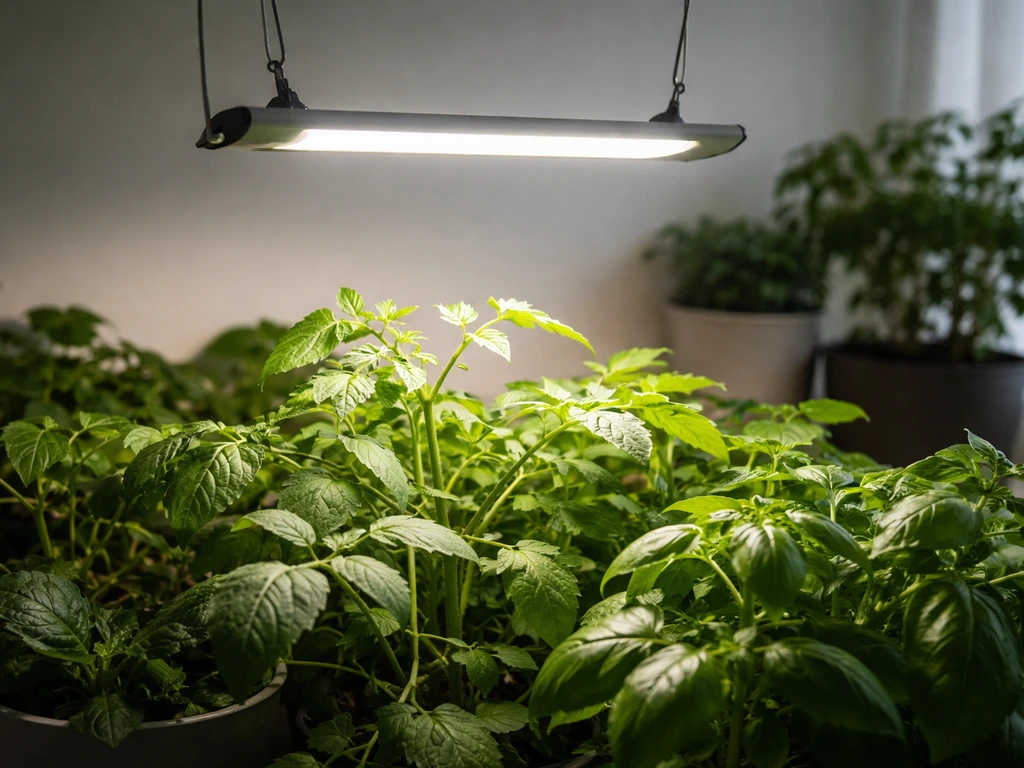
What a grow light actually means (and why it matters)
The formal definition from horticultural lighting standards frames the job this way: deliver the right amount of light, with an appropriate spectral power distribution, to the target plant, at the right time. That three-part definition is worth unpacking because it shapes every decision you will make when buying, placing, and scheduling a grow light.
The "right amount" refers to photon delivery, not just brightness. The "appropriate spectrum" means the light has to hit wavelengths in the PAR range (400–700 nm), with blue (400–500 nm) and red (600–700 nm) being the most effective for photosynthesis because that is where your plant's photosynthetic pigments absorb most efficiently. And "the right time" means photoperiod, how many hours per day your plants receive that light, matters just as much as intensity. A grow light that nails all three is doing its job. A random bright bulb usually misses at least one.
Grow lights also influence more than just photosynthesis. Plants use light for photomorphogenesis, the light-driven developmental process that controls things like stem thickness, leaf shape, and flowering. Blue, red, and far-red wavelengths each trigger different photoreceptor systems in the plant. This is why spectrum is not just a marketing buzzword; it genuinely shapes how your plant grows, not just whether it survives.
How plants actually use light (and why regular bulbs fall short)
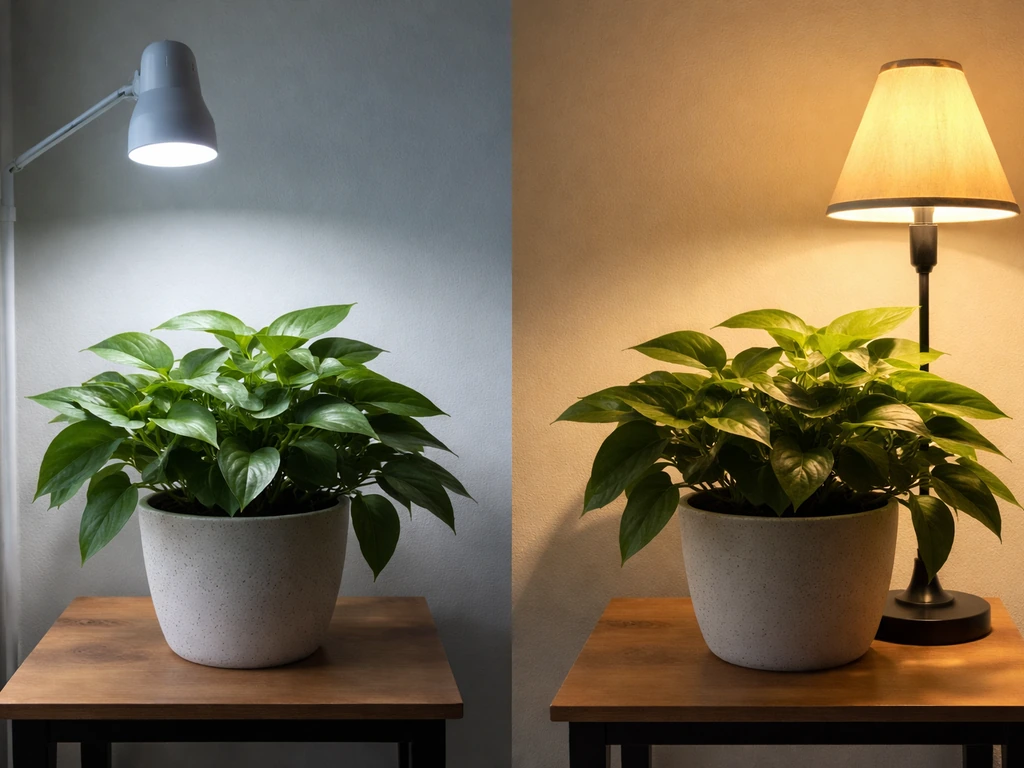
Plants use light as the energy source for photosynthesis, converting CO2 and water into sugars. But what matters physiologically is not brightness in the human sense, it is the number of photons landing on the leaf surface within the PAR range. This is why grow light performance is measured in PPFD (Photosynthetic Photon Flux Density), expressed in µmol·m⁻²·s⁻¹, rather than lumens or watts. Lumens measure brightness as humans perceive it. PPFD measures photon delivery as plants use it. Those are completely different things, and confusing them is one of the most common beginner mistakes.
The daily total of those photons is called DLI, or Daily Light Integral. DLI is measured in mol·m⁻²·day⁻¹ and represents the total photon dose your plant receives over a full day.
Think of PPFD as the flow rate (how many photons per second) and DLI as the tank being filled (total photons accumulated by end of day). Both numbers matter. A high PPFD run for only four hours might give you the same DLI as a moderate PPFD run for ten hours. Understanding that relationship is what lets you schedule your lights intelligently.
For context, a planning example from MU Extension uses a target PPFD of around 510 µmol/m²/s with a target DLI of about 16 mol/m²/day for full indoor production systems.
Types of grow lights and which one to choose
There are four main grow light technologies most home growers encounter. Here is an honest comparison of the tradeoffs, because the right choice depends on your setup, not just what is cheapest.
| Type | Best For | Heat Output | Efficiency | Cost |
|---|---|---|---|---|
| LED (full-spectrum) | Most indoor setups, seedlings, houseplants, herbs | Low | High (best efficacy) | Medium to high upfront, low running cost |
| CFL (compact fluorescent) | Seedlings, clones, low-light houseplants | Low to medium | Moderate | Low upfront |
| T5 Fluorescent | Seedlings, propagation trays, low shelves | Low | Moderate | Low to medium |
| HID (HPS/MH) | Large spaces, serious production | High | Moderate (older tech) | Medium upfront, higher running cost |
LEDs are now the most practical choice for the vast majority of home growers. They are considered the fourth-generation horticultural lighting technology, and modern full-spectrum LEDs deliver PAR efficiently across both the blue and red bands that plants use most. They run cool, last longer, and give you a lot of control over intensity. If you are just getting started, a quality full-spectrum LED panel is the safest, most versatile investment. You can find solid LED grow light guidance to help narrow down specific fixture options once you know your space size.
CFLs are a legitimate budget option for seedlings and small houseplants, especially if you are just starting out and not ready to commit to a larger setup. They work, but they lose efficiency quickly as you scale up. If you want a deeper look at where they still make sense, a solid CFL grow lights guide can walk you through the scenarios where they genuinely hold their own.
HID lights (high-pressure sodium and metal halide) produce a lot of heat and use more electricity, which adds up fast in a home setup. They are still used in larger production environments but are increasingly being replaced by LEDs. Unless you already have HID infrastructure or are managing a large grow room, they are hard to justify for most home growers starting today.
Key specs that actually matter when buying
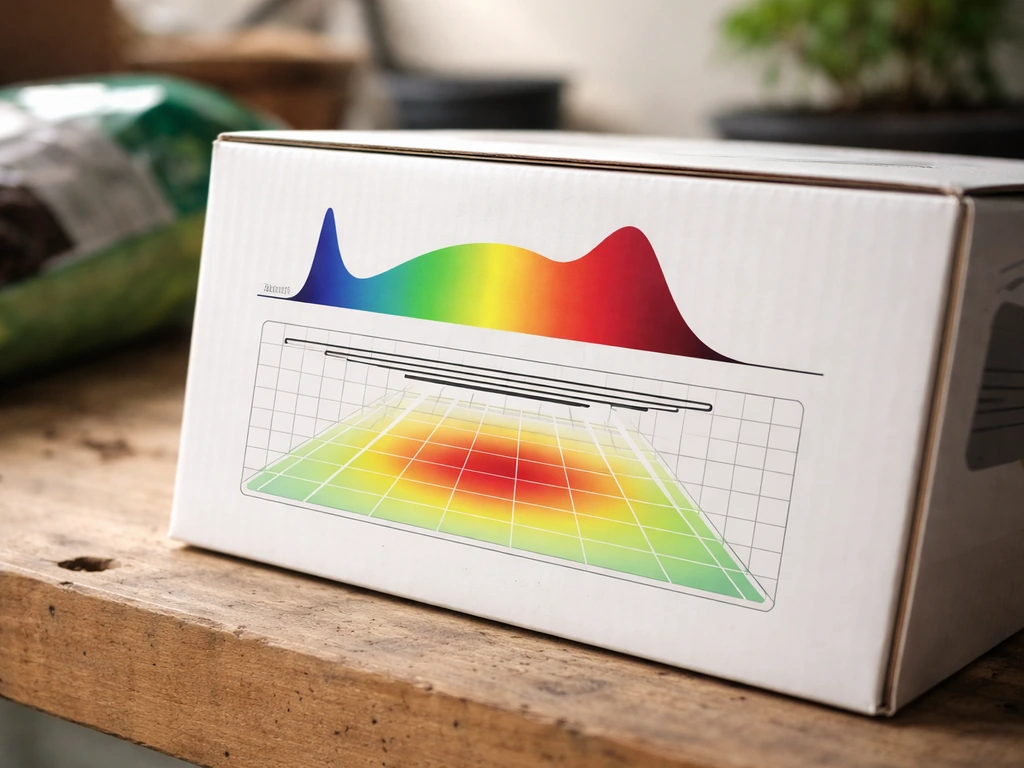
When you are shopping for a grow light, ignore the watt claims on the box as your primary guide. Watts tell you how much power the light consumes, not how much plant-useful light it produces. The specs that actually matter are spectrum, PPFD output, coverage area, and efficacy.
- Spectrum: Check for a spectrum graph. You want the light to emit radiation in the PAR range (400–700 nm), with meaningful output in both blue (400–500 nm) and red (600–700 nm). Some lights also include far-red (~700–750 nm) for flowering support. If a manufacturer will not show you a spectrum graph, that is a red flag.
- PPFD output at distance: Look for PPFD values (in µmol·m⁻²·s⁻¹) reported at specific distances from the fixture. A light that gives 800 µmol/m²/s at 12 inches will not give the same number at 24 inches — the intensity drops significantly with distance.
- Coverage area: Most manufacturers list a recommended coverage footprint. Be realistic about whether a 2x2 ft coverage fixture will actually cover your 3x3 ft seedling tray evenly.
- Efficacy (µmol/J): This tells you how efficiently the light converts electrical power into plant-useful photons. Higher is better. Top-tier LEDs now exceed 2.5 µmol/J.
- Uniformity: A good fixture delivers consistent PPFD across the whole coverage area, not just a hot spot in the center. Check if the manufacturer provides a PPFD distribution map.
One practical tip: if you want to verify what your light is actually delivering after you set it up, you need a PAR meter (also called a PPFD meter or quantum sensor). You cannot measure plant-useful light with a regular lux meter. Tools like those from Apogee Instruments are the professional standard, though they are an investment. For most home growers, even a basic PAR meter app on your phone (used as a rough guide) is better than guessing. The broader grow lights guide covers how to evaluate light output and what to do with those numbers once you have them.
Placement, height, and coverage setup
Where you hang the light matters as much as which light you buy. The relationship between fixture height and PPFD at the canopy follows something close to an inverse-square pattern in open-air conditions: double the distance, and you roughly quarter the light intensity. In practice, walls and reflective surfaces in a grow tent or cabinet complicate that math, but the principle holds, lower is more intense, higher is more diffuse.
Start by following the manufacturer's recommended hang height for your target PPFD range, then adjust based on how your plants respond. A general starting framework:
- Seedlings and clones: 24–36 inches above the canopy, targeting PPFD below 200 µmol/m²/s. Young plants are sensitive and can bleach or stall under intense light.
- Vegetative growth (herbs, leafy greens, most houseplants): 18–24 inches, targeting PPFD in the 200–600 µmol/m²/s range depending on plant type.
- Flowering and fruiting plants: 12–18 inches for high-light crops, PPFD 600–1000+ µmol/m²/s depending on the species.
- Low-light houseplants (pothos, snake plants, peace lilies): even modest PPFD in the 50–150 µmol/m²/s range is often sufficient.
Coverage uniformity is something a lot of beginners overlook. If you have a single fixture over a wide tray, the edges will always receive less light than the center. Rotating your plants weekly is a simple fix that makes a real difference. If you are setting up a more permanent installation, consider using two smaller fixtures rather than one large one, it dramatically improves edge-to-center uniformity. For a more detailed walkthrough of the whole setup process, the indoor grow light guide covers fixture layout and room setup in detail.
Light timing and duration: seedlings vs houseplants
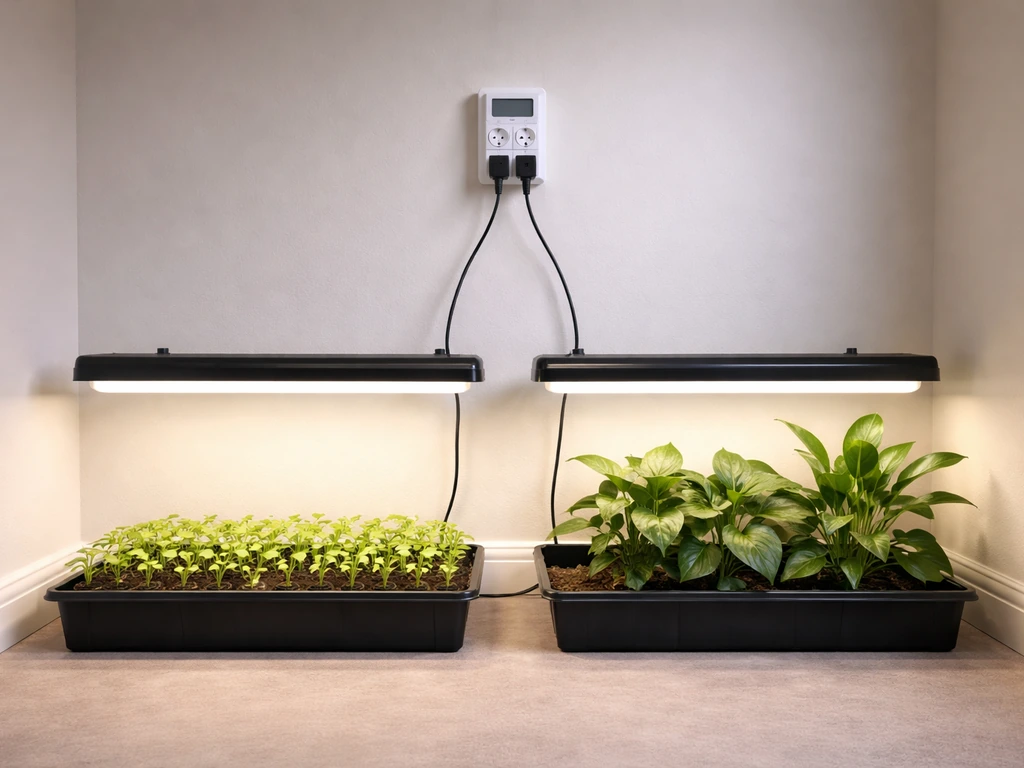
Photoperiod, how many hours per day your light runs, directly controls DLI. Since DLI is what actually determines whether your plants are getting enough daily photon dose, you need to match your timer schedule to your plants' needs, not just run the light "as much as possible."
UNH Extension uses a target DLI of around 12 mol/m²/day for seedlings as a practical planning benchmark. At a modest PPFD of 200 µmol/m²/s, you would need about 16–17 hours of light per day to hit that DLI. At 400 µmol/m²/s, you could cut that to about 8 hours. That is the math behind building a light schedule: pick your PPFD, calculate how many hours you need to reach your target DLI, then set your timer.
Here are practical timing starting points by plant type:
| Plant Type | Daily Light Hours | Target DLI (mol/m²/day) | Notes |
|---|---|---|---|
| Seedlings / clones | 14–18 hrs | 10–14 | Use lower PPFD (under 200 µmol/m²/s) and longer duration |
| Leafy greens / herbs | 14–16 hrs | 14–20 | Moderate PPFD works well; consistent schedule important |
| Fruiting plants (tomatoes, peppers) | 16–18 hrs | 20–30 | Need high PPFD + longer duration or both |
| Houseplants (medium light) | 12–14 hrs | 8–12 | Many tolerate lower DLI; watch for stretching as a sign of too little |
| Low-light houseplants | 10–12 hrs | 4–8 | More is not always better here; these plants adapted to shade |
One scheduling tip: if your plants also receive some natural window light, factor that in. Running your grow light during the morning and evening hours (when natural light is low) rather than overlapping with peak midday sun avoids accidentally overdosing your plants on DLI. For more detailed scheduling strategies across different setups, the LED grow lights FAQ addresses a lot of the timing questions that come up in practice.
Also note that some plants are photoperiod-sensitive, meaning the length of the dark period (not just light) triggers flowering. Keeping those plants on an 18-hour schedule when they need 12 hours of darkness to flower is a common mistake that will keep them in a permanent vegetative state.
Troubleshooting common grow light problems
Most grow light problems fall into one of three categories: not enough light, too much light, or wrong spectrum. Here is how to diagnose each.
Not enough light
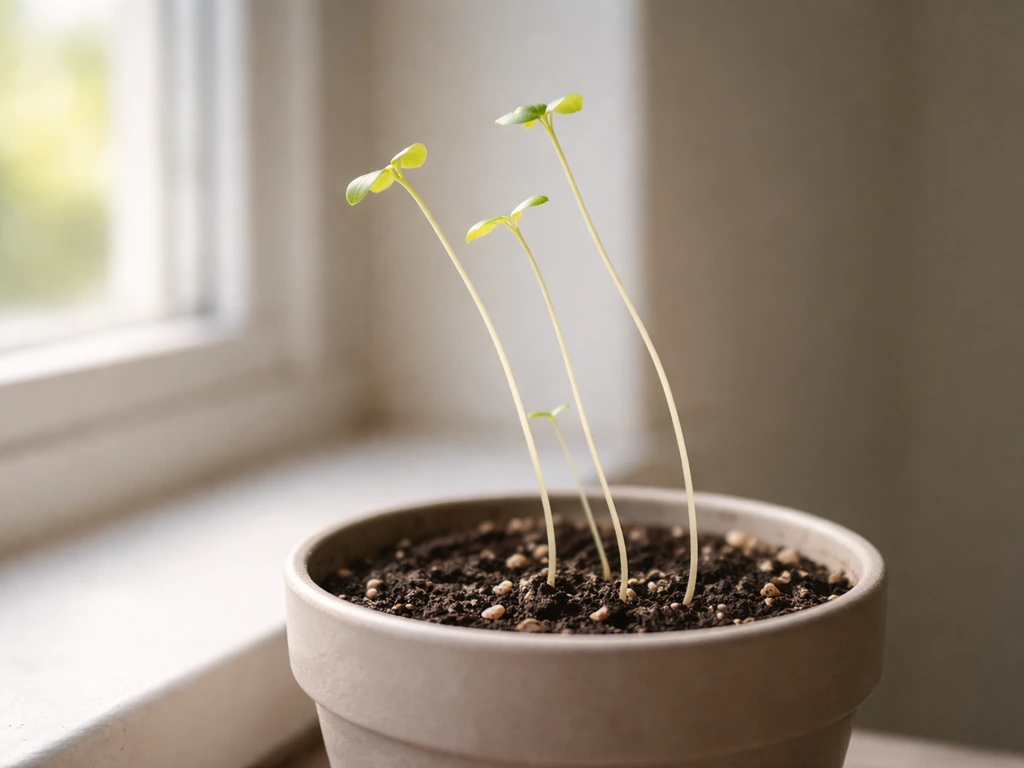
The classic symptom is etiolation, your plant is stretching upward with long, weak stems and widely spaced leaves, essentially reaching toward the light source. Seedlings become leggy. Houseplants lose their compact form. This happens when PPFD is too low or the daily light duration is too short to accumulate enough DLI. Fix: lower the fixture, increase run time, or upgrade to a higher-output light. Etiolation is reversible, once you correct the light levels, new growth will come in compact and healthy.
Too much light
Excessive PPFD causes photoinhibition, where the plant's photosynthetic machinery gets overwhelmed and damaged. Symptoms include bleached or pale patches on leaves (especially near the top of the canopy), leaf curl or cupping, and stunted growth despite seemingly good conditions. This is more common when growers hang lights too close, especially with powerful LEDs. Virginia Tech notes explicitly that PPFD can damage some plant leaves when excessive, and that how much is "too much" depends on both the light source and the distance. Fix: raise the fixture or reduce run time to bring DLI back into a safe range for your plant type.
Wrong spectrum
If you are using a regular household bulb or a cheap "grow light" that does not actually emit in the PAR range, your plant may look like it is getting light while receiving almost no photosynthetically useful photons. The plant will struggle even under a bright-looking fixture. Fix: check the spectrum graph of your light.
If your current bulb does not show meaningful output in the 400–500 nm and 600–700 nm bands, it is not doing the job regardless of how bright it looks. Switching to a full-spectrum LED or even a quality CFL designed for plant growth will produce visible improvement within a week or two.
The LED grow light basics article is a good next read if you are navigating spectrum claims and trying to figure out what full-spectrum actually means on a product label.
Uneven growth across a tray
If plants at the edges of your tray are leggy while plants in the center look healthy, you have a uniformity problem. The fixture is delivering good PPFD in the center and much less at the edges. Solutions: raise the fixture slightly (wider spread but lower peak intensity), add a second fixture, use reflective walls or a grow tent to bounce light back inward, or rotate plants weekly. For practical tips on getting consistent results from your fixture, LED grow light tips covers several layout and optimization strategies that apply regardless of brand.
Light is running but plants are not responding
Sometimes the problem is not the light at all. Remember that light is only one variable, soil, watering, temperature, and humidity all interact with how plants use the photons they receive. If you have verified your PPFD, spectrum, and DLI look right for your plant type but growth is still poor, look at root health, drainage, and whether nighttime temperatures are dropping too low. A comprehensive overview of how all these pieces fit together is available in the indoor grow light guide, but once you rule out the light itself as the culprit, that is your signal to start investigating the other environmental factors.
FAQ
If my grow light is “PAR compliant,” do I still need PPFD or DLI numbers?
Not exactly. PPFD tells you photon intensity at a specific spot on your plant canopy, while PAR is a wavelength range. You typically need PPFD (or DLI after you time it) to know whether your plants are receiving enough plant-useful light for growth.
How can I tell whether a “full-spectrum” grow light actually covers the wavelengths plants use most?
No. “Full-spectrum” can still be unhelpful if it lacks meaningful output in the 400 to 500 nm (blue) and 600 to 700 nm (red) bands. Look for a stated spectrum or spectrum graph, and confirm the fixture’s PPFD/efficacy performance rather than relying on label wording alone.
Can I run my grow light 24/7 to speed up growth?
Most plant setups do not need 24 hours of light. Continuous lighting can overdrive DLI and stress some plants, and photoperiod-sensitive species require an actual dark period to trigger flowering. Use a timer and match both daily dose (DLI) and the required light-dark cycle for the plant.
What’s the best way to confirm my light output if I do not own a PPFD meter?
A phone photo or “brightness” impression is unreliable because cameras and apps do not directly measure photon flux in PAR. If you use an app as a rough check, treat it as a sanity test only, then verify with a real PPFD meter when you are making final decisions about hang height and schedule.
What should I do if I suspect my LED is too intense?
To reduce leaf burn risk, start at a height that yields your target PPFD at the canopy, then make adjustments gradually over several days. If your plants show cupping or bleaching, raise the fixture or shorten the photoperiod, and recheck PPFD at canopy height after changes.
Do I need to adjust the light if my plants are different sizes in the same tray?
Yes, especially if your plants are at different heights. Measure or estimate PPFD at the actual leaf height for the tallest and shortest plants, or group plants with similar height under the same fixture. Otherwise, the top gets overloaded while the bottom may still be light-limited.
My center plants look fine but the edges are leggy. Is that a spectrum or a layout issue?
Look for light coverage uniformity, not just average output. A common pattern is healthy centers with weak edges, which indicates your fixture spread does not match your growing area. Using multiple smaller fixtures or repositioning/rotating plants can correct edge-to-center differences.
I adjusted hang height and the timer, but growth still stalls. What should I check next?
If your plants are not responding, the fix is not always “more light.” First confirm spectrum and PPFD at canopy height, then check for DLI mismatch relative to the plant stage (seedlings versus vegetative growth). Finally, rule out non-light variables like drainage problems, root temperature, and night humidity swings.
How do natural window light and my grow light schedule interact in DLI calculations?
Yes, and it changes your effective DLI. If you get window light, it can add photons during some hours of the day, so your grow light schedule may need fewer hours to hit the same total DLI. Plan for this by measuring or estimating daylight hours and avoiding overlap with peak sun.
What’s the most common photoperiod mistake when using timers?
For photoperiod-sensitive plants, the dark period length matters as much as the light duration. Keep the timer consistent and avoid light leaks during the dark phase, since brief stray illumination can disrupt flowering timing.
Why do two grow lights with the same wattage perform very differently for plants?
Using watts as your main shopping metric often leads to underpowered setups because watts reflect electricity use, not photon delivery. A better approach is to compare stated PPFD (at a defined distance), coverage area, and efficacy, then choose a fixture that can reach your target PPFD across your tray size.
Next Article
Grow Lights Guide: Choose, Set Up, and Troubleshoot
Grow lights buying and setup guide: pick LED or other types, dial spectrum, PPFD, spacing, run times, and fix common iss