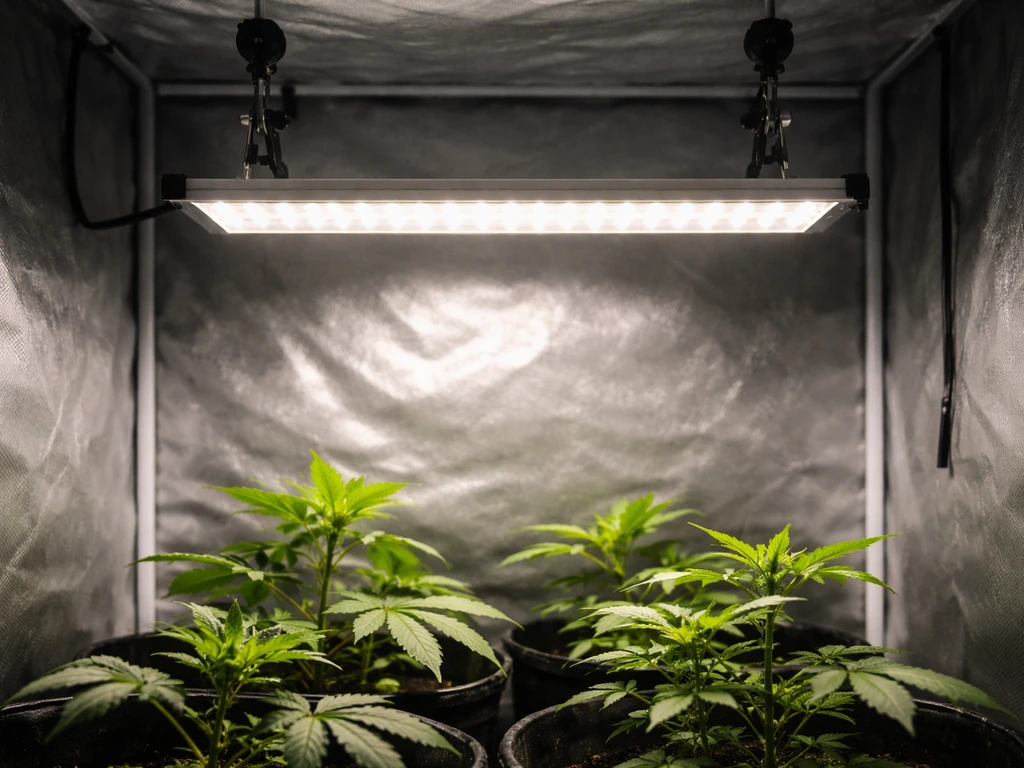
For most indoor plants, you should run your grow light 12 to 16 hours per day. That's the short answer. The longer answer depends on what you're growing, how far the light is from your plants, and what growth stage they're in. Get those three things right and your plants will respond well. Get them wrong and you'll either starve your plants of light or cook them. This guide walks you through exactly how to figure out the right schedule for your setup.
How Long to Use Grow Light: Daily Hours by Plant Stage
Marcus Tillman
8 Apr 2026
Start here: plant type and growth stage
Before you set a timer, you need to know what your plant actually needs. The two biggest factors are the type of plant you're growing and what stage of growth it's in. A seedling has completely different light needs than a mature houseplant, and a flowering tomato needs more than a pothos sitting on a shelf.
Plants are also sorted into light-requirement categories: low light, medium light, and high light. Most tropical houseplants sit in the medium range. Vegetables, herbs, and fruiting plants are high-light plants. And some specialty plants, like Christmas cactus or poinsettia, are what's called short-day plants, meaning they actually need a stretch of complete darkness each day to trigger flowering. Running your grow light too long on those plants will prevent them from ever blooming.
If you're just starting out and want a reliable daily schedule without overthinking it, how often to use a grow light covers the fundamentals in plain terms and is worth reading alongside this guide.
How many hours per day: the baseline schedules
Here are the practical starting points based on what most university extension programs and growers use. These are baselines, not rules set in stone. You'll refine from here based on how your plants respond.
| Plant Type / Stage | Hours per Day | Notes |
|---|---|---|
| Seedlings / clones | 14–16 hours | Consistent light accelerates early root and leaf development |
| Vegetative houseplants (pothos, philodendron, ferns) | 12–14 hours | Many do fine with 12 hours; adjust up if growth seems slow |
| Herbs and leafy vegetables (basil, lettuce, spinach) | 14–16 hours | Lettuce and spinach can bolt if kept over 14 hours long-term |
| Flowering and fruiting plants (tomatoes, peppers, orchids) | 14–18 hours | Higher light demand; keep dark period consistent |
| Short-day plants (poinsettia, Christmas cactus) | 10–12 hours light, 12–14 hours darkness | Uninterrupted darkness is critical to trigger blooming |
| General maintenance (all other houseplants) | 12–16 hours | Use 12 hours as a safe default if unsure |
A 12 hours on / 12 hours off cycle is a solid, universally safe starting point for most indoor plants. It gives them a reasonable amount of light and a proper dark period, which matters more than most beginners realize. Plants aren't just passive light absorbers: they use the dark period for respiration and recovery.
Timing by plant: seedlings, houseplants, and flowering or fruiting plants
Seedlings
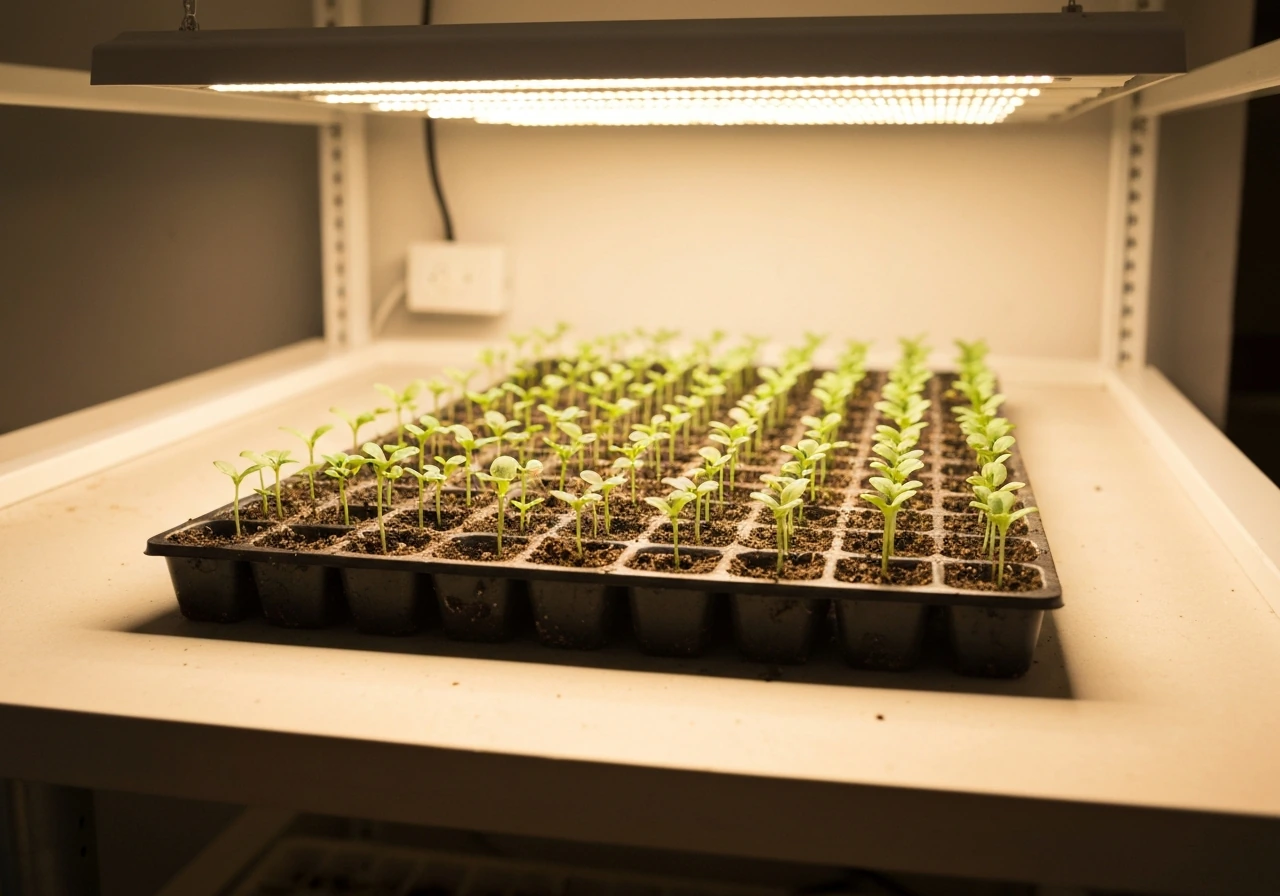
New seedlings need 14 to 16 hours of light per day. They don't have established root systems yet and they're working hard to push out their first true leaves, so consistent, ample light makes a real difference. The light should be on from morning through early evening. Think 7 AM to 9 or 11 PM, depending on your setup. Keep the light close to the seedlings, around 2 to 4 inches for fluorescents and 4 to 8 inches for most LEDs, and resist the urge to run it 24 hours. Plants do need some darkness.
If you're starting seeds specifically to transplant outdoors later, how to use a grow light for vegetables goes deeper on timing by vegetable type, which is useful once your seedlings start maturing.
Mature houseplants
For established houseplants that aren't actively flowering or fruiting, 12 to 14 hours per day is plenty. Many low-to-medium light plants like pothos, snake plants, and peace lilies will do fine at 12 hours. If you're supplementing natural window light, you might only need 4 to 6 hours of artificial light on top of whatever daylight they already receive. The key is total daily light, not just how long the grow light runs.
Flowering and fruiting plants
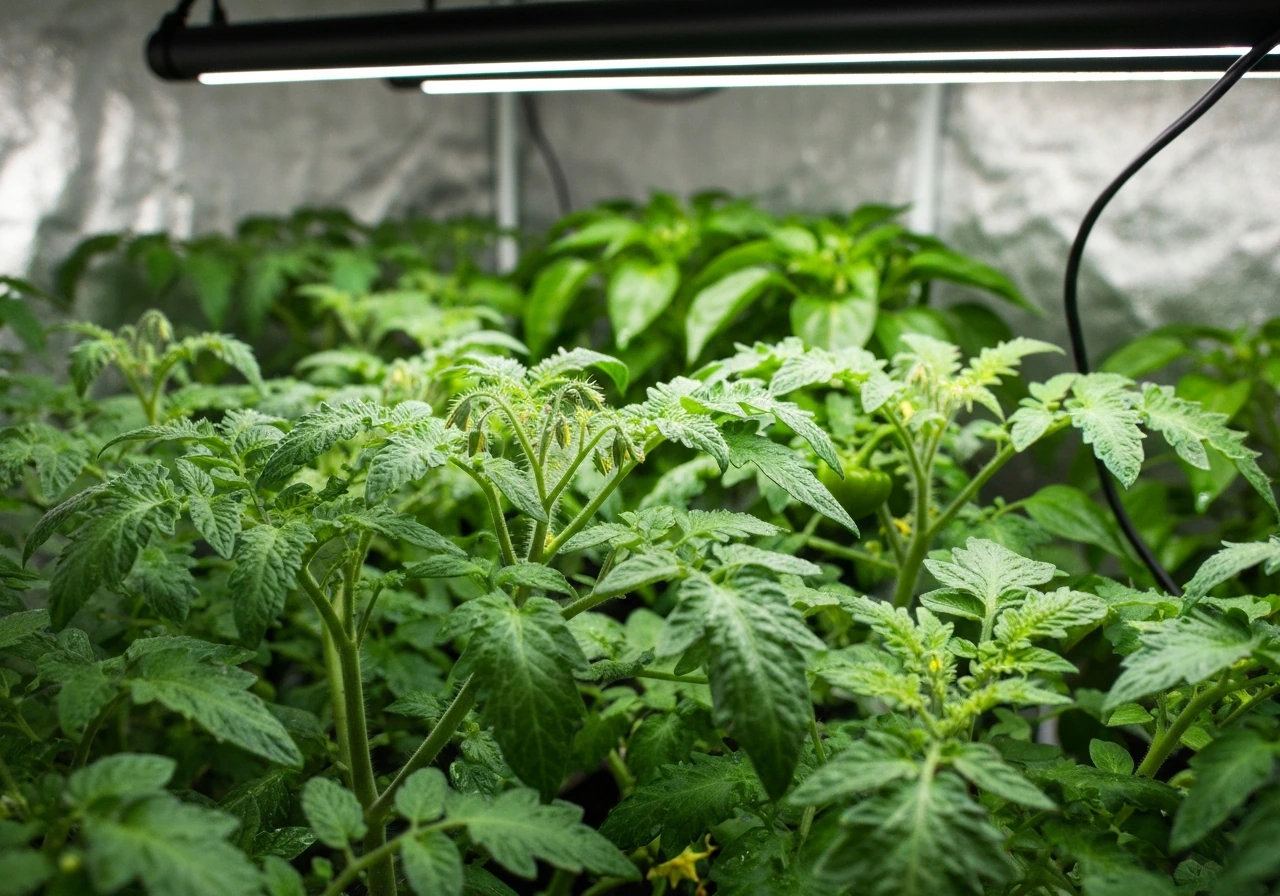
Flowering and fruiting plants are the most light-hungry category. Tomatoes, peppers, strawberries, and many flowering tropicals need light intensities in the range of 400 to 1,200 PPFD (micromoles per square meter per second) and a photoperiod of 14 to 18 hours. For these plants, longer hours and closer light placement work together. If you're running a full spectrum LED for flowering plants, how to use a full spectrum grow light schedule can help you pair the right spectrum settings with the right timing for each growth phase.
Short-day plants are the exception here. Species like Christmas cactus and poinsettia need 10 to 12 hours of light and 12 to 14 hours of genuine, uninterrupted darkness to initiate flowering. Oklahoma State University Extension notes that poinsettias must have complete darkness from 5 p.m. to 8 a.m. each night (starting in late September) to bloom by Christmas. Even a hallway light turning on at midnight can disrupt this cycle. If you're trying to get a short-day plant to bloom, take the darkness requirement seriously.
Adjusting duration based on light intensity and distance
This is where a lot of beginner setups go wrong. People pick a photoperiod (say, 14 hours) and assume that's the whole equation. But how much light actually reaches your plant depends heavily on how far the fixture is from the canopy. Move the light closer and you deliver more light per hour. Move it farther away and you deliver less, which means you'd need to run it longer to make up the difference.
The metric that ties all of this together is called Daily Light Integral, or DLI. It measures the total amount of photosynthetically active radiation (PAR) your plant receives over a full day, expressed in mol/m²/day. You can calculate it roughly like this: DLI = PPFD × hours × 3,600 / 1,000,000. So if your light delivers 200 PPFD at your plant's canopy and you run it for 14 hours, your DLI is about 10 mol/m²/day. For example, Virginia Tech’s DLI guide shows that operating a PPFD of 200 µmol·m−2·s−1 for 16 hours per day corresponds to about 12 mol·m−2·d−1 blank" rel="noopener noreferrer">PPFD of 200 µmol·m−2·s−1 for 16 hours corresponds to about 12 mol·m−2·d−1. Most houseplants want somewhere between 5 and 15 mol/m²/day. Seedlings are happy around 6 to 10. Fruiting vegetables can need 20 or more.
A practical example: if your fixture is mounted about 8 inches above seedlings and delivers enough intensity, you might hit a target DLI in 8 to 10 hours. Pull that same fixture up to 20 inches and you might need 16 hours to hit the same target because the light spreads out and weakens. This is why distance matters as much as duration when you're trying to dial in your schedule. If you're working out where to position your fixture, the guidance on how to hang grow lights covers mounting height and spacing in detail.
You don't need a PAR meter to get this right. A good rule of thumb: if your light feels warm on the back of your hand at canopy height, it's close enough for high-light plants. If it barely registers, it's probably too far. Start at the manufacturer's recommended distance, run your baseline schedule, and watch the plants for a week or two before adjusting.
How to set your timer and dial it in over 1 to 2 weeks
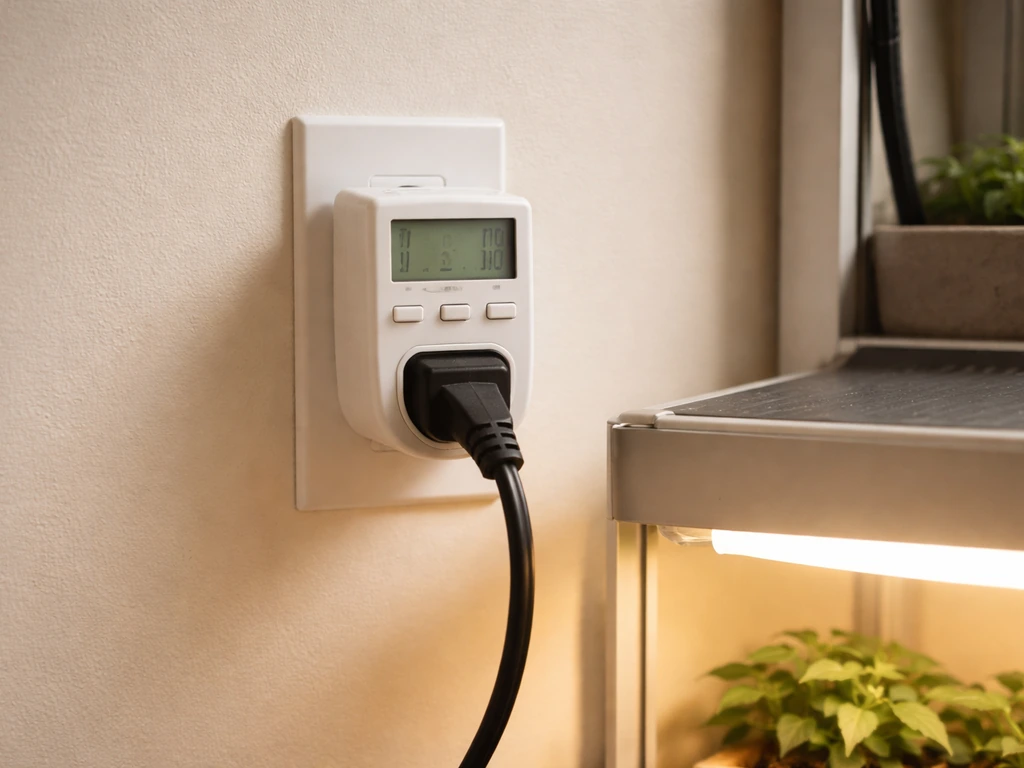
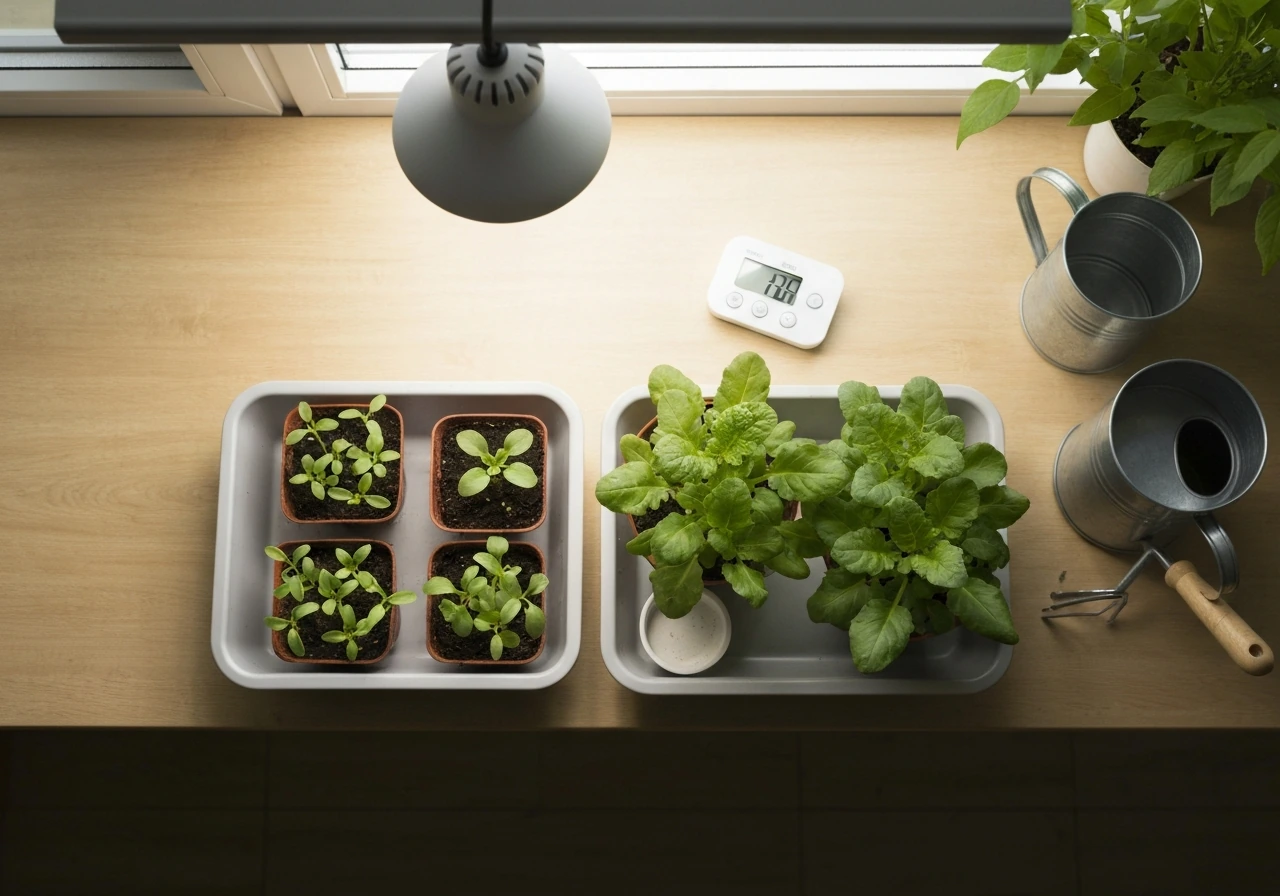
Use a simple outlet timer. Mechanical or digital both work fine. Set it to turn the light on in the morning and off in the evening so the schedule aligns with your household rhythm. Running lights at night is fine if it's more convenient, but make sure the dark period happens when ambient light in the room is low, especially for any plants that are sensitive to photoperiod.
- Pick your starting schedule based on plant type from the table above (12 to 16 hours is the typical range).
- Plug your grow light into the timer and set the on/off times. Write it down or take a photo of the settings.
- Run that schedule for 7 to 10 days without changing anything. Resist the urge to adjust every few days.
- After 10 days, look at your plants closely. Are stems stretching toward the light? Leaves pale or yellowing? Growth stalled? Use those cues to decide whether to adjust up or down.
- Make one change at a time: either move the light closer or add 1 to 2 hours to the schedule, not both at once.
- Give each change another 7 to 10 days before evaluating again. Plants respond slowly and you'll overcorrect if you adjust too often.
Consistency matters a lot here. Irregular schedules, where the light runs 16 hours one day and 10 the next, stress plants and make it nearly impossible to diagnose what's actually wrong. Set the timer and let it do its job.
Common mistakes and how to fix them
Leggy, stretching growth
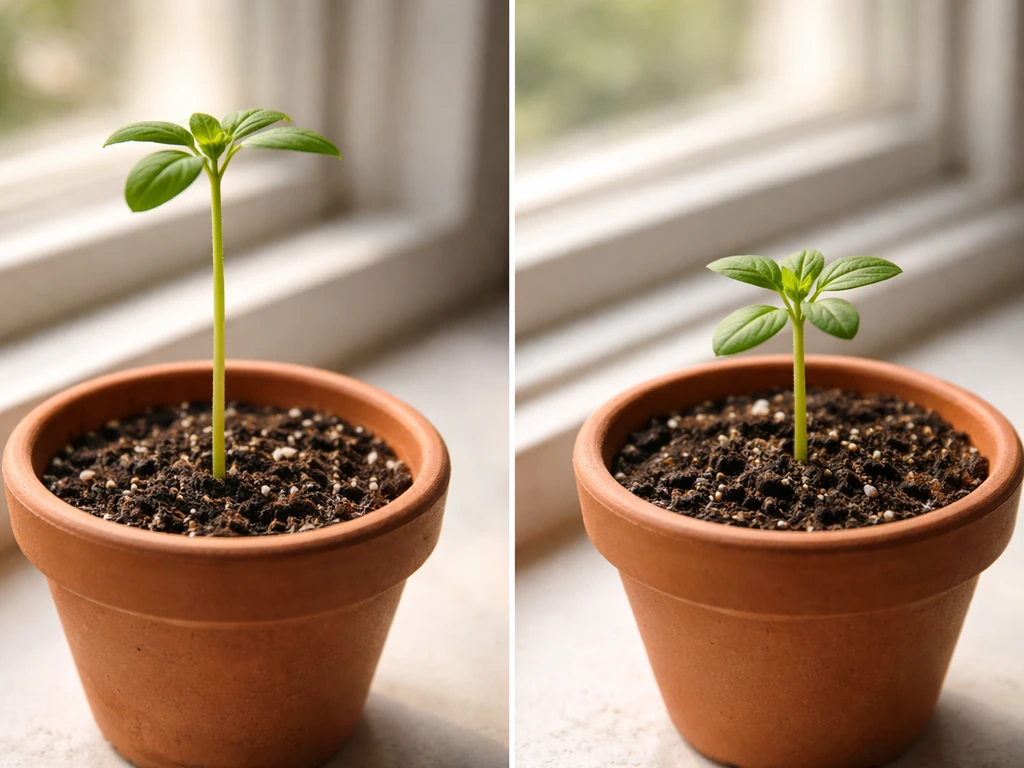
If your seedlings or plants are growing tall and spindly with long gaps between leaves (called etiolation), they're not getting enough light. This usually means the light is too far away, the hours are too short, or both. Fix it by moving the light closer first, then consider adding an hour or two to your daily schedule. Seedlings are especially prone to this in the first two weeks if the light isn't close enough.
Leaf burn or bleaching
White or brown patches on leaves closest to the light usually mean the light is too intense, too close, or running too long. This is more common with high-powered LEDs when they're placed closer than the manufacturer recommends. Raise the fixture a few inches and see if the damage stops spreading. If the fixture is already at a good distance, try reducing the photoperiod by an hour or two. Don't prune the burned leaves yet: watch new growth first to see if the problem resolves.
Slow or stalled growth
If growth has basically stopped and the plant doesn't look burned or stretched, it's often a light quantity issue. Either the intensity is too low (light too far away or a weak fixture) or the hours are too short. Check the distance first. Many beginner setups have the light mounted too high, especially after the plant gets taller and the gap increases. Gradually reduce the distance by 2 to 3 inches at a time and see if growth picks up.
Flowering plants that won't flower
If you have a short-day plant that refuses to bloom, check whether it's really getting uninterrupted darkness during its off hours. Even a small amount of ambient light from a nearby room can reset the clock and prevent flowering. Move the plant to a darker location during its dark period, or use a light-blocking enclosure if needed. For specialty bulb-type grow products that cycle on and off as part of a treatment routine, how often to use a grow ampoule explains how targeted light treatments work differently from continuous grow light schedules.
Safety, heat, and protecting your plants and eyes
Grow lights are generally safe when set up correctly, but there are a few practical things worth taking seriously, especially if you're running them for 12 to 16 hours a day.
- Heat: Older grow light types like HPS and high-wattage HID fixtures produce significant heat and must be kept farther from plant canopies to avoid burning. Modern LEDs run cooler, but they still generate heat, especially at the driver. Make sure the fixture has adequate airflow around it and isn't enclosed in a tight cabinet without ventilation.
- Electrical safety: Don't overload a single outlet with multiple high-wattage fixtures. Use a timer with an appropriate amperage rating for your light. Keep cords away from water and off the floor where they can get wet from watering.
- Eye safety: Full spectrum and high-intensity grow LEDs can be hard on your eyes, especially the blue-heavy spectrum used in many modern fixtures. Avoid looking directly at the light. If you're working under it for more than a minute or two, use sunglasses or UV-protective eyewear.
- Plant heat stress: If the room temperature under your lights climbs above 85°F, growth slows and plants may wilt even with adequate water. Ensure the grow space has airflow. A small fan directed at the canopy also strengthens stems.
- Pets and children: Keep curious kids and pets away from fixtures, especially anything at lower mounting heights. Exposed bulbs and hot surfaces can cause burns on contact.
One thing worth emphasizing: running your grow light longer does not fix a heat problem. If your plants are showing heat stress symptoms, adding hours makes it worse. Solve the heat issue first (better ventilation, raising the fixture, reducing wattage) before adjusting the schedule.
The bottom line is this: start with 14 hours for seedlings and most vegetables, 12 hours for houseplants, and let the timer do the work. Watch your plants for 10 days and adjust from there. Most problems trace back to the light being too far away or the schedule being inconsistent, not to some mysterious plant issue. Get the distance right, set a timer, and give your plants time to respond. That's 90 percent of the work.
FAQ
Can I leave a grow light on 24 hours a day to speed up growth?
In most cases, no. Plants need a real dark period for respiration and stress recovery, and 24 hours often leads to poor form (etiolation) or leaf damage depending on intensity. If you must use longer light, keep a consistent dark window and increase gradually while you watch new growth.
If my plants sit near a window, should I reduce grow-light hours?
Yes, because you’re targeting total daily light, not just grow-light runtime. A simple approach is to start with fewer grow-light hours (for example, 4 to 6 hours) and then monitor leaf spacing and color. If growth is still slow or stretched, you likely need more total light, either by adding hours or lowering the fixture.
How do I know whether I should change the distance or the hours?
Change distance first when plants show stretch or burning right now. Moving closer increases intensity per hour, so it affects DLI quickly. If you’re already at a sensible height and the issue persists, then adjust hours by 1 to 2 hour steps to avoid overshooting.
What time of day should the light run, morning vs evening?
Either works if the dark period is consistent and the room stays dim during the “off” time. Many people run lights from morning to early evening to match household light levels. For short-day plants, the off period matters most, even if it’s during your usual night.
Do I need to worry about “darkness” from indoor lights during the off cycle?
Yes, especially for short-day bloomers. Even a hallway light or another lamp that shines during the off hours can interrupt the flowering trigger. For sensitive plants, shield the setup during the off period or move the plant to a darker room.
How often should I adjust my grow-light schedule?
Make changes slowly and keep them consistent for at least 7 to 10 days before re-evaluating. Plants take time to show new growth, and frequent schedule changes make it hard to diagnose whether the problem is too little light, too much intensity, or a distance issue.
My seedlings look tall and thin, but the leaves are not burned. What does that usually mean?
That pattern usually points to insufficient light quantity, most commonly the fixture being too far away or the photoperiod being too short. Move the light closer in small steps first, then consider adding 1 to 2 hours if you still see extended gaps between leaves.
Leaves near the light have white or brown patches, should I immediately cut the hours in half?
Not usually. Start by raising the fixture a few inches and keep the schedule stable for a few days so you can see whether new growth improves. If the fixture is already at an appropriate height, then reduce photoperiod by 1 to 2 hours rather than making a drastic overnight change.
How do I handle plants that are different species under the same light?
Avoid giving every plant the same schedule if their light needs differ. If you must share a fixture, group plants by similar requirements (low, medium, high, or short-day) or adjust the setup with separate shelves or staggered mounting heights. Otherwise one group may be under-lit while another gets too intense.
Is DLI the only way to set a schedule?
DLI is a strong way to think about it, but you can still use practical checks without a meter. Use consistent timer settings, start at the manufacturer’s recommended distance, and confirm with plant response (stretching means more DLI needed, spotting or scorching means too much intensity). DLI becomes especially helpful when you’re comparing different fixtures or distances.
What should I do if growth seems to stop but the plant doesn’t look damaged?
First check distance, because as plants grow taller the effective intensity drops. Then verify that the photoperiod hasn’t accidentally changed and that the timer is working correctly. If everything looks right, increase light hours gradually by 1 to 2 hours while watching for new signs of stress.
If my grow light runs at night, can it mess up the plant’s sleep cycle?
It can, but the plant doesn’t care about “night” specifically, it cares about the dark period length and consistency. Make sure the off window is uninterrupted and that any ambient room lighting is low during that off period, particularly for short-day plants.
Next Article
Innova Grow Light Instructions: Setup, Use, and Troubleshooting
Step-by-step Innova LED grow light instructions: setup, mounting, distance, schedules, intensity, and fast troubleshooti